« Spend More Today | Main | Assorted links »

Risk Free No Longer

Wow, we usually think about U.S. bonds as being the "risk-free" asset but with a credit default swap you can buy insurance on a US default and the price of such insurance is way up.
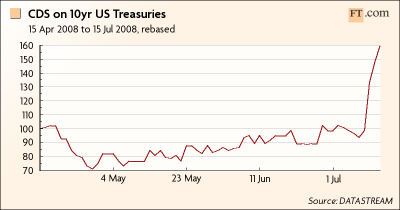
Cds
The change in price is a shock but to put things in perspective do note that the price for insuring US debt is now higher than for German debt but similar to that for Japanese and British debt.  We are still far from Argentinian levels.

Hat tip to at, in the comments to my post on the peso problem.

Posted by Alex Tabarrok on July 17, 2008 at 11:18 AM in Economics | Permalink

Comments

Not to mention the big risks of inflation and a falling dollar.

Posted by: floccina at Jul 17, 2008 11:27:28 AM

Oh Dear! "When Fannie met Freddie at the Treasury door".

Posted by: David Heigham at Jul 17, 2008 11:29:31 AM

Argentine.

Posted by: Pancho at Jul 17, 2008 11:34:01 AM

The article you link to says the cost of insuring US bonds is similar to the cost of insuring UK or Japanese bonds - not less than.

Posted by: jdm at Jul 17, 2008 11:43:09 AM

jdm, right, corrected.

Posted by: Alex Tabarrok at Jul 17, 2008 11:54:47 AM

Gub'ment bails out Fannie and Freddie. Gold $2000 coming right up!

Posted by: Jay at Jul 17, 2008 12:01:14 PM

What would qualify as a US default?

'Sorry, we're repudiating our treasury bonds'?

Posted by: PJ at Jul 17, 2008 12:47:29 PM

"It's the end of the world as we know, and I feel fine."

I wish I could feel as at peace as REM.

Is bailing out the Frannie and Freddie the lesser of two evils? Two government-sponsored giants with skewed lending habits and over-valued assets? We already have enough debt as it is. The problem is that not everyone should have houses, just look at how we got here and theres your sign! Of course I'm only stating what everyone already knows, but I am a firm believer that we need to repeat things until they become part of our mentality, so that we may make better decisions with that in mind.

Posted by: Gunnar at Jul 17, 2008 1:01:22 PM

And the Germans don't even have a currency of their own. Or perhaps their insurance is cheap because people would be quite happy at the return of the Deutschmark.

Posted by: dearieme at Jul 17, 2008 1:46:14 PM

honestly, this is free money. you should be selling protection on Treasuries all day. An "event of default" in treasuries would be a calamity, one that will not happen at least within the next 10 years. this is just mr. market being irrational.

Posted by: joe at Jul 17, 2008 2:20:37 PM

I don't quite understand a CDS on US government debt. Isn't the whole point of CDS to substitute the default risk of a debtor with that of a more creditworthy entity? If the US government defaults, whomever it is that issued the CDS will probably be in quite a bit of trouble themselves

Posted by: Dan at Jul 17, 2008 2:23:09 PM

Could you help me understand? The article says it costs 22 bps. The chart says over 100 ("rebased"). What are the terms of this contract and what is its price?

Posted by: Michael Kelly at Jul 17, 2008 2:25:25 PM

Like Joe, I would be selling these the live long day, if able. The US will never repudiate its bonds, it will simply inflate the problem away. If the worst comes to worst, and the US is forced to actually repudiate, then world civilization is belly up, and you would never have to pay off on your contract.

Posted by: Yancey Ward at Jul 17, 2008 3:05:55 PM

Michael: it means it costs 22gs to cover 10mm of tbill debt (I think).

I assume the "rebased" means they've taken the price as of April 15 and set it to 100.

Posted by: Paul Butterfield at Jul 17, 2008 4:30:42 PM

Please don't post normalized graphs of basis points. They are quite misleading.

Posted by: agent00yak at Jul 17, 2008 4:54:57 PM

Ditto Michael Kelly. Could someone who has a clue PLEASE explain exactly what the graph means? Specifically:

How much money must I set aside today, to bet that the US government will NOT default on ten-year
treasuries, and, if correct, how much will I gain, and when?

Simple question.

Also, what were the terms BEFORE this recent craziness? And if the craziness subsided and I sold the
security, how much would I make?

Posted by: Person at Jul 17, 2008 5:10:13 PM

Agree with agent00yak - that's a terrible graph. I immediately read it as 160bps, which is absurd.

Posted by: 49 at Jul 17, 2008 6:04:35 PM

Collating from several sources I find that it now costs about $22,000 to insure $10 million of U.S. debt from default for five years. To insure the same amount of German debt would cost about $9,500. The US rate has increased rapidly in recent weeks. The seller would have to pay for even a technical default, a default of two days.

Posted by: Alex Tabarrok at Jul 17, 2008 6:17:51 PM

If the US government defaults, whomever it is that issued the CDS will probably be in quite a bit of trouble themselves

I presume that those insuring U.S. debt buy CDS's for U.S. debt backed by European entities, or perhaps a big oil owner like Saudi Arabia, or both, and vice versa (buy CDS's on German debt backed by the U.S. or Saudi Arabia or both).

Posted by: nick at Jul 17, 2008 7:28:15 PM

What type of investor purchases insurance on an investment widely considered the world's safest?

As others have pointed out, this sort of insurance seems markedly irrational to begin with, and I'm surprised that it would even be subject to market forces.

Posted by: Mercutio.Mont at Jul 17, 2008 8:51:57 PM

Actually the bond rating services have been ridiculous on this for some time, irrespective of the markets.
It has been pretty obvious ever since the Congress and President gridlocked over the budget and nearly
closed down much of the US government back in the mid-90s that a default by the divided US government
was far from a ridiculous idea.

What was ridiculous was Moody's downgrading Japanese national debt while keeping US debt as AAA, with the
markets making it effectively AAA+++, given both the divided US government and its mounting foreign
indebtedness, with Japan's international balance situation just the opposite.

Posted by: Barkley Rosser at Jul 18, 2008 12:53:05 AM

Alex: When you say that the insurance pays on even a 2 day default, does that mean that the insurer would have to pay $10,000,000 even if the gov't paid in full 2 days late? Or, would it mean that the insurer would pay the $10,000,000 but get to keep the bonds that 2 days later would be paid up? Big difference.

Posted by: liberalarts at Jul 18, 2008 3:17:55 AM

To understand "events of default" you have to read the individual contract. It's highly unlikely that missing payment by two days would trigger payment of the $10,000,000. that said, there is zero chance that the US Treasury will even be 2 days late in paying off debt in the next 10 years. I'm the biggest alarmist I know about the US Government's balance sheet, but for God's sake, SS doesn't even go cash flow negative until ~ 2017, our foreign debt as % of GDP is below most major developed nations (Japan's exceeds GDP, ours is like 40%), the Fed's balance sheet hasn't exploded, so there's room to monetize debt (not that i like this option, but it's a sure way to prevent default), etc...

Selling CDS protection on US debt is the biggest layup right now.

Posted by: joe at Jul 18, 2008 10:26:17 AM

Hey guys -- thanks for confirming that no one's actually able to explain the contract in plain English.

Anyway, the risk with this one, as always, is inflation. If you have to wait ten years to keep the premium and the government does indeed turn out to have financial troubles, as expected, it will just print the money needed to pay the bonds. Meaning the money in limbo becomes worthless.

If you don't have to put any money aside, just your promise, it's a great deal. Will they let me sell such insurance?

Posted by: Person at Jul 18, 2008 11:11:30 AM

"It has been pretty obvious ever since the Congress and President gridlocked over the budget and nearly closed down much of the US government back in the mid-90s that a default by the divided US government was far from a ridiculous idea."

Did the loan repayments really stop when the government shut down in the 90's? I'm assuming that there's a mechanism in the federal treasury to keep those payments going superseding the congressional budget.

Posted by: MW at Jul 18, 2008 11:37:49 AM

What type of investor purchases insurance on an investment widely considered the world's safest?

Investors who don't buy into the silly mythology of the "risk-free" investment, that's who. Investors who don't blindly worship the federal government and Federal Reserve as if they were omnipotent gods, that's who. In other words, most of the smart money these days. With the Fannie/Freddie guarantees added to the already collosal U.S. federal debt and Medicare/SSN promises, and with the pain caused by high oil prices limiting the degree to which inflating its way out of this debt is politically viable, U.S. debt is even in terms of overt default risk no longer the world's safest -- indeed as the CDS prices indicate it is now twice as risky as Germany's debt. If you look at the finances of the two federal governments their CDS prices make eminent sense.

Posted by: Nick at Jul 18, 2008 8:40:31 PM

joe,

Regarding Japan you have confused "national debt" witih "net foreign debt." Not the same thing. It was indeed the rise of Japan's national debt level to more than 100% of GDP that led Moody's et al to downgrade its debt. However, as FDR used to say, it is not a problem "if we owe it to ourselves" (as the US did with its more than 100% of GDP national debt arising from financing our fighting in WW II). That is the case in Japan with their high savings rate. Most of that national debt is held in the postal savings banks by Japanese citizens. This is despite the interest rates on that debt being very low (with the interest to GDP ratio lower than in the US).

Their net foreign position is positive. They lend more abroad than they borrow from abroad due to their chronically surplus current account balance.

Posted by: Barkley Rosser at Jul 20, 2008 9:25:13 AM

led Moody's et al to downgrade its debt.

Yet they failed to downgrade the debts of U.S. commercial banks that were far less reliable. I'm not sure why anybody takes Moody's seriously anymore. The CDS rates are far more accurate and far less corrupt.

Posted by: bob at Jul 21, 2008 3:39:42 PM

Post a comment