« Assorted links | Main | What I've been reading »
The Inheritance of Education
Economix posted a graph showing a strong positive correlation between SAT score and parental income. Greg Mankiw pointed out that the effect is unlikely to be purely causal because there may be an omitted variable bias, IQ for example. Paul Krugman and Matt Yglesias both attack Mankiw and point to graphs showing that income matters for college completion and enrollment, respectively, holding various achievement scores constant. Brad DeLong crunches the numbers on IQ and income correlation to estimate that half the effect is due to IQ and half to something else.
All this is good but none if it gets at the heart of the matter because there are a lot of way that heredity/genes could explain the income/education correlation; IQ is only one possible mechanism, personality (e.g. conscientiousness) is another possibility.
The type of evidence that we need to resolve this question is adoption studies. Fortunately, such studies have been done and indeed I have presented the data before in my post Nature, Nurture and Income. Let's do so again.
The graph below is from What Happens When We Randomly Assign Children to Families?, by Bruce Sacerdote. Holt's International Children's Services places children, primarily Koreans, with families in the United States. Holt has an interesting proviso to their adoption contract, conditional on being accepted into the program, children are randomly assigned. Sacerdote has collected data from children who were adopted between 1970-1980, and thus who today are in their mid 20's or 30's, and their adoptive parents.
The graph shows how parent income at the time of adoption relates to child income for the adopted and "biological" (non-adopted) children. The income of biological children increases strongly with parental income but the income of adoptive children is flat in parent income. What does this mean?
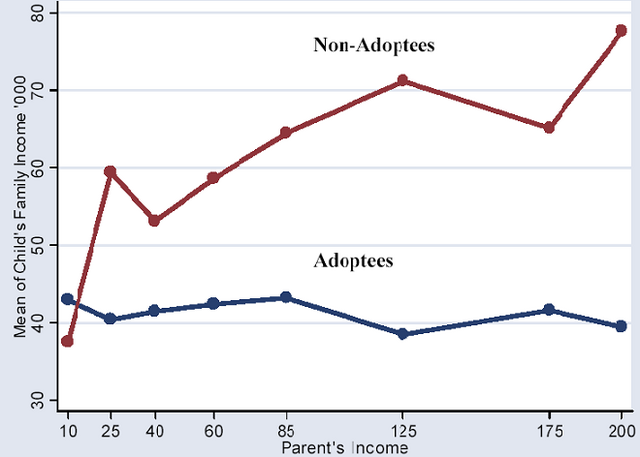
The graph does not say that adopted children necessarily have low income. On the contrary, some have high and some have low income and the same is true of biological children. What the graph says is that higher parental income predicts higher child income but only for biological children and not for adoptees.
Now what about education? Sacerdote looks at that as well. He doesn't have a child SAT-score, parent-income correlation but he does find:
Having a college educated mother increases an adoptee's probability of graduating from college by 7 percentage points, but raises a biological child's probability of graduating from college by 26 percentage points.
The effect for father's years of education is even larger; about a ten times larger effect on biological children than on adoptees. Similarly, parent income has a negligible effect, small and not statistically significant, on an adoptee completing college but an 8 times larger and statistically significant effect on a biological child completing college (Table 4, column 3).
Posted by Alex Tabarrok on August 29, 2009 at 02:25 PM | Permalink
Comments
Very interesting, but hardly conclusive as we, at least from your post, do not know, at what age the children were adopted.
If the impact of care in early childhood is at all important in later life to sort out this issue we would need a random adoption study of children that were adopted immediately post birth.
But even that may not be fully conclusive, because the prebirth environment may affect later life outcomes, we would somehow need to control for things like prebirth nutrition, mother's stress level, etc.
Posted by: Pawel Dobrowolski at Aug 29, 2009 2:37:45 PM
Perhaps people aren't as willing to invest in adopted children as biological children, that would be another obvious answer.
Posted by: Michael Foody at Aug 29, 2009 2:43:50 PM
Pawel, adoption is in infancy and Sacerdote shows "that the child's weight in infancy and other pre-adoption characteristics are uncorrelated with adoptive parent characteristics such as family income, parental education etc."
Michael, I discussed this in my original post where I wrote "Some might suggest that parents treat their biological and adopted children differently and this is what accounts for the difference in incomes. The interpretation is very uncharitable to the parents who have volunteered to raise an adopted child and I think it implausible. Moreover, unless every adopted child is treated equally poorly in all families, then we would still expect the income of adoptees to increase with parental income but perhaps starting at a lower level."
Posted by: Alex Tabarrok at Aug 29, 2009 2:49:20 PM
The difference might partially be due to the "first-born premium", if the adoptees join the families mostly after the biological kids. Arriving first, biological children enjoy resources without having to share early on. Arriving adoptees have to share resources with other kids in their early childhood years, i.e., when it counts most. Of course, this is valid only if arrivals of adoptees are, at least on average, later than the biological children.
Posted by: Utku at Aug 29, 2009 3:19:32 PM
Alex,
This begs another question. Are K-12 schools that better off parents send their kids to actually higher in quality on average, or are the higher recorded SAT scores of "better" schools the result of genes of their biological parents who presumably are wealthier due to better genes themselves? Note that a majority of parents try to send their kids to the best schools that they can reasonably afford, and this is usually done by buying a home in a more expensive suburb.
I'd love to see if the high schools these adopted kids went to had higher class SAT scores when the parents had higher income. If adoptees of better off parents almost always send their kids to K-12 school systems with better SAT score averages, then this study has very different implications than if those same parents in aggregate managed to send their kids to schools with a wide variety of different SAT averages.
Posted by: happyjuggler0 at Aug 29, 2009 3:39:35 PM
Whatever their potential defects, natural experiments are so much more powerful than mere correlation studies.
About the "first born effect": I remember reading years ago that the effect is predominantly an artefact of counting only children as first born - if you count them as last born the effect much diminishes. Does anyone know if that story stands up?
Posted by: dearieme at Aug 29, 2009 3:47:10 PM
I took a look at the racial variation in SAT scores. I had data from '89 to '04, and average SAT scores for AAs, whites, and Asians. Assigning the CW mean IQ scores for the races (85, 100, and 105, respectively), r^2 was 0.93.
IQ is the determinant. The decline in SAT scores over the years is due to expandidng the test to lower IQ cohorts, as college attendance has expanded.
Posted by: Buzzcut at Aug 29, 2009 3:53:53 PM
Maybe the graph says more about Korean-ness than it does adoptee-ness.
Posted by: Harkins at Aug 29, 2009 3:56:38 PM
Wow, this chart really undermines the libertarian/conservative presumption that good morals, hard work, the right upbringing, "merit", etc. are what leads to higher incomes.
It appears to be largely based on a genetic lottery with little or no role for parenting, neighborhood, etc. (at least not those components that are correlated with income).
If that's true, it provides a very interesting perspective on income inequality and social justice.
Posted by: a student of economics at Aug 29, 2009 4:23:16 PM
This is maybe a superficial comment, but I'd just like to point out how much better Alex's post is than the other blogged treatments of the topic.
Posted by: Tyler Cowen at Aug 29, 2009 4:26:45 PM
Moreover, unless every adopted child is treated equally poorly in all families, then we would still expect the income of adoptees to increase with parental income but perhaps starting at a lower level.
Not necessarily. Some parents might treat their adoptees better than others; if that better treatment is uncorrelated with parental income, then you'd still see a flat adoptee income curve.
You're right that "parents treat adoptees worse than biological children" is an uncharitable explanation, but I don't see any data in this post to rule it out. Plus, it's certainly an intuitive explanation from a "selfish gene" point of view.
Posted by: Mitch at Aug 29, 2009 4:37:21 PM
"Wow, this chart really undermines the libertarian/conservative presumption that good morals, hard work, the right upbringing, "merit", etc. are what leads to higher incomes."
Or more correctly, it undermines the notion that "good morals, [the proclivity to engage in] hard work,...." are inculcated in the child by parental environmental factors. I do not believe it shows "good moral, hard work..." do not affect income, however. Given your next sentence, this may be ticky-tac, but it's useful to remember that the winnings from the genetic lottery are bountiful and varied.
Posted by: Ray Midge at Aug 29, 2009 4:39:09 PM
The flatness of the graph cannot be explained by supposing that adoptees get treated worse than natural born children.
You would have to suppose that the discrepancy is greater among rich parents than poor parents, which is unlikely.
The graph proves zero effect of parental wealth, that inheritance of wealth is wholly through genes.
However, other graphs in the same paper hint at very great parental influence, uncorrelated with parental wealth. The income of adoptees tends to resemble the income of their adoptive siblings, but not their adoptive parents - which could be parents inculcating thrift and ambition, could be the inspiring example of adoptive siblings, could be the inspiring example of peer groups.
Posted by: James A. Donald at Aug 29, 2009 4:50:08 PM
@a student of economics
indeed, i don't know how any one could have came to any other conclusion considering the x axis were work ethic, good morals, etc
of course if you weren't just trying to make a sniping and infantile partisan point you could have also said, 'i guess this completely knocks down the liberal myth that throwing more money at a problem helps to alleviate it and that it isn't lack of funding that has been hurting our schools'
the truth is the graph says nothing about how factors like hard work (good morals?) etc bias such earnings as there's no obvious correlation shown between parental income and how one's children are imbued with such traits---even marginal 'student of economics' wouldn't have made such a mistake
Posted by: hidik at Aug 29, 2009 4:58:44 PM
Krugman and Yglesias err in using college enrollment as their ultimate outcome for intelligence. Union jobs and skilled trades can be a better option than college for many young people and are more encouraged by working class parents.
Posted by: Ted Craig at Aug 29, 2009 5:00:11 PM
happyjuggler0 - This begs another question.
No, it doesn't "beg" this or any other question.
Posted by: Scrutineer at Aug 29, 2009 5:04:27 PM
Why is "IQ" treated as something independent of income?
Posted by: Habermas at Aug 29, 2009 5:21:18 PM
Maybe parents who take education seriously...maybe smart parents make bank and then marry smart and then have smart kids...maybe...nah...it must be about income inequality. Case closed. But seriously, great post. (And I typed that before reading Tyler's props).
And, this appears to be one of those things where people will find all kinds of caveats, but the answer is probably right there staring them in the face. From my experience, it is hard as hell to excel and the marginal factor of not wanting to let down parents that take education seriously is a big deal. When nothing else kicks you out of bed for that 8'o'clock class, that'll guilt 'er done. I can also imagine a negative correlation component with income as I consider staying home to raise my kid.
Seriously, libs are so out to lunch on what education is it's funny. This is just another example. They believe in evolution, but can't imagine that some traits get passed down to children. They also talk a lot about how we waste resources trying to get ahead, but what do they think education is all about? Oh, wait, right, it's not ALL about getting ahead, it's also about some establishment figure telling you what they want you to know (and most importantly it's about THEIR career).
P.S. a student is good, but sometimes I wonder if someone falsely posts in his name. Genetics may play a large role in success. But that has to do with free will, not libertarianism. There have been some reports recently that indicate that the "quality" of a degree (the prestige of the university) does not correlate to ultimate pay. And from personal anecdotal experience, the friends who were least served by the education experience are currently spanking everyone in our little cohort because they opened their own businesses. So no, I don't buy any refutation of free will or libertarianism.
Posted by: Andrew at Aug 29, 2009 5:29:27 PM
An earlier comment raises a good question. Does Sacerdote control for family size and birth order? Higher birth order (meaning, more siblings) has been shown to reduce labor market outcomes, mostly likely due to crowding out of parental resources (see Joseph Price's 2006/2007 JHR, Sandra Black's QJE paper, and Stephane Mechoulan's papers, all on birth order).
Adoption may also be more likely to occur as parents are older. What is the average age of the parents of the non-adoptees vs. the adoptees? Or is it that the pre-adoption characteristics of parents are balanced across treatment and control?
Posted by: anony at Aug 29, 2009 5:33:48 PM
Minor typo: your old post was "Nature, Nurture" not "Nature, Nature".
GNXP has a post on the Bowles/Gintis examination of the heritability of IQ and income:
http://www.gnxp.com/blog/2008/07/inheritance-of-inequality-big-insight.php
Posted by: TGGP at Aug 29, 2009 5:43:48 PM
adoptee kids got bad genes.
Posted by: jz at Aug 29, 2009 5:59:00 PM
Excellent post.
As an adopted child myself, let me point out that infant adoptees are mostly raised in average to above average home environments: the adoption agency usually makes sure that there two married parents, no arrest records, steady employment and the like. So, there is a definite restriction of range issue: this graph doesn't tell much about how harmful it is to be raised by, say, a single crack addict welfare mother in a public housing project.
Posted by: Steve Sailer at Aug 29, 2009 6:14:25 PM
Suprised no one has mentioned physical appearance as another inherited trait that might have a significant influence on income. File under "life's not fair", but I think it's still real. Hard to measure, of course, but we all can see it.
Posted by: Jim Vernon at Aug 29, 2009 6:15:46 PM
Why is everyone ignoring the first post by Pawel? There's a bunch of data showing that the mother's health and diet during pregnancy. I don't know if anyone has done stuff about income but I do know that its very strongly correlated to height. The study is interesting but it doesn't isolate genes as everyone seems to want to believe.
Posted by: GK at Aug 29, 2009 6:22:21 PM
The graph disproves nature, unless the Korean people (or all those adopted) as a gene pool are more inferior than nearly all Americans.
If the adoptees came in at $60K across the board, then outcomes would argue for genes determining outcomes because the high/low outcomes genes would be spread across adopting parent incomes and the outcomes would be near the median of the non-adoptive kids.
Nurture is a real possibility; guessing adoption in early years from poor economic status, nutrition would be less which would result in poorer performance as we see in the US, but long term in the US probably means good health (the advantage of being starved for longevity).
The more probably factor, in my view, but who knows I'm guessing, is the adoptees "differentness" negates the network effect benefits wealthier parents have and transfer to their kids. The kid of in Irish family cohort of the Kennedy clan would move easily in their Boston social scene, while the Korean kid would instant standout and cause people to pause and pull back, I'm guessing. So, while Teddy might instantly hug as he did everyone, others wouldn't quite rush in without thought, and that would transmit a certain caution to the kid so he pulls back and doesn't assume the favor would be granted and thus doesn't ask for the favor that certainly would be granted. So, the opportunity that exists isn't exploited.
However appearance is genetic, so for the latter to be true, genetics determines the outcome, but not skill, IQ, etc. But hey, we know those with the handsome/beauty genes get better jobs and have higher incomes.
Instead of education, maybe plastic surgery is needed to improve the outcomes of the chronically poor segments of society.
Posted by: mulp at Aug 29, 2009 6:43:39 PM