« MJ, R.I.P | Main | What is transhumanism? »
Regulation and Distrust
In an interesting paper, Aghion, Algan, Cahuc and Shleifer show that regulation is greater in societies where people do not trust one another. The graph below, for example, shows that societies with a greater level of distrust have stronger minimum wage laws. Note that the result is not that distrust in markets is associated with stronger minimum wages but that distrust in general is associated with greater regulation of all kinds. Distrust in government, for example, is positively correlated with regulation of business. Or to put it the other way, trust in government (as well as other institutions) is associated with less regulation.
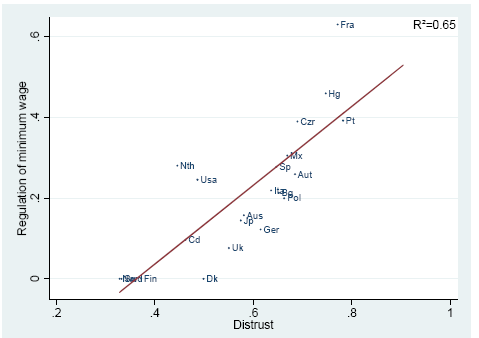
Aghion et al. argue that the causality flows both ways on the regulation-distrust nexus. Distrust makes people turn to government but in a society with a lot of distrust government is often corrupt and this makes people distrust even more. Crucially, when people distrust others they invest not in the highest return projects but in human and physical capital that is complementary to distrust--for example, they invest in human capital that helps them bond with their group/tribe/family rather than in human capital that helps them to bond with "outsiders" and they invest in physical capital that is more difficult to expropriate rather than in easier to expropriate capital, even though in both cases the latter investments may be the all-else-equal higher return investments. Such distrust traps are quite similar to Bryan Caplan's idea traps.
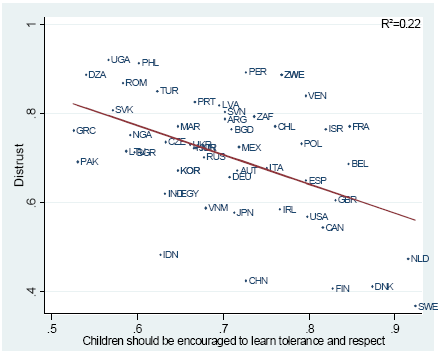
Thus, societies with a lot of distrust generate regulation and corruption and citizens who don't have the skills or preferences to break out of the distrust equilibrium. Consider, for example, that in societies with a lot of distrust parents are less likely to consider it important to teach their children about tolerance and respect for others.
Posted by Alex Tabarrok on June 26, 2009 at 07:39 AM in Economics, History, Political Science | Permalink
Comments
Interesting ? Not for what is posted here, at least. The second regression is a shame that would get busted if an undergrad made it. The core problem is that the author use the World Values Survey, notoriously unreliable. I cannot understand how this made it to the QJE.
Posted by: Mathieu P. at Jun 26, 2009 9:08:28 AM
The first regression looks ok, but the second one is horrible.
Posted by: Doc Merlin at Jun 26, 2009 11:10:00 AM
"Aghion et al. argue that the *causality flows both ways* on the regulation-distrust nexus"
Oh my god ! an undergrad should know that this invalidates the use of regression
Posted by: vak at Jun 26, 2009 11:45:49 AM
"Distrust in general"???
Since 1980, the mantra has been to distrust government, distrust the intentions of "them" whether foriegners, liberals, civil rights advocates, minorities, distrust the safety of your neighborhood, yet the solution advocated was to deregulate and cut taxes and trust free market profit maximizing capitalists to bring us security and safety.
The things that have been trusted most in the past quarter century seem to be greed and self interest driven by the belief that they are trying to impose regulations and take your money (with taxes).
And I suppose you can argue that the other mantra was to put your trust in capital, the capital that was at the center of this thing to trust was heavily unproductive, bigger houses, and firms that are valued for the consumption they are built on, with firms centered on productivity being disfavored and distrusted. What does it say when a steel mill is valued less than monopolies on what are basically just ideas; compare the value of the rights to Thriller with the value of those midwest steel mills in 1982.
I'm sure that you can find nations where the government is highly trusted in large part because people trust each other and the government creates the rules and safety that make it safe for people to trust each other.
I'd say the premise of the work is driven by ideology, not reason. For example, aren't the nations with the lowest "distrust" the ones with the government having the greatest hold on society? Aren't they the evil socialists that crush the spirit of the people and hold back economic growth? When the socialists provide a massive safety net, why are minimum wage laws required?
Posted by: mulp at Jun 26, 2009 1:58:03 PM
The causality seems pretty simple to me: high levels of regulation produce rent-seeking behavior (i.e. corruption), which generates distrust.
Posted by: Rick at Jun 26, 2009 2:05:06 PM
"...regulation is greater in societies where people do not trust one another."
Liberals like to regulate more because they do not trust others - realizing how little they should be trusted themselves.
Posted by: Td at Jun 26, 2009 2:21:47 PM
I'd be willing to bet an exponential would fit the first graph a lot better. At least use something that does not trend the value of a fraction of a population becoming negative.
Posted by: ila at Jun 26, 2009 5:17:57 PM
I have to agree with Rick on this one. You should see a high level of distrust in areas with high corruption, which will then lead to higher rent seeking behavior. Which will then lead to more regulation to quell/control/get_a_cut_of the rent seeking, which then leads to more rent seeking due to more rules existing which can be gamed.
Posted by: Doc Merlin at Jun 26, 2009 5:34:52 PM
Take first graph, flip axes, and draw line from Dk to Hg, and calculate fit.
Posted by: Anthony at Jun 26, 2009 8:04:18 PM
And how is this NOT poorly done sociology, could you tell me? I'm not a sociologist, but I bet that the idea that groups with high levels of distrust require more explicit rules to function isn't new. Now ¿why some societies have different levels of distrust?. That is probably a job for historians and sociologists.
Posted by: Charrua at Jun 27, 2009 9:14:10 AM
So what happens when people trust say the finance industry more than it deserves. Ooops, i guess we know the answer.
Posted by: urgs at Jun 27, 2009 10:12:15 AM
what does "tolerance" and "respect for others" have to do with high/low trust societies? If anything, a highly intolerant society like Japan can use its intolerance to maintain high homogeneity and hence protect its high trust environment. OTOH Chinese are also intolerant but low trust. YMMV.
Posted by: non sequitur at Jun 27, 2009 6:05:13 PM
Tiffany silver jewelry based Tiffany on sale, classic or modern stylish quality jewelry for both women and men. Our online store now is using McAfee security technology to protect our customers from identity theft, credit card fraud, spam and malicious software. Also we have developed some return and exchange policy for customer service purposes.Shopping online at Tiffany on sale mean
tiffany jewelry tiffany jewelry
Gucci Shoes
Tiffany Rings
Tiffany Earrings
Tiffany Necklaces
Tiffany Earrings
Tiffany & Co specialises in quality handcrafted designer silver tiffany jewelry, Tiffany On Sale provides hundreds of discount Tiffany & Co jewelry, Pendants.Tiffanys And Co Jewelry
Tiffany Bracelets
Tiffany Rings
Tiffany Necklaces
Gucci Shoes
Louis Vuitton
Gucci Shoes
Posted by: linda at Jun 28, 2009 10:49:41 PM
The first regression is highly skewed by placing Denmark, Sweden and Norway (high trust countries) at 0 on minimum wage regulation. That's true if you look at laws, but in reality minimum wages are enforced in Scandinavia through negotiated agreements with trade unions and laws requiring equal pay. Therefore, the effective minimum wage is way higher in Scandinavia than most other countries.
Take away these three (or better: move them way up on the y axis), and you end up with a rather uninteresting regression.
Posted by: indregard at Jul 1, 2009 8:55:20 AM
We are the best Louis Vuitton,Cheap Louis Vuitton online shop
Louis Vuitton sale,
Louis Vuitton handbags,Louis Vuitton the best services are waiting for you.
Posted by: cheap louis vuitton at Jul 16, 2009 12:48:25 PM