« Betting markets in everything | Main | China market of the day »

Unemployment During the Great Depression

Regarding unemployment during the Great Depression, Andrew Wilson writing at the WSJ recently said:

As late as 1938, after almost a decade of governmental "pump priming," almost one out of five workers remained unemployed.

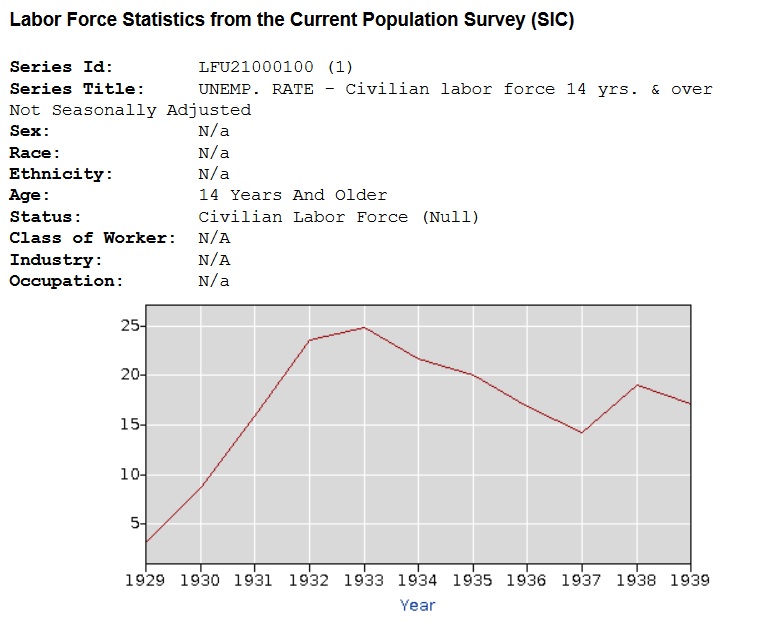
Historian Eric Rauchway says this is a lie, a lie spread by conservatives to besmirch the sainted FDR.  Nonsense.  In 1938 the unemployment rate was 19.1%, i.e. almost one out of five workers was unemployed, this is from the official Bureau of Census/Bureau of Labor Statistics data series for the 1930s. You can find the series in Historical Statistics of the United States here (big PDF) or a graph from Rauchway here.  Rauchway knows this but wants to measure unemployment using an alternative series which shows a lower unemployment rate in 1938 (12.5%).  Nothing wrong with that but there's no reason to call people who use the official series liars.

So why are there multiple series on unemployment for the 1930s?  The reason is that the current sampling method of estimation was not developed until 1940, thus unemployment rates prior to this time have to be estimated and this leads to some judgment calls.  The primary judgment call is what do about people on work relief.  The official series counts these people as unemployed.

Rauchway thinks that counting people on work-relief as unemployed is a right-wing plot.  If so, it is a right-wing plot that exists to this day because people who are on workfare, the modern version of work relief, are also counted as unemployed.  Now if Rauchway wants to lower all estimates of unemployment, including those under say George W. Bush, then at least that would be even-handed but lowering unemployment rates just under the Presidents you like hardly seems like fair play.

Moreover, it's quite reasonable to count people on work-relief as unemployed.  Notice that if we counted people on work-relief as employed then eliminating unemployment would be very easy - just require everyone on any kind of unemployment relief to lick stamps.  Of course if we made this change, politicians would immediately conspire to hide as much unemployment as possible behind the fig leaf of workfare/work-relief.

There is a second reason we may not want to count people on work-relief as employed and that is if we are interested in the effect of the New Deal on the private economy.  In other words, did the fiscal stimulus work to restore the economy and get people back to work?  Well, we can't answer that question using unemployment statistics if we count people on work-relief as employed.  Notice that this was precisely the context of the WSJ quote

One final thing that one could do is count people on work-relief as neither employed nor unemployed, i.e. not part of the labor force which is what we do for people in the military.  Rauchway has data on this and it shows almost the same thing, nearly one in five unemployed, as the original series.  (In this case, however, Rauchway counts nearly one in five unemployed as a win for the New Deal because the same series also shows higher unemployment earlier in the Great Depression.)

Any way you slice it there is no right-wing plot to raise unemployment rates during the New Deal and a historian should not go around calling people liars just because their judgment offends his wish-conclusions.

Hat tip to Mark Thoma.

Posted by Alex Tabarrok on November 7, 2008 at 07:41 AM in Data Source, Economics, History | Permalink

Comments

"Notice that if we counted people on work-relief as employed then eliminating unemployment would be very easy - just require everyone on any kind of unemployment relief to lick stamps. Of course if we made this change, politicians would immediately conspire to hide as much unemployment as possible behind the fig leaf of workfare/work-relief."

Funny, that's exactly what they do here in Denmark, which is the reason we have such "low" unemployment. In reality 1/3 of the working force is on some kind of government programme.

Posted by: Lars Hvidberg at Nov 7, 2008 7:56:08 AM

After the recent election, one of my colleagues was telling me how much he and his family adored FDR.

I asked him how he felt about our 3rd socialist president (and if McCain had been elected he woud have been our 3rd socialist president, too). He looked confused, and asked me who the first one was. I then asked him who he thought was the 2nd: after he replied "Bill Clinton" I corrected him that it was the incumbent, W.

He did not like it one bit that I was describing the "adored" FDR as a socialist.


,
that could just have been McCain, btw),

Posted by: at Nov 7, 2008 8:19:14 AM

Person with no name,

Your statement makes no sense at all and is not backed by any statistics.

I understand and respect your personal disdain for President Bush as well as the Republican nominee, McCain, but that does not make your statement understandable.

If I am correct, you seem to be inferring that both McCain and Obama would/will be socialist presidents.

Seems like a stretch, but if your going that far, I think 3 is way too low of a number.

Posted by: Jason at Nov 7, 2008 8:35:27 AM

Apparently it will be quite a while before the historians are able to see Roosevelt for what he was -pretty much the opposite of what they have been claiming. Most historians' conclusions about Roosevelt are (unintentionally) ironical. Not that Hoover comes off very well, but at least he tried to do good.

Posted by: at Nov 7, 2008 8:51:01 AM

Don't forget the BLS changed their qualifications again in the early 90s which lowered the overall figure. By the broadest current BLS measure we are already at 11%, by the broadest measure of how it was previously calculated we are already at 15%. This 6% numbers is complete BS. BLS doesn't count people who are so fed up with the job search that they gave up. Well, last I checked that still means they don't have a job and should be included. www.shadowstats.com

Posted by: Adam at Nov 7, 2008 9:00:22 AM

It certainly seems that a relevant fact and as I've heard a lot of people cite those employment series, I think it's troubling I've never heard it. I also don't love that people cite the ending unemployment, but rarely the positive downward trends. And, of course, there is always growth to look at, which people that want to take issue with FDR policies never bring up.

The growth rate of real GDP:

1933 - 1939: 6.94%
FDR (first two terms 1933 - 1941): 8.39%
Reagan (1981 - 1989): 3.52%
Clinton (1993 - 2001): 3.46%

Things were really bad when FDR took over. After 8 years things were still not good, but a whole lot better. U.S. GDP fell 20% from 1930-1933, then bottomed out, then started growing.

Maybe it didn't grow fast enough, maybe emergency work crowded out people that could get more productive private sector work, it is still possible to argue FDR's policies were bad. But I think a fair reading of the record cites the good and the bad and the argument begins there.

Charlie

Posted by: Charlie at Nov 7, 2008 9:05:58 AM

Making things up out of whole cloth is the Democratic method. Lies that advance their cause are truth. Hell, they just got elected a PAIR of liars! What's the problem?

Posted by: torabora at Nov 7, 2008 9:47:54 AM

Roosevelt's economic knowledge was found wanting by no less than
J.M. Keynes, so why is it taking more than 60 years to start to make
a critical examination of his record? Simple, hagiographers like
Rauchway who are trying to perpetrate a post mortem cult of per-
sonality.

Amity Shlaes "The Forgotten Man" is an excellent account of FDR's
flailing and misguided interventionism.

Then there's the matter of a man who called Stalin "Uncle Joe" and
was so arrogant and carelessthat he concealed the existence of the
atomic bomb from his VP.

Posted by: Superheater at Nov 7, 2008 10:01:42 AM

Alex, you're citing the old ("bicentennial") version of HSUS. If you look in the current ("millennial") version, you find the data I've cited.

I think it is therefore incorrect to describe the data you cite as "official" and the data I cite as "alternative." Indeed, if anything, it's the other way around.

As to which series is more in line with modern methods of citing unemployment, I quote you David Weir, who composed the current official series (the one I cite): "counting all relief workers as employed is more consistent with modern theoretical interpretations of unemployment, so I include them as government workers."

More here.

Yours,
ER

Posted by: Eric Rauchway at Nov 7, 2008 10:11:33 AM

"a lie spread by conservatives to besmirch the sainted FDR."

When you start a blog off with hyperbole like this, I just stop reading.

Take a tip from TC on how to write.

Posted by: Mark at Nov 7, 2008 10:11:55 AM

Actually, if you read Rauchway, you would know that he didn't call the WSJ liars for using different numbers--he called them liars for the totality of that editorial, which was full of false and misleading information.

Posted by: Richard at Nov 7, 2008 10:18:07 AM

Ah, yes. Roosevelt's New Deal was so unsuccessful that you will notice the number of subsequent Republican administrations that went back to Herbert Hoover's policies - exactly zero. And, in fact, exactly zero will do so in the future.

Conservatism is a schizo business at best, what with the rhetoric of 'small government' on one side, and Republican administrations remaining politically viable by turning around and inevitably expanding government just to remain in office. Hence, the existence of things like Bush's 700 billion dollar pill bill, which had the effect of shifting enough people to his side in the over 60 demographic that he won in 2004. Or the putting through bills that provide price supports for agriculture, without which the red states would be the purest blue. Conservative senator Saxby Chambliss, for instance, would be history if it weren't for his carefully making sure Georgia cotton farmers benefited from the New Deal agricultural policies, and has touted this in order to survive in his election campaign. Funny, he didn't tout showing his conservative courage and cutting off the Georgia cotton farmers. I wonder why? Social security, medicaid and medicare - the latter two crafted in the spirit of the New Deal - have somehow miraculously survived Nixon's, Ford's, Reagan's, Bush I's and Bush II's administrations - I wonder how?

The rhetorical push against the New Deal is particularly rich on the part of a newspaper that welcomed the massive support just offered by the Federal Government to socialize losses in the financial sector. But it is consistent with usual ability of the rightwing to strain at a gnat and swallow a camel - hence, the recent campaign to make Obama's return to Clinton's tax rates evidence of socialism, while at the same time ignoring the most socialistic and Rooseveltian proposal of the whole campaign, McCain's 300 billion dollar "let the government take care of your mortgage" idea.

Obviously, the success, politically and economically, of the New Deal - its entrenchment of state intervention into the private sphere that all sides practically accept today, right and left - has to be dealt with by the right the way the Church used to deal with sex - it is a sinful thing by nature, but if you must do it, get married. That solution nicely produced guilt as, at the same time, it recognized reality. Which sums up conservative politics.

Posted by: roger at Nov 7, 2008 10:39:40 AM

As late as 1938, after almost a decade of governmental "pump priming," almost one out of five workers remained unemployed.

Alex,

Even if we use your series, the deception in this sentence is in the word "remained." In fact, unemployment dropped from around 25% down to about 14% in 1937, and then spiked upwards in 1938, I believe partly due to a cutback in govt spending. To say "remained" is to suggest that this intevening drop did not occur, and that there was no progress on the unemployment front between 1933 and 1937. That's not true.

Also, I think there is a case for considering those on work-relief as employed for some purposes. The paychecks did buy food, for example, so leaving statistical purity aside, there's a case for considering them employed, especially in an era where social safety nets were otherwise non-existent.

Posted by: Bernard Yomtov at Nov 7, 2008 10:52:23 AM

Ummm, okay. Eric Rauchway claims that unemployment in 1938 was "only" 12.5%, which, in turn, suggests
that Rauchway thinks the New Deal was going along swimmingly, n'est-ce pas?

If I am correct, then how would Rauchway explain the fact that at the height of the "Reagan Recession," in September 1982,
Democrats were loudly asserting we were in the midst of a full-blown depression with a 12.8% unemployment rate?

Another fun factoid: BLS numbers for 1940, which was supposedly a "recovery year," report that aggregate unemployment was still around 14% (it was undoubtedly far higher for what we'd now call "underrepresented minorities").

Thought for the day: We are far less patient than we were in 1940. If unemployment hits 14% under Obama, he might as well activate his secret Swiss bank account, turn off the Oval Office lights, and jet off to his exile villa in Cannes with his angry wife, because people will marching in the streets and muttering, "We've got your hope and change right here, pal."

Posted by: MarkJ at Nov 7, 2008 10:53:20 AM

Wow MarkJ-

With that kind of analysis, you should take over Rauchway's job. Professional academic historians have yet to discover your obviously useful tool of taking temporally separated historical events and willy-nilly performing superficial comparisons.

Posted by: Richard at Nov 7, 2008 10:56:07 AM

A discussion about FDR and no mention of the recent study out of UCLA showing his policies caused the great depression to last seven years longer than it should've.

The difference between conservatives and liberals when discussing their presidents is best illustrated by comparing cons review of Lincoln v. libs of FDR. Cons can acknowledge Lincoln's shortcomings, while libs consider it sacrilige to do likewise to FDR. Liberalism is a religion and the second coming has arrived. I'm sure it will as successful as the Great Society, public housing, and all the other wonderful problems that have solved the problems liberals have been promising to solve for 60 yrs to no avail.

Maybe it's more than ironic that a group that calls itself progressive continues to favor failed policies from decades past (including the great Marx's), maybe it is a menal disorder. Conservatives are former liberals who accepted that doing the same thing over and over again is insanity.

"The definition of conservative used in college class rooms and political science textbooks often reduces conservatism to a blind adherence to the past. The root of the word conservative, i.e. to conserve, is overemphasized and the conservative world view is reduced to a stubborn opposition to progress."

"The definition of conservative, then, is not an opposition to progress in itself. Conservatism as a mere nostalgia for the past is not a fixed position on the political spectrum. . . ."

Posted by: Jason Smarcolmn at Nov 7, 2008 11:03:56 AM

Dear Richard,

And your point is...? Do tell me what part of my comments aren't true.

As for taking Rauchway's job, thanks for the recommendation but I've already gainfully--and honesty--employed. ;)

Posted by: MarkJ at Nov 7, 2008 11:06:26 AM

Does liberalism fall apart if FDR's economic policies are shown to be failures? The policies are politically popular, whether they work or not.

Rent control exists in many cities, but economists don't destory their credibility defending it. Or do they?

Posted by: 8 at Nov 7, 2008 11:28:51 AM

Roger-

I agree with a lot of what you wrote. I am a conservative (fiscal- marry your toaster for all I care). Our side doesn't practice what we preach. But it's not schizo. It's not even political weakness. It's political viability. ...which doesn't make it right. The main flaw in your thesis is that FDR's economically was anything more than politically successful. Whether it hastened or slowed recovery is far from proven. Nor does the US slide toward socialism by popular demand mean it will eventually be economically successful. It is a recipe for disaster. (The markets are already showing us this.) Disastrous as it may be, dems, repubs, and voters would rather bankrupt the nation than accept personal responsibility. The conservatives have to play this game too to get into office to ween our citizens off the public treasury. Bush's pill bill, it's substance, and the lies that got it passed, were awful. I'm glad to see Bush gone. This two trillion dollar bailout is sickening. And finally, there are far uglier things to be said about liberal politics.

Posted by: Steve at Nov 7, 2008 11:46:36 AM

Hey Roger - just so you know - Hoover and FDR had very similar policies. I suggest you review your history. FDR's interventions were larger in degree but Hoover was every bit the socialist that FDR was.

Posted by: jdd at Nov 7, 2008 11:48:56 AM

It is hard for me to accept for that unemployment was greater than 10% for more than 10 years. In the absence of wage floor it would seem to go against the law of supply and demand.

An alternative model:

When I lived in Honduras people would tell me that the unemployment rate was 40% and yet everybody seemed to be working (except my brother in-law but that was voluntary). As far as I could tell people were working but since Honduras had a system to similar SS only the companies that paid SS where officially employed. It was my sense that most people worked doing things that were not official employment. I have to wonder if there was not a similar situation here during the great depression. Were the people selling apples on street corners considered unemployed? If I could get people to work for me at $1.00/hour I would hire plenty.

Posted by: floccina at Nov 7, 2008 12:18:54 PM

To begin with, Roosevelt was by consensus of contemporary accounts, not the sharpest knife in the drawer. He, like Clinton, counted on charm to see him through. He was arrogant enough to think he could charm Stalin, which is laughable.

People who lived through the Depression swore by Roosevelt because he gave them hope. And that's all he gave them. The New Deal was a failure even in the estimation of some of the people who were responsible for it.

Recovery began in '33 and continued to late '37 when things turned downward again. The period from '38 until the war began is often termed the Roosevelt Recession. Neither he nor his advisers knew what to do next but along came WWII and the beginning of the myth that Roosevelt ended the Depression.

Posted by: whosonfirst at Nov 7, 2008 12:59:12 PM

As late as 1938, after almost a decade of governmental "pump priming," almost one out of five workers remained unemployed

But FDR took office in 1933. How did 1933 to 1938 become a decade?

What you are doing is taking the data at the bottom of the second 1930's recession and making comparisons to 1929 to demonstrate that the recovery was weak. There is disagreement about what caused the 1937-38 recession-- I lean toward the Fed raising the discount rate but other favor some story about FDR cutting government expenditures.

But I become immediately suspicious of anyone who elects to pick 1938 to base their comparisons on of biased analysis and of deliberately cherry picking the years that give the worse results.

Yes, the unemployment rate was 19% in 1938. But it was 17% in 1936--down from 25% in 1933. The very fact that you selected to make the comparison from 1933 to 1938 rather than from 1933 to 1936 demonstrates to me that you are cherry picking data to prove a pre-conceived conclusion. Yes, I plead guilty to that bias in using 1936. But if the 1937-38 recession was caused by the Fed raising the discount rate how do you defend yourself against the charge that you are cherry picking data points.

Blaming FDR for the 1937-38 recession is almost as bad as blaming him for the 1929-33 recession. The record is clear that the in 1937 the Fed concluded that the economy was too strong and they believed it was creating inflationary pressures and the Fed tightened to prevent the strong 1933-36 recovery -- in their own words-- from creating inflation.

Posted by: spencer at Nov 7, 2008 1:38:34 PM

Excerpts from America's great depression. Hoover and FDR, most likely aggravated the depression.

Posted by: Oil Shock at Nov 7, 2008 1:42:31 PM

Well, if there is no vast right wing conspiracy, then the obvious course of action is to instigate one.

Let's start by saying all permanent government workers are underemployed, which they are.

Posted by: Andrew at Nov 7, 2008 1:54:38 PM

I think Rauchway (following the link from his comment on Shlaes) explains things well here:

http://edgeofthewest.wordpress.com/2008/10/10/very-short-reading-list-unemployment-in-the-1930s/

The conclusion: "if faced with these alternatives, you chose [the data Shlaes used showing a relatively small drop in unemployment between 1932 and 1938], you would be presenting the data that showed the New Deal in the worst possible light...."

Of course "presenting the data that show[s] the New Deal in the worst possible light" is not that same thing as lying. I think Shlaes should make her arguments with more statistical detail, but I don't think anyone, including Rauchway, has in the slightest rebutted Alex Tabarrok's point that Rauchway is "calling people liars just because their judgment offends his wish-conclusions" Why else would he call her a liar?

Posted by: anon/portly at Nov 7, 2008 2:11:35 PM

Don't forget the undistributed profits tax of 1936, just before the recession.

Posted by: 8 at Nov 7, 2008 2:17:45 PM

Actually, anon/portly, Tabarrok's is completely absurd. Rauchway didn't call the WSJ liars because they used different stastistics, he called the WSJ liars because they lied in their editorial! As Rauchway says:

"That’s not why I called him a liar, and Alex, you know that. The WSJ op-ed says,

As late as 1938, after almost a decade of governmental “pump priming,” almost one out of five workers remained unemployed.
There’s no sense in which this is not dishonest, for reason (1) below; reason (2) makes it merely indefensible, not dishonest.

(1) “As late as … remained” means the unemployment rate *stayed* high. The truth is, the unemployment rate was *again* high, after going significantly down 1933-37.

And the reasons it was significantly down 1933-37 almost certainly owe to intelligent government intervention—I would call it banking and monetary—by the Roosevelt White House. In other words, by part of the New Deal.

As to why it was *up* again in 1938, there are different stories about this, as I’m sure you know: Keynes blamed both Roosevelt’s fiscal stringency *and* his rhetorical excesses against bankers; modern econ historians (Lester Chandler, if memory serves) blame the Fed.

(2) The phrase “after almost a decade of governmental ‘pump priming,’” is wrong, too—maybe not so obviously wrong as to be dishonest, but it’s wronger than a careful economist or historian should be. As you know, I’m sure, E. Cary Brown long ago pointed out that the thing about fiscal policy in the New Deal was that it was never sufficient to have Keynesian effects. The implication of the WSJ op-ed is that *all this* pump priming didn’t work. The truth seems to be, there never was enough pump-priming to work."

Posted by: Richard at Nov 7, 2008 2:19:36 PM

So, Tabarrok is wrong because (1) the New Deal worked and (2) the New Deal didn't work?

Posted by: Tom T. at Nov 7, 2008 2:49:57 PM

@Richard
And the reasons it was significantly down 1933-37 almost certainly owe to intelligent government intervention

This would seem to me to imply that you believe that natural state is double diget unemployment and that it is natural to have productive people not working.

Posted by: floccina at Nov 7, 2008 3:15:08 PM

If someone said, "At the end of the Bush Administration, the stock market remained below its peak under the Clinton Administration," I think it would be an awful stretch to call that statement a "lie."

Maybe to be more precise the WSJ should have said, "After half a decade of pump priming, the unemployment rate was not significantly lower than it had been in 1933." That doesn't seem like a big enough change to make the initial statement a "lie."

Posted by: y81 at Nov 7, 2008 3:24:37 PM

It seems to me that there are several different things being measured, and maybe we don't want a single unemployment number. There's poverty, there's not earning money when able and willing to do so, there's whether you're paid for doing something that might be useful, and there's whether you've got a job in the private economy.

I'm not clear on why soldiers aren't counted as employed when other government employees and private security guards are counted as employed.

Posted by: Nancy Lebovitz at Nov 7, 2008 3:25:45 PM

It is hard for me to accept for that unemployment was greater than 10% for more than 10 years. In the absence of wage floor it would seem to go against the law of supply and demand.

Didn't someone write a whole book to explain that? Some "Keynes" guy?

Posted by: Anderson at Nov 7, 2008 3:49:02 PM

"Ah, yes. Roosevelt's New Deal was so unsuccessful that you will notice the number of subsequent Republican administrations that went back to Herbert Hoover's policies - exactly zero."

Actually, exactly all of them, because FDR's policies were Hoover's policies, only ramped up further. Claiming Hoover was laissez-faire is as inaccurate as claiming that "Patrick Henry, our second President, is on the one dollar bill." One of the themes FDR VP John Nance Garner used in the '32 campaign was attacking Hoover for intervening in the economy, delaying its natural recovery.

Posted by: New Frontiersman at Nov 7, 2008 3:54:31 PM

Hoover insisted on the gold standard and on balanced budgets. FDR did not.

Posted by: Lord at Nov 7, 2008 4:16:12 PM

Lord,

Take the red pill, click on the link I provided earlier.

Posted by: Oil Shock at Nov 7, 2008 5:01:11 PM

Charlie:

"The growth rate of real GDP:

1933 - 1939: 6.94%
FDR (first two terms 1933 - 1941): 8.39%
Reagan (1981 - 1989): 3.52%
Clinton (1993 - 2001): 3.46%

Things were really bad when FDR took over. After 8 years things were still not good, but a whole lot better. U.S. GDP fell 20% from 1930-1933, then bottomed out, then started growing."

This is the key point - FDR turned the country around, after three years of Hoover's failures. And we even have a confirmation, in the late '30's recession - a GOP faction in Congress forced a pull-back of the New Deal, with immediate bad results. Rather strong proof, considering most economics is observational.

Posted by: Barry at Nov 7, 2008 5:17:35 PM

"Hoover insisted on the gold standard and on balanced budgets. FDR did not."

I'd like to add "!!!!!!!!!!!!!!!!!!!!!!!!!!!!!!!!" to Lord's statement. The great depression is about monetary policy...terrible, terrible monetary policy.

Posted by: Charlie at Nov 7, 2008 5:25:00 PM

Pull-back of the New Deal? By a GOP faction? The Democrat to Republican ratio at the time was like 3:1. Who's to blame next? Snowball?

Posted by: DDP at Nov 7, 2008 5:32:45 PM

Charlie had a hard time explaining to me why 1929 was so special, compared to all the panics and crashes before that time. How did the economy recover without any monetary policy, during the crashes prior to 1929, and even prior to a central bank?

Economy recovered despite Hoover and FDR, that's what economies do after they purge the malinvestments. Hoover & FDR helped prolong the agony of the adjusments by intervening in the economy.

Posted by: Oil Shock at Nov 7, 2008 5:33:16 PM

If not for FDR, I suppose we would still be in depression.

Let's say I'm a guy who creates jobs. The government taking my money, hiring dudes, making me have to compete with my own money to hire them away from the government wouldn't seem to put me in a real creative mood.

Posted by: Andrew at Nov 7, 2008 5:37:39 PM

Hoover did not insist on a balanced budget or at least did not achieve them. The budget was in deficit 31,32 and 33. In 32 and 33 the deficit was in fact larger than the revenues! (So spending was more than 200% of the government income.) In contrast the government ran a surplus before Hoover.

Since the deficits was a combination of falling tax revenues and increased spending you got to assume Hoover did not in fact try to balance the budget.

You can see the historical statistics here. http://www.gpoaccess.gov/usbudget/fy09/pdf/hist.pdf

Note that the deficits under Roosevelt aren't much larger than Hoovers in absolute numbers and smaller relative to the federal budget.

I believe he did defend the gold standard.

Posted by: jr at Nov 7, 2008 6:25:43 PM

In earlier times, it usually recovered by the discovery of new gold deposits or new extraction methods, altering the balance of trade through tariffs, and in other countries, devaluation. The 1907 panic was corrected by responding correctly to prior gold inflows after having failing to do so.

Posted by: Lord at Nov 7, 2008 6:27:30 PM

Hoover did not insist on a balanced budget or at least did not achieve them. The budget was in deficit 31,32 and 33. In 32 and 33 the deficit was in fact larger than the revenues! (So spending was more than 200% of the government income.) In contrast the government ran a surplus before Hoover.

Since the deficits was a combination of falling tax revenues and increased spending you got to assume Hoover did not in fact try to balance the budget.

You can see the historical statistics here. http://www.gpoaccess.gov/usbudget/fy09/pdf/hist.pdf

Note that the deficits under Roosevelt aren't much larger than Hoovers in absolute numbers and smaller relative to the federal budget.

I believe he did defend the gold standard.

Posted by: jr at Nov 7, 2008 6:28:06 PM

He did try to balance the budget and raised taxes to do so, but the economy was running to ground ahead of him.

Posted by: Lord at Nov 7, 2008 6:29:32 PM

people's beliefs about the WSJ's intent are leading them to misread the word "remained," which does not necessarily indicate (even if it might suggest) that there was no change in the intervening years. whatever was done between the two peaks did not conclusively resolve the unemployment problem, and unemployment "remained" high after X years, even if it might have varied somewhat during those years. perhaps not incredibly precise, might have been preferable to say it returned to high levels or somesuch, but the point seemingly was that the unemployment problem had not been solved despite actions taken during intervening period.

rauch's complaint would have far more force if unemployment had reverted to historical norms in the intervening years, but then he would be arguing that there were two separate depressions. if there was just one, then it seemingly should be "remained" (because we remained mired in the great depression and the related high unemployment).

Posted by: dj superflat at Nov 7, 2008 6:46:11 PM

Conservatism is a schizo business at best, what with the rhetoric of 'small government' on one side, and Republican administrations remaining politically viable by turning around and inevitably expanding government just to remain in office. Hence, the existence of things like Bush's 700 billion dollar pill bill, which had the effect of shifting enough people to his side in the over 60 demographic that he won in 2004. Or the putting through bills that provide price supports for agriculture, without which the red states would be the purest blue. Conservative senator Saxby Chambliss, for instance, would be history if it weren't for his carefully making sure Georgia cotton farmers benefited from the New Deal agricultural policies, and has touted this in order to survive in his election campaign. Funny, he didn't tout showing his conservative courage and cutting off the Georgia cotton farmers. I wonder why? Social security, medicaid and medicare - the latter two crafted in the spirit of the New Deal - have somehow miraculously survived Nixon's, Ford's, Reagan's, Bush I's and Bush II's administrations - I wonder how?

The rhetorical push against the New Deal is particularly rich on the part of a newspaper that welcomed the massive support just offered by the Federal Government to socialize losses in the financial sector. But it is consistent with usual ability of the rightwing to strain at a gnat and swallow a camel - hence, the recent campaign to make Obama's return to Clinton's tax rates evidence of socialism, while at the same time ignoring the most socialistic and Rooseveltian proposal of the whole campaign, McCain's 300 billion dollar "let the government take care of your mortgage" idea.

Obviously, the success, politically and economically, of the New Deal - its entrenchment of state intervention into the private sphere that all sides practically accept today, right and left - has to be dealt with by the right the way the Church used to deal with sex - it is a sinful thing by nature, but if you must do it, get married. That solution nicely produced guilt as, at the same time, it recognized reality. Which sums up conservative politics.

Roger said this above and sums it up best. The fact that Alex brings this up NOW signals the usual alarmist attitudes stirred up by conservatives and douchebag economists.

Recommended reading: THE PREDATOR STATE by James K. Galbraith

Posted by: Sammy at Nov 7, 2008 6:51:57 PM

Government "workers" are not just unemployed; they are anti-employed because they are stealing from taxpayers.
Come to think of it, that's what Rauchway is doing.

Posted by: Bill Stepp at Nov 7, 2008 7:29:47 PM

"Government "workers" are not just unemployed; they are anti-employed because they are stealing from taxpayers."

Wow. Since there are about 20 million people employed by the government at the moment, federal state and local, then American capitalism seems never to have recovered from the depression. Which is just what I thought - the private sector sucks, and has always sucked. Without the state to help them out, American capitalism would be exposed as an absolute failure...

Or maybe it is this... it is complete stupidity to say that government employees are stealing from the taxpayers.

Let's see. I wonder then about, say, IBM engineers working on contracts for the Pentagon? Obviously, welfare chiselers. In fact, almost all engineers in the U.S., plus the chiselers who work for big pharma - floated by the massive infusion of medicare benefits - plus the banks are chiselers who we should count as anti-employed. That's a lot of folks. We are in economic meltdown mode! I figure that, given these conservative truths, we can all see that in the last seventy years, the U.S. is really about as prosperous as Zimbabwe. The only true Americans, the only non-chiselers, are the brave men in Northern Idaho who are protecting our rights to bear arms in various compounds with funny flags over them.

Nice to know that fantasy and alternative universes are alive in the right wingosphere.

Posted by: roger at Nov 7, 2008 7:52:52 PM

I roger that. Roger has his nose in the fire, yet he can't find the source of the burn.

Imagine if all those resources misallocated by the government for the purpose of supporting its cronies were to become available for productive work!

Yes capitalism has been suppressed since the great depression, it has never been allowed to recover. What ever progress we have made since then is despite the parasites in Washington and the various state capitals.

Posted by: Oil Shock at Nov 7, 2008 8:16:16 PM

Post a comment