« Roger Congleton's notes on the credit crisis | Main | What will happen with the dollar? »

Plans, plans, plans

There is the O'Neill plan:

His plan to deal with the crisis would start with a "discounted cash-flow analysis'' of distressed instruments that are clogging the financial system. The government would guarantee the assets, paring back the support as principal and interest payments were made, he said. "That should take care of the liquidity problem because if they have a government guarantee at a specified level they should trade just like cash,'' O'Neill said.

Or the Soros plan.  And here is a "SuperBond" plan to recapitalize the banking system. 

And then there is the Phelps plan for capital injection in return for warrants.  Not to mention the French plan.

Or how about the Wright plan:

...to let any American with a mortgage swap it out for a government one at 7% for up to 50 years (to get the monthly payment down to where the borrower can handle it). The Treasury will pay off the existing mortgage with bonds (which it can sell cheap right now). If a borrower wants to default instead s/he can do so, and then the lender can mortgage the property on the above terms.

So many plans!

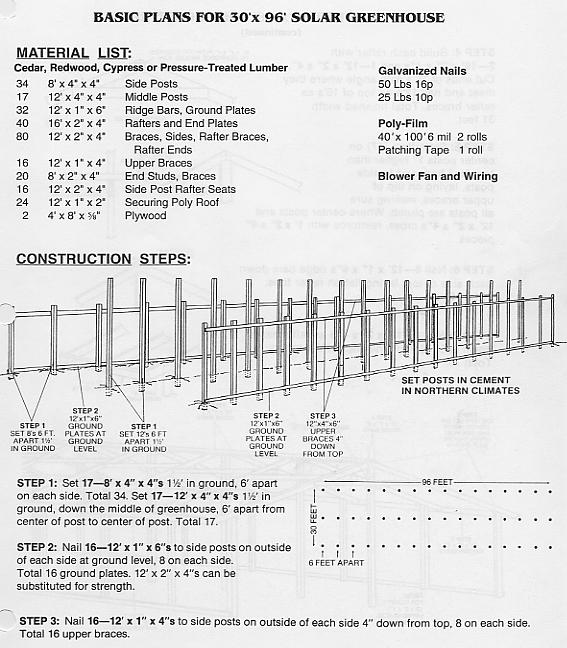
Here are some solar greenhouse plans.  And here are Silly Billy's World's Elementary Lesson Plans.

Posted by Tyler Cowen on October 2, 2008 at 06:10 AM in Economics | Permalink

Comments

The Wright plan looks like a no-brainer. It would protect everybody involved without running into 'moral hazard' issues. Anyone care to explain why Wright's plan isn't exactly what this country needs?

Posted by: Roger, FCD at Oct 2, 2008 8:25:28 AM

Here's another one to keep defaults down and keep housing pprices from fallin as hard and fast. A Housing Shuffle:

Handling the Housing Default Side of the Crisis

Part of the problem is that when default risk went up, buying slowed and so values on homes went down. This means that for many people, if they sell they are still stuck with a sizeable debt and no asset to lose if they default on it. And banks end up with an oversupply of properties it can only sell at firesale prices, which push home prices down further.

Here's a way to mitigate some of the problem.

Upon sale or foreclosure, the bank gives the borrower foreclosed properties on its books for the value, or partial-value, of the remaining debt.

Posted by: aaron at Oct 2, 2008 8:44:33 AM

Roger: perhaps you can explain why we need MORE transfers of wealth from renters to owners?

Posted by: Ninja Zombie at Oct 2, 2008 9:10:23 AM

The Wright Plan won't work. Most borrowers in trouble won't be able to make payments on an interest-only 7% loan. In fact, many are having trouble making interest-only payments on loans with 6% or lower rates. There are lots of subprime loans where the the borrower qualified based on artificially low short-term payment levels, and can't hope to actually make amortizing payments on the loan amounts they took out.

Making the problem worse has been the decline in house prices, as now many of those loans are underwater, and will cause banks to take a loss in foreclosure.

Posted by: Anthony at Oct 2, 2008 9:55:26 AM

My reasoning is based upon my understanding of the situation the financial sector, which goes something like this:
A. Consumer Banks in the 90's were allowed to package the mortgages they sold into securities, relieving them of the 'burden' of making sure that they invest depositor's money wisely. They could 'turn and burn' most mortgages into MBS's.
B. Rating companies completely failed at their jobs of rating MBS's, causing a significant portion of the financial sector to buy junk MBS's at AAA prices.
C. Investment Banks, wanting to get in on the action, thought that it would be a great idea to sell insurance on these AAA rated MBS's, and charged premiums on this based on the idea that MBS's are low risk, not high risk.
D. Put all of that together and you have a bunch of crappy loans (that Consumer Banks didn't care about) rated far to high (causing investors to over-expose) and 'insurance claims' far exceeding projected rates. The homeowners lose their homes when interest rates spike, causing investors to lose their shirts when their MBS's hemmorage, causing them to call in the woefully underfunded insurance.

There's plenty of blame to go around, almost nobody practiced any due dilligence. However, golden parachutes protect the people at the top, but who protects the homeowner who was told that a 5y ARM was a "great idea!" and that they could easily refinance later on? It's the sheer number of defaults on mortgages that are causing the problem. If you stop the defaults, the MBS's are suddenly worth their AAA ratings, the insurance payments that are bankrupting the Investment Banks suddenly stop being called in and the government makes a nice profit selling bonds @ 2-3% and sells mortgages to people for 7% all at the expense of the sector that caused this problem in the first place!

Win, win, win, win situation as far as I can see.

Posted by: Roger, FCD at Oct 2, 2008 10:25:01 AM

That solar greenhouse plan would never work. It doesn't even have a proper drainage system.

Posted by: at Oct 2, 2008 11:16:38 AM

Anthony,

You are correct, but presumably many of the people in the situations you describe will be helped out by the $300 billion Hope for Homeowners program. The others will default but their creditors will re-fi and turn the house into less of a loser and perhaps even into a positive net income stream if the Treasuries are sold and re-invested in assets returning more than 7%. And of course the mortgages will be repaid as soon as possible.

Roger,

I appreciate your support! I fear, though, that the answer to your question "Anyone care to explain why Wright's plan isn't exactly what this country needs?" is that this problem is now much bigger than just bad MBSs and CMOs. The shocks of the past year, I fear, have set off a complex wave of broken promises, mostly in the form of derivatives like credit swaps and all the arcane stuff that folks like Henry Kaufman have warned about for years, that threaten the entire financial system. The government doesn't want to publicize this for obvious reasons -- it would increase the panic and opposition to its plan.

Posted by: Wright Plan Author at Oct 2, 2008 11:34:36 AM

Here's the problem I have with the Soros plan:
//Private investors, including me, are likely to jump at the opportunity. The recapitalised banks would be allowed to increase their leverage, so they would resume lending. Limits on bank leverage could be imposed later, after the economy has recovered. If the funds were used in this way, the recapitalisation of the banking system could be achieved with less than $500bn of public funds.//

He admits leverage is a significant problem, but proposes to allow banks to *temporarily* increase their leverage so that they might resume lending.

My only question is when will Congress come back and limit leverage? If the problem becomes resolved, I suspect Congress might leave it at that...

Posted by: at Oct 2, 2008 12:25:34 PM

"To A Mouse, on Turning Her Up in Her Nest, With The Plough"[1] is a Scots poem written by Robert Burns in 1785, and was included in the Kilmarnock volume. As the legend goes, Burns wrote the poem after, as the poem suggests, turning up the winter nest of a mouse on his farm.

John Steinbeck took the title of his 1937 novel Of Mice and Men from a line contained in the second last stanza: 'The best laid schemes o' mice an' men / Gang aft agley' (often paraphrased in English as 'The best-laid plans of mice and men / Go oft awry').

From Wikipedia

Posted by: at Oct 2, 2008 3:00:07 PM

Here's what I'm thinking. The housing mortgages needed to be sold to foreigners because of the balance of payments deficit. Foreigners thought they were safe profitable investments.

And the complex derivatives needed to be sold to foreigners for the same reason.

Regardless how we jumpstart the credit markets to trade debts among ourselves, isn't it all worthless unless we can get foreigners to go back to buying our debt? And why would they do that now?

Anything we do to increase the supply of dollars will increase the inflation rate, right? And lead to foreigners' dollars getting devalued? So the more we do to inflate the money supply, the less foreigners will want dollars?

So when the Treasury sells a trillion dollars in new T-bonds, how much inflation will that make? Banks can buy the bonds and treat them as reserves, to make more loans. But will they make more loans? That's officially what we want them to do, but doesn't it seem like a risky sort of thing these days? Any fixed-interest loan is risky to lend when you don't know what the inflation rates will be. Any adjustable-rate loan is risky to borrow period. Maybe the new money won't make as much inflation as usual.

We're in trouble unless foreigners give or invest rather a lot of money in us. Why should they do that? If they don't, and if they don't just sell more for dollars and then hold the dollars, imports get more expensive. Our standard of living goes down. Our exports get cheaper so the same level of exports won't buy as much in the way of imports as it used to.

On the bright side, if our standard of living gets low enough we could get lots of low-paying jobs making stuff for export.

Posted by: J Thomas at Oct 2, 2008 4:48:40 PM

It isn't enough to guess what will happen by default. Somebody is going to take initiative.

I figure american politicians mostly can't take initiative at this point because we don't have the initiative. We have to respond to what the rest of the world does, and we lack the money to start something new.

Could china take initiative? Suppose that china offered to trade renminbi for dollars at a slightly higher rate than expected. Trade for international dollars mostly. The dollar is no longer an acceptable reserve currency. Could the renminbi become an acceptable reserve currency? They have a lot of production backing up the money. If the world community could trade their dollars for renminbi, would they?

So, say china prints up a whole lot of renminbi and trades them for the dollars we can't redeem. They wind up with a tremendous number of dollars, and if we default nobody much is hurt but them.

At that point they are the superpower and we are just another defaulted nation that maybe deserves the Argentina treatment, though one with nukes. Would china pay that price to get that result?

Posted by: J Thomas at Oct 2, 2008 4:56:56 PM

I agree with many of O'Neill's critiques in the Bloomberg article, but this is just silly: "His plan to deal with the crisis would start with a "discounted cash-flow analysis'' of distressed instruments that are clogging the financial system."

As if a discounted cash-flow analysis of bonds isn't what everybody already does.

People keep saying 'nobody knows what the bonds are worth', and this is misleading. What nobody knows is the future prepayment/default path of the collateral. 'Starting with a discounted cash-flow analysis' is all well and good but unless you know exactly which payment scenario will play out, you can and probably will be way off.

Thus, it's not that these bonds (many of the ones we're talking about) are just somehow 'hard to value' but if someone stepped in and spent enough time they could do it. The bonds are actually easy to value, given a payment scenario. What's "hard" - actually, impossible - is to project that payment scenario accurately. O'Neill wouldn't be able to do it and neither will Paulson.

This is a big reason why such bonds are discounted. The future is fuzzy and the bond is discounted for that uncertainty. This is as it should be. Another thing people keep saying/assuming is that somehow virtually every MBS/ABS bond is being marked way below its 'intrinsic' or hold-to-maturity value. Paulson seems to think so.

I see very little evidence that this is the case.

Posted by: Sonic Charmer at Oct 2, 2008 7:59:56 PM

Post a comment