« Economic notes from underground | Main | Five weeks »

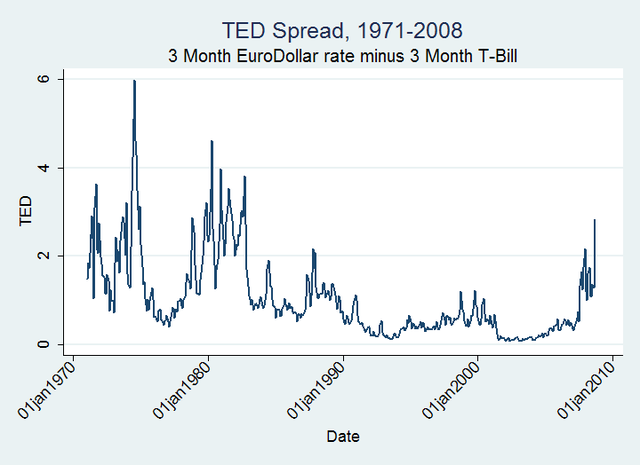
The Long Term Perspective on the TED Spread

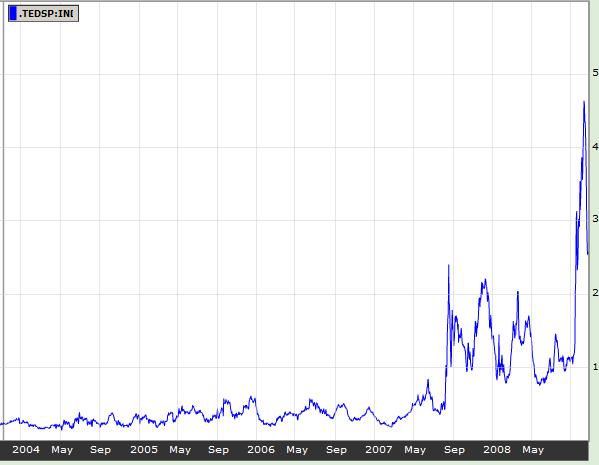
Here is the usual picture of the TED spread from Bloomberg.
Ted_spread_bloom_2
I was curious to see a longer-term picture so I collected data on the 3 month Treasury bill rate (TB3MS from the St. Louis Fed.) and the 3-month Eurodollar rate (EDM3 from the Fed.)  Note that this is current up to September.  Also this is slightly different from calculations elsewhere because it's on a monthly basis, so some daily jumps are smoothed out, and sometimes a different LIBOR rate seems to be used for the ED rate but the different versions appear to correlate well.  The advantage of using these measures is that you can get a much longer time series.  Here it is (click to expand if unclear).
Ted_long_2

Posted by Alex Tabarrok on October 24, 2008 at 02:36 PM in Data Source, Economics | Permalink

Comments

Can someone explain in laymans terms why the TED spread is important and what it means?

Thank you.

Posted by: bski at Oct 24, 2008 2:43:58 PM

I second the request to balance the "Duhn-duhn-DAAHHH!" revelation with a little analysis, please.

Posted by: at Oct 24, 2008 2:50:34 PM

Oh that's a relief. So the TED spread has only been the worst it's been since 1974. I don't know what all the fuss is about.

Posted by: Finnsense at Oct 24, 2008 2:53:56 PM

Can someone explain in laymans terms why the TED spread is important and what it means?


Ideally, the rate banks charge each other for short term lending should be very close to the 3-month t-bill (which is essentially riskless)

So, when banks are charging each other a lot more to lend, it indicates that they are perceiving a lot of risk and are reluctant to lend to one another. it's a rough measure of jitters.

Posted by: pants at Oct 24, 2008 3:02:04 PM

The TED spread is an indicator of credit risk. Lower TED demonstrates lower percieved risk of default on interbank loans.

Posted by: Michael at Oct 24, 2008 3:04:01 PM

It would be interesting to see the TED spread as a percent of the T-bill rate.

The high spreads appear to be back when nominal interest rates were high.

Of course, I do not know why bank default risk would be proportional to nominal interest rates.

But, it might be.

Posted by: Greg at Oct 24, 2008 3:08:19 PM

Alex:
I can guarantee you that it looks at LOT scarier as a ratio, try this edm3/tb3ms

Posted by: jck at Oct 24, 2008 3:11:11 PM

was a wide ted spread perceived as a credit crisis in the early 80s or 70s?

If not, what's the different now?

Posted by: dm at Oct 24, 2008 3:18:20 PM

i will add another comment mentioning the ratio of the two. when treasury rates are in the double digits a larger spread should be expected on an absolute basis.

when 3mTBill rates are at or near zero, a spread of 300 bp is scarier. especially since you have tools to reduce the Tbill rate (fed funds is a direct substitute) and once you're at zero on the bills there's not much else you can do.

Posted by: Sean at Oct 24, 2008 3:22:13 PM

"So, when banks are charging each other a lot more to lend, it indicates that they are perceiving a lot of risk and are reluctant to lend to one another. it's a rough measure of jitters."

So would it indicate a lot of risk in other banks defaulting or in the economy in general?

Posted by: bski at Oct 24, 2008 3:26:11 PM

jck, why look it as a ratio? Isn't the spread the theoretical risk premium? This is an honest question, wondering what I'm missing. Thanks!

Posted by: pytheian at Oct 24, 2008 3:27:02 PM

Could we get a more detailed time axis, please? Thank you!

Posted by: Chris at Oct 24, 2008 3:35:43 PM

the spikes in the 70s and early 80s were when interest rates were much higher.

Posted by: jck at Oct 24, 2008 3:37:32 PM

I put up a graph as a ratio using the same data as Alex, for the same period.
This is worth looking at since the TED spread at 100 bp isn't the same thing if t-bills are at 1% or at 15%.

http://www.aleablog.com/the-long-term-perspective-on-the-ted-ratio/

Posted by: jck at Oct 24, 2008 3:55:06 PM

That is a lot scarier...

Posted by: WCH at Oct 24, 2008 4:01:05 PM

Banks are excellent at judging risk. Oh wait, they just sucked. Banks just got better at judging risk right.

"So the TED spread has only been the worst it's been since 1974."

Ewww, this does not bode well for men's fashion.

Posted by: Andrew at Oct 24, 2008 4:16:28 PM

Also, it should be noted that the first interest rate swap wasn't until 1982, and the first swap was in 1980.

In general, very long term charts of the ted spread are not useful.

Posted by: mickslam at Oct 24, 2008 4:17:34 PM

This is really bad. Banks are careful about giving out other people's money.

Or maybe we should have a TED spread on government spending.

Posted by: Acton. at Oct 24, 2008 4:18:51 PM

jck,

Nice chart and blog, read you all the time.

From the ratio chart you can see how out of wack the .tedsp index is right now.

Posted by: mickslam at Oct 24, 2008 4:20:15 PM

There is a reason it's called the TED spread and not the TED ratio. The spread measures the correct opportunity cost/risk. Imagine, for example, that people thought there was a big default risk on Treasuries so they started to move into cash. The interest rate on Treasuries would then rise indicating the risk. In other words, people would implicitly compare the rate of return on treasures with that on cash, zero. Call that the CT spread. No one would say look at the CT ratio, it's infinite!

Google "TED spread" and you find lots of links. Google "TED ratio" and you get nothing relevant except the post linked to above!

Posted by: Joe the Economist at Oct 24, 2008 5:14:25 PM

I understand theoretically why it is called a spread and not a ratio. A bank has a choice of giving money to the government risk-free or to another bank for a slightly higher yield. The spread factors in the risk of a bank defaulting, regardless of what the underlying T-bill rate is.

However, why was the TED spread so much higher then pre-1985 than 1985-2007. Right now, I can only think one explanation. Pre-1985, banks were much more regionalized and Podunk National Bank would typically only use deposits to finance lending. A bank asking for loans from another bank was a signal of a bank possibly in trouble. Since 1985, banks became more consolidated and they realized it was very unlikely for another big bank like BoA or Citi to fail.

Posted by: mw at Oct 24, 2008 5:35:33 PM

LIBOR OIS & TED spreads ended the week down 21% and 27%

CP Yields on 90day paper increased to 4.9% on Firday, posting a 14% decrease for the week

5 year spreads on A-rated corporate bond increasing 4.9% and B-rated bonds increased 3.7% for the week.

Posted by: Vincent Huang at Oct 24, 2008 6:13:25 PM

I think TED is interesting, but not relevant for economic policy.

It is the increase in the LIBOR that is the problem, not the drop in the T-Bill rate.

If the higher interbank lending rate is resulting in higher interest rates for final borrowers, and so, consumption and investment are depressed, then, a more expansive monetary policy to maintain spending is waranted. And that would tend to lower interest rates--most rapidly the interest rate on interbank loans and then on other loans.

Simiarly, that there is a large gap between higher and lower risk commercial paper rates, closing the gap shouldn't be the goal. The goal should be to lower the rates on high risk and lower risk borrowers so that the decrease in borrowing by the high risk borrowers is dampened, and offset by the increase in borrowing by low risk borrowers.

To the degree that the expansive monetary policy lowers the T-Bill rate more rapidly than other interest rates--so what? The gap is not the problem.

However, LIBOR is a poor measure of the cost of interbank lending.

LIBOR is an average of the interest rates that 20 major money center banks pay on short term loans.

If you assume that these are the soundest institutions, then, everyone else would, naturally, be paying more.

However, what has happened is that large money center banks are paying more than everyone else. (The TED is a measure of lack to confidence in large money center banks.)

The Fed tracks actual federal funds transactions. This is all the interbank lending, not just the 20 large money center banks. Actual Federal Funds transactions are below target. Often less than 1%.

Some banks are lending to other banks. It is just that the 20 money center banks whose borrowing rates are tracked by LIBOR are paying high rates.

The CD rates tracked by the Fed tell the same story. These are on the secondary market--in other words, negotiable CD's issued by large, money center banks. The rates on these are very high.

If we look at the banking system as a whole, deposits are expanding. Persumably, funds are moving from large money center banks (and from money market funds, and from direct investments in commercial paper) into bank deposits.

Bank credit is expanding. Higher risk firms that had borrowed by issuing commercial paper are now borrowing from banks.

So what if they are using lines of credit? That is what lines of credit are for.

Banks aren't lending? False. They are lending, but maybe not the same banks are lending to the same people as before.

Posted by: Bill Woolsey at Oct 24, 2008 6:15:36 PM

Hi Alex, thank you for the graphs. I have one question, though, which currency have you used for the spread pre-euro (French francs, Deutsche Marks, British Pounds)?

Thank you, all the best,

Jorge

Posted by: Jorge at Oct 24, 2008 6:29:02 PM

Oh people, please stop arguing using TED ratios. Spread is a risk price, but the ratio of spread to risk free rate is economic garbage. You could make the graphs look even scarier by multiplying the time series with exp(g*t), g>0. But again you only get garbarge.

The risk free rate expresses the pure time preference of economic agents (influences the willingness to shift consumption intertemporally). The spread expresses the willingness to enter riskier intratemporal bets. They are two different concepts. The spread, as a measure of the risk price, has exactly the same meaning regardless of what the level of the risk free rate is.

Have we moved to a situation where we evaluate the relevance of economic indicators based on how scary they look like?

Posted by: pinus at Oct 24, 2008 7:09:54 PM

Post a comment