« My favorite things Chile | Main | China fact of the day »
The Obama tax plan
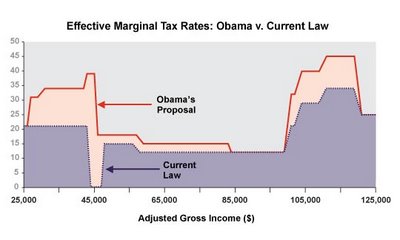
Those are the marginal tax rates and how they would change, analyzed here, via Greg Mankiw. The key point is this: "Reducing a person’s tax credit as his income goes up also reduces his incentive to earn more income." But before some of you get all upset, I do not intend this presentation as an endorsement of John McCain's utterances on fiscal policy.
Addendum: I am not saying that Obama is "raising taxes on the poor." It is about marginal rates and yes marginal rates do matter for incentives. This is a genuine problem of many indeed most anti-poverty programs, it is not an attempt to mislead anyone. Don't treat everything as necessitating a response to right- or left-wing talking points. You still ought to look at this diagram and think that the "notches" are too discrete and too strong.
Second addendum: Here is an Econ4Obama response.
Posted by Tyler Cowen on August 13, 2008 at 07:56 AM in Economics | Permalink
Comments
Is the argument: cutting taxes on the poor makes them happier, which is bad, because it keeps them from the true (though not preferred) happiness that comes from working harder?
Or is it: cutting taxes on the poor makes them happier, which is bad for people who want to buy their labor?
Posted by: beamish at Aug 13, 2008 8:27:59 AM
Please don't let this blog descend into mouthpiece for snide & deceptive talking points a la Mankiw & AEI.
The obvious missing point here is that Obama's proposals leave people at a given low level of income significantly better off.
Posted by: jonm at Aug 13, 2008 8:28:43 AM
This is one of those cases where a picture isn't worth a thousand words: the graph is a quite misleading representation of Obama's tax plan. It is dependent on picking a family with two children: one who is a dependent and one who is in college. The bumps in the graph are due to accelerated phase outs (of sometimes more generous) college and dependent child tax credits.
While phase-outs are equivalent to a tax, it is a bit silly for conservatives to get excited by this fact because it's probably the case that a family making $15,000 faces the worst marginal incentives of any group in the country (due to phase-outs of various federal, state and local benefits).
Posted by: no at Aug 13, 2008 8:29:18 AM
It is very misleading to present the graph like this.
As the original article admits Obama actually CUTS taxes for lower income workers. However, since he cuts taxes MORE at the very low end (via a refundable tax credit), that is called a "marginal" rate increase: I.e. by earning and extra dollar you get less of a tax credit. That's right, a bigger tax refund is labeled as a higher marginal tax even though the taxpayer is playing less tax overall.
I'm not surprised that some people would present misleading graphs like this.
However, just a few weeks ago Tyler wrote an article advocating phasing out medicare via means testing. At that time, he vehemently argued against labeling phase-outs a marginal tax increase.
So I am surprised that he would now use the "marginal tax increase" label for Barack's expanded tax credit without further explanation.
I wonder how many people will be fooled into thinking Obama is raising taxes on the poor?
Nice job muddying the debate, Tyler.
Posted by: a student of economics at Aug 13, 2008 8:39:46 AM
Looks like another screwing of the middle class to me. Nothing like a clear signal from the government that you're making too much money to keep you in your place.
Posted by: Jim at Aug 13, 2008 8:45:15 AM
The jaggedness, the ups and downs, dips and swirls on the yield curve posted are enough to create more inefficiencies regardless of the phase out/in schedule.
Posted by: MattY at Aug 13, 2008 8:48:18 AM
"Reducing a person’s tax credit as his income goes up also reduces his incentive to earn more income."
Actually, after 25 years of tax planning, no such thing happens.
What does happen is an increased desire to use deferral and avoidance planning, so there may be an a short run appearance of disincentive.
Posted by: save_the_rustbelt at Aug 13, 2008 8:51:14 AM
"Reducing a person’s tax credit as his income goes up also reduces his incentive to earn more income."
Actually, after 25 years of tax planning, no such thing happens.
What does happen is an increased desire to use deferral and avoidance planning, so there may be an a short run appearance of disincentive.
Posted by: save_the_rustbelt at Aug 13, 2008 8:53:14 AM
"What does happen is an increased desire to use deferral and avoidance planning, so there may be an a short run appearance of disincentive."
Well, at least it allows YOU to take home more, Rustbelt.
Posted by: Tom at Aug 13, 2008 9:15:06 AM
"Reducing a person’s tax credit as his income goes up also reduces his incentive to earn more income."
This is BS. My wife and I are on the cusp of entering the next tax bracket and we're close to losing some of our deductions. Do you think that means I'm going to turn down my raise or promotion at the end of the year?
Posted by: schultz at Aug 13, 2008 9:24:01 AM
Do you think that means I'm going to turn down my raise or promotion at the end of the year?
Schultz, the point is that there are a certain number of people for whom it's a close call whether they want to earn more, or trade off some income for other considerations such as more leisure time, or a less stressful career. A disincentive in the tax system will cause more of those people to forgo the extra income, than would otherwise have been the case.
Posted by: Richard at Aug 13, 2008 9:39:18 AM
@schultz
It does matter in a two income household with opportunity costs. My wife is seriously considering giving up her career as a nurse and staying home with the kids because every single dollar she makes will be taxed at nearly 40% (live in NJ).
Posted by: jmulls at Aug 13, 2008 9:41:39 AM
Normally I love MR. I hate this post. The graph is Completely misleading, as its improperly labeled, which is something that was hammered into me when I was in grad school at GMU. Always label your graphs specifically and correctly. The presented graph cherrypicks a particular demographic taxpayer, presenting as what will occur for all tax payers.
Tyler, I strongly encourage you to properly label this
Posted by: Stephen at Aug 13, 2008 9:45:00 AM
Ok, leaving aside that this is a highly one-sided analysis and rather sloppy from the AEI (why only one set of assumptions?), I think the question of marginal phase-outs is pretty interesting. Do they really affect perceived incentives? Using myself as an example, I would say no. I don't think about phase-outs until I'm filing, at which point my response is "Shoot, missed the student loan deduction because of the phase-out. Oh, well." It doesn't affect my decision-making, and even when doing my taxes, I'm highly unlikely to connect the dots and say, "Damn, with the phase-out my marginal tax rate on that last dollar of income was 50%. What a travesty!" I'm inclined to think 95%+ of taxpayers are equally clueless about our true incentives; we just think about our nominal gain in income.
So I would argue that yes, these provisions decrease the absolute incentive to make more, but they don't significantly change people's behavior. Isn't that a good tax because it minimizes deadweight loss? Let's make the tax code more complicated so that people don't realize they have less of an incentive to work harder!
Posted by: Greg at Aug 13, 2008 9:45:53 AM
Learn to read, please. He didn't say it "eliminates" incentive, he said it "reduces" it--which it does.
Posted by: CDeBoe at Aug 13, 2008 9:46:22 AM
And this graph doesn't even show the disincentives in store for those making over $205,000 (those bastards!). With the elimination of the cap on SS tax the marginal rate is increased by 12.4% on the self-employed. When you add in federal income tax and state tax marginal rates can exceed 60%. Time to retire, anyone?
Posted by: Rich Berger at Aug 13, 2008 9:53:22 AM
We have a Federal debt, and short-term deficit. In my opinion that rational theoretical baseline is the tax burden to balance the deficit, and pay a bit down on the debt.
Therefore I am very disappointed when I read lines like this:
The key point is this: "Reducing a person’s tax credit as his income goes up also reduces his incentive to earn more income."
It pretty much suggests that the baseline is "a person's tax credit." Of course a nation told "he wants to take away your credit" will never come to terms with debt!
(not to say that the chart above looks good.)
Posted by: odograph at Aug 13, 2008 9:53:30 AM
Of course Richard is right, at the margin some people will act as his theory implies.
But of course we never see any estimates of how significant that "some people" actually are.
Is it two, or maybe four individuals out of the millions of tax payers?
Maybe it is millions. But if we do not have any idea how significant it is we have no idea how seriously to take his argument.
Posted by: spencer at Aug 13, 2008 9:56:35 AM
Thanks for the addendum, Tyler.
Unfortunately, I suspect the vast majority of people who browse and see this chart will come away with the false impression that Obama increases taxes on poor and middle class people (up to $125K/yr in income).
I'm not saying that was your intent, but that's the effect.
Creating a false and damaging impression, while purporting to be making a different point, has been raised to an art form by partisans (esp. those on one side of the debate, IMHO).
So honest brokers need to be careful about re-using charts, images and factoids that are carefully created and disseminated by ideologically driven foundations. Partisans count on people like you to amplify their distortions and lend an air of legitimacy.
Posted by: a student of economics at Aug 13, 2008 9:56:38 AM
(repost after failure)
We have a Federal debt, and short-term deficit. In my opinion that rational theoretical baseline is the tax burden to balance the deficit, and pay a bit down on the debt.
Therefore I am very disappointed when I read lines like this:
The key point is this: "Reducing a person’s tax credit as his income goes up also reduces his incentive to earn more income."
It pretty much suggests that the baseline is "a person's tax credit." Of course a nation told "he wants to take away your credit" will never come to terms with debt!
(not to say that the chart above looks good.)
Posted by: odograph at Aug 13, 2008 9:58:46 AM
What is the notch where the marginal rate goes to zero for current law???
Posted by: Clay B at Aug 13, 2008 10:03:16 AM
My previous comment wasn't in response to Greg.
However, I will say that increasing the complexity of the tax code may well get you more money, but at the cost of hate and discontent.
Posted by: CDeBoe at Aug 13, 2008 10:05:28 AM
I think the last line of that article, "“tax cuts for the middle class” are actually marginal rate hikes in disguise." is intentionally misleading. While it's factually correct (for their cherry picked demographic at least), it seems that they are trying to make it look like it raises absolute taxes on middle income individuals.
In response to Tom saying "Well, at least [a lower marginal tax rate] allows YOU to take home more, Rustbelt," Obama's plan actually allows 95% of Americans to take more money home than does McCain's plan. Marginal tax rates are about efficiency whereas average tax rates are about how much money you take home. Average tax rates for 95% of Americans would be lower under Obama than under McCain.
Posted by: brian at Aug 13, 2008 10:10:30 AM
I would also like to challenge the idea that marginal tax hikes have a measurable effect on incentive. Perhaps at high incomes where people are seeing 40% or more of their paycheck go to taxes. But I think we should all agree that it is ridiculous to attribute disincentive to low income workers. Take jmulls example. He's making 6 figures likely and his wife's nursing job probably adds another 60-80k which amounts to 35-45K after taxes. Add in daycare costs and one can see the disincentive not to work. But how would we fix this anyway? If we got those taxes down to 35% would that really affect the decision that much.
Now at the lower levels, it's a completely different story. Every cent really matters and the likelihood that a low-educated taxpayer analyzes tax policy before taking a job strikes me as quite unlikely. And to boot, Obama's tax plan ends up putting more money into their pockets then the current tax plan. That's what is meant by incentivising work. Add better health care and one can see how work starts to pay off quite a bit more for the bottom 50% in Obama's tax plan. There's your real incentive.
Posted by: KJ at Aug 13, 2008 10:14:29 AM
Sorry, but even with your addendum, this is a hackneyed piece of FUD. I agree that the discontinuities are too strong in both the existing tax code and Obama's tax plan, but the primary effect of this chart is to imply a tax increase on the poor, which is of course utterly false.
The only way to cut taxes *without* creating an increase on the margin is to only cut them for the wealthy -- or, in the best case scenario, by the same amount for wealthy and poor alike. Obama's plan cuts taxes a lot for the poor, and a little for the middle class, while raising them slightly for the wealthy. Naturally, this creates a steeper gradient of progressive taxation -- in other words, more taxes on the margin.
So Alex Brill's complaint is that under Obama's plan, wealthier people don't get their taxes reduced by the same amount that poorer people do. Well, boo-f-ing-hoo for them. Brill has worded this complaint in a disingenuous fashion, so that unless you're paying really close attention it sounds like Obama is actually raising taxes on the poor. What absolute rubbish.
And all that stuff about higher marginal rates reducing incentives to earn? Sorry, but people -- especially poor people -- simply aren't that rational on the margin. Having grown up in and around poor families, I've never known anyone to turn down additional income because it would increase their taxes. The very idea is laughable. Only ivory-tower idiots with their own personal tax accountants could ever come up with crap like that.
Posted by: Nathan Koren at Aug 13, 2008 10:25:51 AM


