« Your Favorite Things China? | Main | Focal points »

Krugman gets a Rotten Tomato

Paul Krugman is attacking Milton Friedman (again) for rotten tomatoes.  Here's Krugman in 2007:

These are anxious days at the lunch table. For all you know, there may be E. coli on your spinach, salmonella in your peanut butter and melamine in your pet’s food and, because it was in the feed, in your chicken sandwich.

Who’s responsible for the new fear of eating? Some blame globalization; some blame food-producing corporations; some blame the Bush administration. But I blame Milton Friedman.

...Without question, America’s food safety system has degenerated over the past six years.

and here he is today repeating himself:

Lately, however, there always seems to be at least one food-safety crisis in the headlines — tainted spinach, poisonous peanut butter and, currently, the attack of the killer tomatoes.

How did America find itself back in The Jungle?

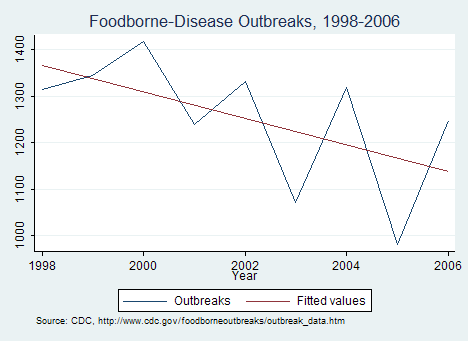
I was curious so I collected data from the Center for Disease Control on Foodborne Disease Outbreaks from 1998-2006.   The data only go back to 1998 because in that year the CDC changed its surveillance system creating a discontinuity but note that we are covering a chunk of the Clinton years and are well within the time frame over which Krugman says the safety system has degenerated.  Here's the result:

Foodoutbreaks

What we see is a lot of variability from year to year but a net downward trend.  You can also look at cases per year which are more variable but also show a net downward trend.  No evidence whatsoever that we are back "in The Jungle."

Posted by Alex Tabarrok on June 13, 2008 at 12:31 PM in Economics, Food and Drink, Medicine | Permalink

Comments

Interesting. I'd like to hear more about the other variables you included for controls and the t-statistics, if it's not too much trouble.

Posted by: brian at Jun 13, 2008 12:47:38 PM

Please send that to the NY Times and request both a retraction and Krugman's firing. There are arguments to make for more and less regulation (on nearly every issue) but no one really benefits from people like Krugman, who either can't be bothered to look up facts or knowingly lies to further his arguments.

Posted by: Scoop at Jun 13, 2008 12:48:55 PM

Never let the facts get in the way of a good socialist rant. ;-)

Posted by: Speedmaster at Jun 13, 2008 12:49:56 PM

On face, Krugman could be referring to the size of individual outbreaks, rather than the overall number. I doubt this, as it appears that he (like most commentators) is reacting to volatility rather than fundamental numbers. It isn't too much of a jump to assume that our impression of food safety is driven more by volatility than actual number of outbreaks. For one, small disease outbreaks in this country are REALLY small. If an e. coli outbreak kills just one person, it is national news. The converse of that is that we are likely to never hear of small outbreaks or outbreaks caught at the factory or distribution level. I think that most people assumed (I certainly did before seeing that chart) that there were closer to 0 outbreaks on average and that the recent years were a large jump. If we change the axes on that graph so that the origin of the vertical axis begins at zero outbreaks, the number would appear almost constant.

But, unfortunately, a broken clock is right twice a day. Krugman, like most pundits, is capable of being right for the wrong reason. Like most regulatory arms of the executive, the FDA has atrophied during the tenure of the Bush administration. To the best of my knowledge this is because of willful neglect rather than directed malice (unlike the MSHA, OSHA, or the EPA). To say otherwise would ignore the explicit promises of the bush administration vis a vis these regulatory agencies as well as their past actions.

Posted by: Adam Hyland at Jun 13, 2008 12:53:31 PM

Brian: they are probably in the link. Doesn't look like Alex produced the graph himself. As we say at /., RTFA. :)

Posted by: Adam Hyland at Jun 13, 2008 12:55:02 PM

There aren't enough data points there to know whether there's a real trend. The volatility is as big as the trend.

But I think that observation alone is enough to question whether there is really any evidence for Krugman's claim.

Posted by: Michael F. Martin at Jun 13, 2008 1:00:57 PM

No controls - just the raw data by year. I produced the graph. Email me if you want the data.

Posted by: Alex Tabarrok at Jun 13, 2008 1:06:50 PM

This seems reminiscent of what happened to a variety of different rates of violence throughout the 1990s, with particular regard to John DiIulio's "superpredator" (the spread of merciless, murderous juveniles)... though media coverage skyrocketed, the number of actual incidents fell.

Posted by: Glenn at Jun 13, 2008 1:09:11 PM

Personally, I find all of these food outbreak things to be quite silly. I remember not being able to get Spinach on a pizza back when that thing was going on. Obviously there wasn't any risk (no way the bacteria survives a 400 degree oven), and I was fully aware of the scare, so it's not like I was being duped.

But the fear of litigation by the restaurant and the media blitz basically made it impossible for me to make that choice for myself.

I guess a case can be made that consumers being near-100% confident that the products they buy aren't contaminated with anything is worth the costs of the massive recalls that accompany such scares. But there's no way the physical medical benefits (ie, fewer people getting sick) are.

Posted by: mravery at Jun 13, 2008 1:22:22 PM

Salmonella, shmalonella. There's been, what, a couple hundred cases? My odds of getting killed crossing the street are still greater. Mind you, I don't know the exact odds of getting killed while crossing the street, especially for a relatively small town like mine, but if Krugman doesn't need facts ....

Posted by: Franklin Harris at Jun 13, 2008 1:25:40 PM

Paul Krugman says that food safety deregulation is the cause of the recent trend in food safety, or the lack thereof.

I'll second the motion, Krugman is right (!), deregulation is the cause of the increase in food safety.

That said, I'm not going to hold my breath waiting for Krugman to write an article called I was wrong, Milton Friedman is right, food deregulation is making us safer.

Posted by: happyjuggler0 at Jun 13, 2008 1:25:59 PM

These data include all outbreaks, including those originating in private homes. Therefore they don't settle the issue one way or the other. If you were to isolate just the outbreaks originating in places that the FDA monitors, get data from prior to 1996, and then compare the trends to other countries that have maintained the same inspection system over the same period, you might have a point. As it is, you seem to have produced an interesting graph, but not one that is relevant to the question at hand.

Posted by: es32 at Jun 13, 2008 1:28:31 PM

Like most regulatory arms of the executive, the FDA has atrophied during the tenure of the Bush administration. To the best of my knowledge this is because of willful neglect rather than directed malice (unlike the MSHA, OSHA, or the EPA).

But:
1) Mine incidents, costs, and people injured show a downward trend.
2) Workplace incidents, costs, and people injured show a downward trend.
3) Food incidents, costs, and people injured show a downward trend.
4) On another level, plane crashes also show a downward trend.

There have been people jumping all over year-to-year volatility or incidents that make the paper, but the data, including that from independent groups, say otherwise. Why, one might almost think that other factors are more important than OHSA, MHSA, and all the rest at promoting safety.

Posted by: John Thacker at Jun 13, 2008 1:28:39 PM

We weren't even in "back in 'The Jungle'" when we were back "The Jungle." Conditions were nowhere near what Sinclair described. Investigative reporting by mainstream newspapers after "The Jungle" was published thoroughly debunked his histrionic depictions.

People should remember that Sinclair was a muckracker journalist before he became a muckracker fictionalist (and socialist agitator).

Posted by: KipEsquire at Jun 13, 2008 1:37:58 PM

John:

I don't think that trend is robust against the industry trends independent of regulation. E.g. cancer rates due to uranium dust has decreased in the 1990's in the US but safety practices really haven't changed, the mines have been closing down.

Also, I don't automatically think that the impacts are coupled directly to regulation. In the case of the FAA, there are thousands of checks built in from a half-century of regulation. That Northwest wiring inspection incident? It was a non-starter from the safety point of view because the engineering practices undertaken by the manufacturer. We aren't decreasing regulation and suddenly entering the state of nature.

RE: Plane crashes. I think the governing data here should be near miss and collected anon reports from pilots and controllers. Again, the system in question is VERY, VERY robust.

RE: Mine, workplace, and other incidents. Where is that data coming from?

Posted by: Adam Hyland at Jun 13, 2008 1:39:07 PM

Perception is reality, and the buzz surrounding a story such as food safety makes for good copy. The media hypes it, creating a perception in the readers' minds, absent any change in trends.

Posted by: jn at Jun 13, 2008 1:50:03 PM

Adam Hyland already hit on the main part of this problem, however, it's not just the federal level.

There has been a continuing decline over the past couple of decades of the resources and thus the ability of state public health agencies to adequately collect, analyze and report much of this type of data.

What you are therefore seeing in the CDC data is at least partly (a very large part IMHO)due to the decline of incoming data and not really a decline in actual incidents.

Posted by: Blaine Higgy at Jun 13, 2008 1:55:26 PM

Cure for tainted foods: Wash or cook foods before eating them.

Or, as in China, eat some garlic cloves beforehand.

Posted by: jorod at Jun 13, 2008 2:20:41 PM

Anyone got a good hypothesis about why outbreaks go up in even numbered years? Congressional elections?

Posted by: mobile at Jun 13, 2008 2:54:31 PM

"Lately, however, there always seems to be at least one food-safety crisis in the headlines"

And it doesn't occur to him, a journalist (mainly), that the writers of the headlines might be as much to blame as anything? It's as if he's willfully ignoring the way journalism works as much as he's ignoring economics.

Posted by: M. Hodak at Jun 13, 2008 2:55:02 PM

Did you really just plot a trend line with 8 data points and no control variables? This almost makes me jump to the conclusion that Krugman must be right, or you would have put real arguments up to counter him. What is the correct measure? Probably not outbreaks. With increased news coverage (that some have mentioned are the reason people think there is a trend) the outbreaks are very limited. Although i am bummed right now I can't get tomato on my hamburger at Wendy's, at least I am not getting sick. Maybe quantity of food contaminated is the correct measure. It seems that the quantity of tomatoes (and spinach earlier) affected is very high, but the information is spread quick enough to reduce the outbreaks from reaching large numbers of people.

Posted by: drh at Jun 13, 2008 3:04:44 PM

Did you really just plot a trend line with 8 data points and no control variables? This almost makes me jump to the conclusion that Krugman must be right, or you would have put real arguments up to counter him. What is the correct measure? Probably not outbreaks. With increased news coverage (that some have mentioned are the reason people think there is a trend) the outbreaks are very limited. Although i am bummed right now I can't get tomato on my hamburger at Wendy's, at least I am not getting sick. Maybe quantity of food contaminated is the correct measure. It seems that the quantity of tomatoes (and spinach earlier) affected is very high, but the information is spread quick enough to reduce the outbreaks from reaching large numbers of people.

Posted by: drh at Jun 13, 2008 3:05:01 PM

In my fantasy world, every news article is required to have a little blurb at the bottom that indicates the true statistical likelihood of the events covered in the article happening to the average person. I'm getting so tired of people getting riled up over nothing because some journalism major couldn't think of anything novel to write this week. This is just another example.

Posted by: 12345 at Jun 13, 2008 3:15:21 PM

Odd. Its almost like Krugman emphasizes scoring political points for causes he is sympathetic to over honest economics and journalistic integrity.

I am shocked because this is so uncharacteristic for him.

Posted by: kevin at Jun 13, 2008 3:17:03 PM

Is that correct - 8 data points in 8 years?

Posted by: gab at Jun 13, 2008 3:22:21 PM

Post a comment