« Haitian prison | Main | Headlines »
More on Bartels
I'm a little surprised that the Bartels result is receiving so much attention because the result, in slightly different form, has long been known to political economists under the rubric of partisan business cycle theory. In a nutshell, the theory of partisan business cycles says that Democrats care more about reducing unemployment, Republicans care more about reducing inflation. Wage growth is set according to expected inflation in advance of an election. Since which party will win the election is unknown wages growth is set according to a mean of the Democrat (high) and Republican (low) expected inflation rates. If Democrats are elected they inflate and real wages fall creating a boom. If Republicans are elected they reduce inflation and real wages rise creating a bust. Notice that in PBC theory neither party creates a boom or bust it's uncertainty which drives the result - if the winning party were known there would be neither boom nor bust.
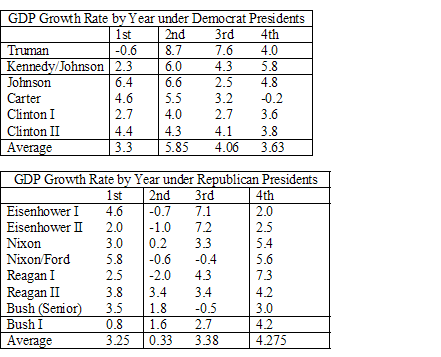
Ok, there's plenty to question about the theory but let's look at the data.
Notice that in the second year of just about every Democratic Presidency there is a boom. Interestingly, the boom is biggest for Truman whose reelection was highly uncertain (remember Dewey wins!) thus expected inflation would have been low and the boom big. Similarly the boom is smallest (relative to the surrounding years) for Clinton II a relatively certain reelection.
Now look at Republicans in just about every second year of a Republican Presidency there is a bust. The one major exception being Reagan II where uncertainty about the outcome was low.
It's pretty clear that this result can explain Bartels's result which is exactly Tyler's point in his post. It's equally clear that when we consider Presidents there aren't many data points. (PBC does appear to hold somewhat in other countries).
Notice that the reason for the result, according to PBC, is sticky wages and the business cycle and not some nefarious story about taxes, oligarchies and political conspiracies.

Posted by Alex Tabarrok on April 8, 2008 at 07:42 AM in Economics | Permalink
Comments
Alex-
After I read about the Bartels piece I was curious about the results and went back to historical GDPs. I was surprised to see that growth was fairly strong during Carter's presidency. Alas, inflation was also going up, too. I think the growth was goosed by more inflation each year. It took a couple of years into Reagan to clean up the mess.
Posted by: Rich Berger at Apr 8, 2008 7:52:01 AM
Does this imply, then, that if the Democrats were to hold on to power for longer than two terms, the relationship would break down? As opposed to if the pattern was being driven by taxes & transfers (and oligarchs etc.).
Because I imagine some people will be looking at Bartel's graph and thinking, well, if we want to help the man on the street, we need to keep the Democrats in power.
I am confused however - if the Democrat boom is driven by inflation-caused lower real wages, how come the lower income percentiles see real income growth during that boom? Is it because when calculating average incomes, the decrease in unemployment outweighs the lower real wages for the already employed? That assuming the data includes the unemployed somewhere in its averages. Or something else?
Posted by: Luis Enrique at Apr 8, 2008 8:08:16 AM
It's only been a little more than a century since Democrats and Republicans explicity endorsed inflation versus sound money policies in their presidential campaigns, with direct appeals to the social classes and constituencies that would benefit accordingly.
The William Jennings Bryan "Cross of Gold" speech pretty well sums up the raw conflict: http://en.wikipedia.org/wiki/Cross_of_gold_speech
Posted by: Bob Knaus at Apr 8, 2008 8:26:21 AM
But where are those expectations supposed to come from?
There seems little basis for them in the record even without considering other factors.
Posted by: Jack at Apr 8, 2008 8:50:21 AM
Yes Rich the first term Reagan recession can be seen as necessary to break many years of inflation expectations built up by previous administrations. This also answers Luis question - if inflation is not to skyrocket someone has to cut inflation and bring on the recession. If the Republicans didn't, inflation would skyrocket until Democrats were willing to bear the costs. Keeping the Democrats in power, therefore, doesn't work.
Put differently, in PBC you need Republicans to get a Democrat boom and you need Democrats to get a Republican bust.
Luis point about lower real wages is well taken but I wouldn't take the model too seriously. You can also push the model in terms of sticky prices which gets you similar results but a more clearly rising real wage.
Posted by: Alex Tabarrok at Apr 8, 2008 8:58:23 AM
That makes sense. Bartel's wildly implausible homo-economicus-with-Caplan's-voting-limitations result would be less implausible than the nefarious stories about taxes, oligarchy, and conspiracies if we didn't already know, for good independent reasons, that the taxes, oligarchy, and conspiracies are basically real.
Posted by: michael vassar at Apr 8, 2008 9:34:48 AM
Interesting that there is virtually no difference in GDP growth rates under Democratic and Republican administrations, in spite of all the bleating and posturing about the economy that we hear during political campaigns.
Posted by: Ned at Apr 8, 2008 9:46:39 AM
Interesting that there is virtually no difference in GDP growth rates under Democratic and Republican administrations, in spite of all the bleating and posturing about the economy that we hear during political campaigns.
Posted by: Ned at Apr 8, 2008 9:47:28 AM
It was not just ReaganII but the election of Eisenhower for both term ,Johnson in 1964, Nixon in 1972,and Clinton in 1996 were not uncertain.
Posted by: joan at Apr 8, 2008 9:58:26 AM
I guess I'm a little confused. Isn't Bartels' result for real income, not nominal GDP? That seems to be precisely the opposite of what's predicted by this model. Are "sticky prices" enough to get the result for real wages?
I also like Jack's point.
Posted by: gauss at Apr 8, 2008 10:17:57 AM
There was also little uncertainty about Nixon and Eisenhower re-election. Landslide victorys for both of them in their second elections.
Posted by: mickslam at Apr 8, 2008 10:22:39 AM
guass,
Good point on the real income. Real GDP isn't being debated by Bartels.
Posted by: mickslam at Apr 8, 2008 10:24:26 AM
Um Ned, "Interesting that there is virtually no difference in GDP growth rates under Democratic and Republican administrations, in spite of all the bleating and posturing about the economy that we hear during political campaigns." There is a 50% difference in GDP growth between the parties. Look at the chart again. GDP doing 1.5 times better under democrats hardly seems like "virtually no difference".
Also, I'm confused about real wages rising under Republicans as Alex seems to take for granted. The data I've seen says the opposite. Here's Angry Bear: http://angrybear.blogspot.com/2007/10/comparing-presidents-average-real.html
Posted by: KJ at Apr 8, 2008 10:31:56 AM
Alex writes: "the first term Reagan recession can be seen as necessary to break many years of inflation expectations built up by previous administrations."
Actually, the inflation in the 1970s was largely the result of expansionary monetary policy by Arthur Burns, appointed by Nixon. It's well-documented that he goosed the money supply to help with Nixon's re-election, with unfortunately results thereafter.
Conversely, it was Jimmy Carter who appointed Paul Volcker to chair the fed in 1979. He explicitly broke the back of inflation with much tighter monetary policy, with the side effect of costing Jimmy Carter the election via a recession.
Similarly, Greenspan was appointed and reappointed by both Republicans and Democrats and, if anything, as a Republican he endorsed a much more expansionary fiscal policy during Bush II (e.g. large tax cuts, unconstrained by budget "circuit-breakers") than he did during Clinton (when his strong words were focused on deficit reduction).
Furthermore, over 70% of the national debt run up since 1776 has been under just three republicans, Reagan, Bush I and Bush II, while Clinton actually closed a record deficit leaving a record surplus.
So perhaps the facts don't line up quite as neatly with your ideology as you would like.
Posted by: a student of economics at Apr 8, 2008 11:57:27 AM
"If Democrats are elected they inflate and real wages fall creating a boom. If Republicans are elected they reduce inflation and real wages rise creating a bust."
Not to be really clueless, but could you elaborate on the specific mechanism you are suggesting administrations use for affecting inflation here? Changing G? Changing T (actually t)? Browbeating the supposedly independent central bank?
Not that I know from economics, but my Macro 101 instructor said that it wouldn't be that much of a stretch to call the Reagan I recession the Volcker recession because the actions of the Fed are assumed to have brought inflation under control.
Also, in your chart you list Bush (Senior) and Bush I, which I assume is a typo ...
Posted by: Robert Bell at Apr 8, 2008 12:04:20 PM
Alex's chart is very useful. However, as noted above, its probably too narrow to focus only on inflation and unemployment as the only trade-offs Democrats and Republicans differ on.
If we admit they bring different priorities on other issues, it seems like that there are myriad policy differences that may have an effect. Of the top of my head, e.g. antitrust policy and tolerance of monopoly, labor policy and attitudes toward strikers and unions, minimum wage policy, tax policy, especially w.r.t. progressivity, regulation, public goods provision, foreign trade policy, estate taxes, capital gains, environmental and safety regulation, the bully pulpit as a forum for praising or condemning high executive pay (and perhaps affecting norms and expectations), job training programs, educational spending, immigration policy, etc. etc.
Many of these policies have a differential impact on rich vs. poor Americans.
With thousands of appointees making hundreds of thousands of large and small policy decisions, it seems plausible that they could, on average net out to a differential effect that shows up in the data.
Posted by: a student of economics at Apr 8, 2008 12:07:09 PM
"Furthermore, over 70% of the national debt run up since 1776 has been under just three republicans, Reagan, Bush I and Bush II, while Clinton actually closed a record deficit leaving a record surplus."
Uh... you're comparing year 1850 dollars with 1950 dollars with 2000 dollars? Surely you can't be serious?
Posted by: Chuck at Apr 8, 2008 12:41:28 PM
Chuck, It's true that the surplus at the end of Clinton's term was in slightly different dollars than the deficit under Reagan, Bush I and Bush II.
Here's the inflation adjusted chart since 1940.
http://www.brillig.com/debt_clock/inflation.gif
From 1950 to 1980, the debt was consistently a bit under $2 trillion in 2000 dollars. Then it exploded. Today, it's a well over $7 Trillion in 2000 dollars, or about $9.5 Trillion in current dollars.
Before seeing the data, had you believed that deficits were greater under Democrats in the past half century?
Posted by: a student of economics at Apr 8, 2008 1:07:46 PM
This is an interesting topic. I agree that inflation and unemployment are pretty narrow standards of measure. National debt and budget deficits, and tax rates are important too.
If one looks at inflation numbers instead of GDP (granted, using the imperfect CPI measure, from ftp://ftp.bls.gov/pub/special.requests/cpi/cpiai.txt), one finds that regardless of party, the median inflation rate in the last year of a presidental term is for the most part higher than the previous couple of years.
Mean totals for the Republicans decrease the first three years before increasing in the last year, while Democrats spike in the 2nd year of a term on average and stay high until the end of their terms. This is the case even if you drop the highest and lowest numbers for each party.
Inflation tends to be higher when following a Republican term of office -- for both parties -- compared to when someone follows a Democrat into office. This is where the Fed policies of Burns and Miller might be skewing the averages, though.
Posted by: Ken at Apr 8, 2008 1:11:32 PM
"Conversely, it was Jimmy Carter who appointed Paul Volcker to chair the fed in 1979. He explicitly broke the back of inflation with much tighter monetary policy, with the side effect of costing Jimmy Carter the election via a recession."
Volker started to contain inflation until Carter had him back off - election time. It was After Carter lost the election Volker was able to hit it again.
What year was it that Clinton didn't add to the debt?
(hint: last time it went down was 1957).
Posted by: Tom at Apr 8, 2008 1:21:24 PM
Tom the reason Volcker puled back was the economy was in a recession, not anything Carter said or did.
Posted by: spencer at Apr 8, 2008 1:54:59 PM
John McCain: "I wish interest rates were zero."
Posted by: Eli Dourado at Apr 9, 2008 1:23:37 AM
Both parties are boobs, creating a duopoly via regulation of the political market. Blah. Can't count on either of them for squat.
And I also have to say I think this is a pretty tenuous cause-and-effect relationship being established, that leaves virtually no room for specific events of the time, factors beyond unemployment and monetary policy, etc.
And GDP is just one indicator. How have Presidents left the economy when their term was over? Did America have a higher or lower standard of living after eight years of Reagan, or four of Carter, or eight of Bush?
Posted by: Jacob Oost at Apr 9, 2008 2:40:12 AM
Cold war ends. Eastern Europe opens and demand for dollars abroad rises.
Fed can print more dollars. No need to tax so much and we can avoid deficits.
Fast forward. Fed decides to print dollars like they are going out of style. Pretty soon they do.
Demand for dollars drops and we can't get away with printing any. Deficits soar.
Rein in inflation. Recession time. Tax receipts plummet. Baby boomers need their money for retirement now.
Republicans ended the cold war and created prosperity for Clinton. Then Bush destroyed it. Yeah, it was in trouble when he got in, but he and the Fed decided to borrow, in many different ways, like there is no tomorrow.
We could have left all those dollars out there for decades, an interest-free loan that we'd only have to pay back if we failed to protect their value. Well, we've screwed that up. Nice legacy, Alan.
Posted by: Alan Brown at Apr 9, 2008 4:30:55 AM
PBC is fun stuff, but in what possible way does this explain Bartels' result, which is concerned with income INEQUALITY? And the results here take into account every year of presidents' administrations, not just the second.
Posted by: PA at Apr 9, 2008 1:21:58 PM