« China fact of the day | Main | Markets in everything »

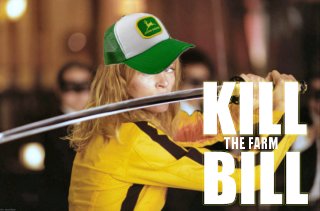
Kill the Farm Bill

Farm subsidies in the United States go to just a handful of crops, corn, wheat, cotton, soybeans, and rice.  Most fruits and vegetables are not subsidized, at least not directly but don't forget opportunity cost!

Killbill3_2 David Zetland has the dirt:

In this op/ed, a Minnesota farmer complains that he cannot increase production of garden crops by growing them on former-program crop land because these acres will lose their corn subsidy forever if non-program crops are grown on the land for a year.

Why? Because national fruit and vegetable growers based in California, Florida and Texas fear competition from regional producers like myself. Through their control of Congressional delegations from those states, they have been able to virtually monopolize the country’s fresh produce markets.

...In other words, it seems that non-program crop states have been willing to support continued subsidies for program crop states because they are facing less competition in return. Less competition, higher prices and more money. Voila!

Posted by Alex Tabarrok on March 5, 2008 at 08:13 AM in Economics | Permalink

Comments

Why is paying people not to play automatically suspect?

Posted by: michael webster at Mar 5, 2008 8:37:33 AM

Kill farm (and energy) subsidies.

We are rich enough and globally integrated enough that we will prosper.

Posted by: odograph at Mar 5, 2008 9:12:26 AM

BTW Michael, for $5 I will not participate in this thread.

Posted by: odograph at Mar 5, 2008 9:14:14 AM

Didn't New Zealand & Australia kill their ag subsidies in the 80s, and become more productive as a result?

Posted by: Independent George at Mar 5, 2008 9:15:48 AM

We know who the bootleggers are, but who are the baptists?

Posted by: josh at Mar 5, 2008 9:26:57 AM

"Why is paying people not to play automatically suspect?"

Because, all things held equal, "playing" would result in them producing more goods for everyone, making us all better off.

Also, while I know this has no doubt been harped on over and over, I can't help but repeating: subsidies for corn (and therefore corn syrup), wheat and rice make them more attractive to the consumer -- despite their relative (compared to many unsubsidized crops) unhealthiness.

Posted by: Brian Moore at Mar 5, 2008 9:29:38 AM

I wholeheartedly agree. Doing so would also have a very beneficial impact on third world economies, particularly in Africa by opening up a very large new market in which they could compete.

Posted by: Jeremiah at Mar 5, 2008 9:41:21 AM

I don't know if eliminating the subsidies are a good idea, but look at the increasing fruit prices, and the food pyramid, and the drink milk commercials. I do like the fact that the US produces high fructose corn oil which is found in almost everything as a substitute for sugar. But would the increased costs of buying sugar really be that bad for the cheap foods that abuse our corn subsidies??

Posted by: Brainwarped at Mar 5, 2008 9:49:03 AM

The cost of sugar would be half what it is if the bans on sugar importation were lifted. At the moment it's a $4 billion gift to the sugar industry at a cost of $8 billion in lost consumer surplus, the latter being probably larger since American sugar isn't a cost-effect substitute for corn syrup and the like

Posted by: Petrarch at Mar 5, 2008 10:23:07 AM

Corn growers have seen the writing on the wall regarding subsidies so they moved on to a more palatable one: ethanol production. To be against that is to be pro-pollution.

Posted by: BlogReader at Mar 5, 2008 10:25:57 AM

Did you know David Letterman gets subsidies?
http://farm.ewg.org/sites/farmbill2007/index.php
http://www.mulchblog.com/

Posted by: liberty at Mar 5, 2008 10:31:37 AM

Government payments to farmers go disproportionately to men. This is primarily because, surprisingly,
a higher proportion of women run livestock farms than run crop farms, while subsidies go almost solely to crop farms.

New York Times's example of a Minnesota farmer hindered growing garden crops on corn land seems stretched.
He's complaining about a government program,
but he wants the government program (transfer payments).

Would New York Times prefer changes in transfer payments to farmers; eg, a flat $30,000 to every farmer to lessen market distortion?
Or would he prefer the abolition of transfer payments to farmers?

Hopefully, government programs seek more to reduce "risk" than to profit farmers.
This is the "risk" from variability in weather and prices, the same risk hedge funds and other financial companies have measured because they could
(opposed to "risks" we've recently seen from bad stock companies or bad home loans which the financial community almost completely ignored in its hedges).

Minnesota has but 225,000 acres in vegetables,
while it has 6,556,000 acres in corn for grain, and 22,729,000 acres in cropland,
so vegetables represent but 1 percent of Minnesota's cropland acreage.
Only 2640 farmers out of 80,800 Minnesota farmers grow vegetables, so vegetable farmers represent but 4 percent of farmers.
The average farmer with corn plants 206 acres,
while the average vegetable farmer plants but 85 acres.
Surprise, half (139,000 acres) those vegetable acres are in sweet corn (not subsidized I presume), and most of the rest (69,000 acres in peas).
Your usual impression of vegetables are crops like
lettuce, carrots, beans.
The average farmer planting these vegetable crops has the following
Crop Mean-Acres Number-of-Farmers
lettuce 0.5 12
carrots 30.3 59
beans 17.0 287
Almost always, only a few acres are involved, and only a very small proportion of farmers grow vegetables in cool Minnesota.

Many things in markets appear odd; like the best fruits going from Florida to northern states, because those states already pay transportation, so they will pay a small proportion more for better fruits.

Suppose government changes its program so any farmer can enter the subsidy program in any year. Then any year that appears to give poor prices on all crops, the farmer will declare himself a corn farm and collect subsidies. This becomes like the health care program letting suddenly sick people start health insurance at the same rate as everyone else. The world is full of inconsistencies: try making invariant estimates with an invariant loss function so you get the same answer whether measured in centimeters or inches -- you must use a right invariant Harr measure (what, you say).

Posted by: restrain_oligopolies at Mar 5, 2008 10:37:46 AM

In regards to New Zealand getting off of the subsidy fix, here is a link supporting that position http://boomtownusa.blogspot.com/2007_02_01_archive.html. Here is a more scholarly approach www.debate-central.org/file_download/66
So it can work for first world countries.

This is from David Dollar (great name) of the World Bank at http://discuss.worldbank.org/content/interview/detail/674/

" Gillian Virata:
So many knowledgeable individuals have written and said so much about having to eliminate agricultural subsidies to help the poorest of the poor. Shouldn't more be done for this knowledge to filter down to NGOs, consumers, and other groups to generate the public outcry against the subsidies that has been so sorely lacking?

David Dollar:
I very much welcome your point about the need to rally NGOs, consumers, and other groups to bring down agricultural subsidies of rich countries. This would create more trading opportunities for poor countries and raise the incomes of their farmers. I fear that the anti-globalization movement has created the false impression in rich countries that trade is a bad thing for poor countries and poor people so that it is harder to rally groups to support efforts that make it easier for poor countries to trade. Activists who care about the poor in the developing world should be trying to make it easier - not harder - for them to access US and other rich markets."
This paper from the North-South Institute would also agree.
http://www.nsi-ins.ca/english/pdf/FDI_policy_brief.pdf
so it would seem to work well for third world countries if the first world gave up its subsidies.

As for being against ethanol is being for pollution, I have to disagree. There are some links here http://briandrpm.blogspot.com/2008/02/biofuels-arguably-worse-than-gasoline.html that argue that is is more complicated than that especially the Economist article.

Posted by: BrianDRPM at Mar 5, 2008 11:02:52 AM

This poor farmer. I guess the $90 billion in subsidies and below-cost provision of water for irrigation is not enough for him. He want's more money to grow vegetables. If not we're going to pay five cents more for an apple. Maybe it's not about fear of competion. Maybe it's more about, 'You got enough welfare so grow what you say you're gonna grow'. Come on let's talk about a real story.

Posted by: dag at Mar 5, 2008 11:17:25 AM

capitalism for thee, socialism for me.

Always the same story, from the biggest IBs down to the humble farmer.

Posted by: mickslam at Mar 5, 2008 11:20:08 AM

...non-program crop states have been willing to support continued subsidies for program crop states because they are facing less competition in return.

That's ingenious! I knew there had to be a reason why Big Veg wasn't getting subsidies (though rest assured they're still angling for trade protection!).

See the latest accomplishment of the ongoing series NAFTA: Protecting Free Trade through Trade Protection!
ia.ita.doc.gov/tomato/2008-agreement/2008-agreement.html

Posted by: Garrett Schmitt at Mar 5, 2008 11:31:42 AM

I thought evidence was tipping that ethanol did not reduce pollution (a quick surf seems to confirm this).

Posted by: odograph at Mar 5, 2008 11:37:17 AM

Students of political economy may be interested in the following fine print of farm subsidy legislation.

If in fact political forces succeeded in killing the 2007 (now 2008) farm bill, and also succeed in killing an extension of the 2002 farm bill, the provisions of the 1949 "Permanent" legislation would again be in effect. For example, the milk support price ($9.90 under the 2002 law) would increase to at least $28 (the 1949 legislation requires that the milk price support level be at 75-90% of the parity price, currently at over $37.)

Here's a Congressional Research Service report on this. http://www.nationalaglawcenter.org/assets/crs/RL34154.pdf

Posted by: howard at Mar 5, 2008 1:01:14 PM

Alex -- thanks for the plug. A few comments:
@brainwarped -- Petrarch is right

@josh -- baptists are the big brands in CA, FL that sell salad mix, carrots, "California raisins" , happy cows, etc. They are claiming that a little sunshine is in every can and package and will make your miserable midwestern life better /sarcasm

@dag -- the farmer is NOT asking for subsidies. He is asking for freedom to farm (the real type, not the congressional type)

@restrain oligopolies -- 1) he was not asking for subsidies. 2) NYT has no position -- it was the farmer's op/ed. 3) flat subsidies to farmers are not going to work and much of your data may be suspect because USDA does not sample small farms very well. 4) I disagree that the current cropping pattern is the result of nature -- government programs cause HEAVY distortions -- mostly through trade barriers, not subsidies (cf, sugar)

Posted by: David Zetland at Mar 5, 2008 2:46:39 PM

If his wife's name is Julia Hedin then he recieves subsidies every year. The fact that he is complaining about not being able to expand his opperation by 25% without paying penalties implies that he wants more breaks. These guys on average get paid back $1.75 per dollar spent. I will not feel sorry for them.

http://farm.ewg.org/sites/farmbill2007/s1614_addrsearch.php?yr=S1614&s=yup&stab=MN&city=&zip=&last=HEDIN&first=&i=Search+Beneficiaries&fullname=

Posted by: dag at Mar 5, 2008 3:54:22 PM

You would be able to save a few bucks each if subsidies were eliminated.Each farmer will lost thousans perhaps millions.You are 330 millions, they are how much? 10.000? So subsidies wont be eliminated soon

Posted by: karl at Mar 5, 2008 4:28:24 PM

I asked my students in Iowa if we should end subsidies for ethanol and corn syrup. Their response? But my family's farm will go out of business!

As long as that's the prevailing view in farm country, the Farm Bill will continue to be unkillable.

Posted by: Jams Hanley at Mar 5, 2008 4:37:52 PM

California farmers pay a lower price for subsidized water.

Posted by: Richard A. at Mar 5, 2008 6:02:43 PM

I think President Bush was right to try the means-test as a way around the emotional connection to "small family farms" ... but that failed didn't it?

Posted by: odograph at Mar 5, 2008 8:40:10 PM

@Richard A, Farmers on the FEDERAL Central Valley Project pay about 20% of the cost of water. Farmers getting FEDERAL water from the Colorado river MAKE money from water (since they get hydropower revenue). Farmers who get water from the STATE water project pay cost of transport and infrastructure but no opportunity cost. They are still paying 10x what farmers on the federal teat are getting.

If you want to end subsides on water, go to DC (I happen to be here now, but nobody from the Bureau of Reclamation is listening to me shouting :)

Posted by: David Zetland at Mar 5, 2008 8:58:13 PM

Independant George, BrianDRPM:

I can't speak for Australia, but its true that New Zealand has no farm subsidies, and hasn't has since the '80s.

Since we have plenty of land we also don't rely on intensive farming, using corn as feed, ar anyhwere near as much nitrate fertilizer either, so liberalising agricultural trade would be good for the environment as well.

Posted by: James K at Mar 5, 2008 11:54:09 PM

We know who the bootleggers are, but who are the baptists?

Posted by: エッチ at Mar 6, 2008 2:05:36 AM

For more detail on the NZ 'cold turkey' approach to removing agricultural subsidies, the following link give a good, concise summary in the form of a speech by the NZ ambassador to Korea.
http://www.nzembassy.com/info.cfm?c=8&l=39&CFID=502&CFTOKEN=99681217&s=go&p=62795

Sorry, the link isn't so concise.

The impacts of reform are spelled out in much more detail by the NZ Ministry of Agriculture here:

http://nzfsa.org/mafnet/rural-nz/profitability-and-economics/structural-change/reform-of-nz-agriculture/httoc.htm

It needs to be pointed out that the reforms were carried out in response to an economic and (to a lesser extent) political crisis. Under other circumstances, they couldn't have been as sweeping or as rapid.

And they really have worked. As the leader of NZ's main farmer lobby group is fond of saying "Its hard to stand tall with your hand out."

Posted by: 40 degrees south at Mar 6, 2008 4:51:55 AM

Baptists and bootleggers--

Farm bills include not only subsidies for farmers, but also the food stamp program and nutritional programs in the schools. These programs represent the majority of the farm bill expenditures.

In Congress, therefore, farm state legislators vote for subsidies for farmer constituents, big-city legislators support those programs to get more food stamp and nutritional programs for their inner-city poor.

Posted by: Francesca at Mar 6, 2008 1:06:02 PM

I don't raise vegetables and think the requirement that the farmer lose his grain subsidies if he wants to raise vegetable is a very good thing.

If this provision was not in place vagaries and changes in the farm bill would have a great ability to destroy the economics vegetable production. And vegetable production is not government subsidized.

An example of how this works was seen in feed grain programs when the government required a certain amount of the crop be destroyed to receive program benefits.

The farmers destroyed their crops by baling them into hay. Then they sold this hay into the non - subsidized hay market.

The glut of hay caused by the farm program requirement to destroy feed grains wrecked the hay market.

If the captioned requirement was not in place vegetable producers would face the same risk.

Posted by: TJIT at Mar 8, 2008 2:56:08 PM

A lot of our country's subsidized corn goes to a few rich people in Guatemala. They transform the corn into worthless chips and other nutritionless snacks that are bagged in non-degradable plastic and are purchased by the poorest of the children in Guatemala. This situation is causing bad health, bad eating habits, and worst of all, resentment against America.
We Americans must start changing our thirst for huge meals, and must controlled our, apparently, never ending desire of having things.
I have a small farm in Guatemala which is open to all poor people who need land to cultivate their corn for their own families. We get no subsidies. Many families want to cultivate but do not have even the minimum to purchase seeds, etc.
We must begin to recognize our responsibility with the entire world WE ARE NOT THE CENTER OF THE WORLD. We must stop being so arrogant.
Our government seems to be blind to this fact.
guatemalanproject@netzero.net

Posted by: Cecilia Campoverde at Apr 16, 2008 10:47:54 PM

While there are alot of problems with different versions of the Farm Bill, it is important that we have one, especially one that supports conservation.

Posted by: Andrew at May 2, 2008 11:04:18 AM

The reason that vegetable growers don't get subsidies is that vegetables are perishable. The Farm Bill was organized to make sure that we can feed our military in times of war. The subsides are paid so that the land can be used to grow non-perishable food in case our surplus runs down. The thing about food is that non-perishable will still spoil after a certain amount of time, so our reserves must be "rotated" just as the stock in restaurants are rotated to assure freshness. When a farmer takes his land out of the commodities program, that land is not safeguarding the implied growing capacity that the farmer is being paid for, so he should not expect to continue to receive payments.
The issue should not be to eliminate subsidies by ending the Farm Bill, instead the focus should be on supporting programs which encourage environmental stewardship,conservation, revitalization of rural communities, hunger issues associated with poverty in our own country, improvement of nutrition for all americans( and ultimately all people), and recreating local "food sheds" and local food economies. The subsides must be in place, we can't stop cold turkey. We need to support farmers, the people, not industrial farming But, there are vital programs which focus on the issues which I mentioned that exist within the Farm Bill; many of these programs will not have funding if we do not pass a new Farm Bill. Don't Kill the Bill, Fill the Bill (with sustainable agriculture programs that have mandatory funding.)

Posted by: Sandra Corlett at May 2, 2008 6:36:35 PM


The Farm Bill has ended up being a joke. The obscene welfare going to farmers
directly is still happening and going to some of the richest "farmers" in the
world. I am working right now on a farm that has gas wells all around it. The
well I am on now is a reworked well that is making about 70 thousand dollars a
day in gas production with a lot of older wells around. The farm is primarily
cotton and I am sure the family who owns the farm (they have other people farming
it and most of them live in the really really nice part of town) are getting
cotton subsidies on the 2300 acres under production.

I noticed the conferenced farm bill has passed the Senate and the House.
Subsidies were left in but the justice was left out. The senate version of the
farm bill had contract reforms that addressed some of the abuses of the largest
companies against farmers. In the conference bill, those protections were given
to GIPSA (Grain Inspection Packers and Stockyards Administration) to write up and
enforce. The whole reason they were in the Senate version was that GIPSA was not
even coming close to enforcing the law and an OIG investigation was so damning to
the administration that JoAnn Waterfield left as head and is nowhere to be found.
The OIG investigation documented GIPSA's fraud to Congress but from my
perspective of being in the middle of it, let them off the hook, hence the Senate
version of Title 10.

Now the same responsibilities that were always with GIPSA have been given to them
again in the Farm Bill instead of being enacted into law. If they couldn't do
anything but protect the big boys like Tyson in the first place, why give them
the same responsibility again?

The worst thing is that the "reforms" again are put in the hands of the
agriculture committees so that they again can take contributions from Tyson and
the other poultry companies to do absolutely nothing that makes any difference at
all. This is happening as the Senators and Congressmen spend countless minutes
in front of C-Span about how good the job is that they have done. My friend in
the business who testified in front of Congress committed suicide. Others have
tried it that I know of. For what? All so Tyson et al can have a few billion
more by stealing the value from farmers? So much for being president of the TN
Poultry Grower's Association and trying to fight for fairness for my fellow
farmers. Their cause is lost as long as legislators and the administration are
taking payoffs from the industry. Money is the root of all evil and it has deep
roots in the agriculture industry.

In my own case against Tyson, the same U.S. attorney that was put in charge of
the illegal alien case that was dismissed against Tyson was promoted to be a
federal judge. Guess who got my case? The same judge, Judge Mattice. In
addition, Tyson hired his old law firm that he was a partner in to represent
them. Mattice dismissed my case with prejudice against me so Tyson's attorneys
could threaten me with having to pay their legal fees. I am in this cotton
fields in a different state trying to make my farm payments (I did receive a new
farmer loan from the FSA) and not put my family through bankruptcy. I have been
home twice in the last nine months for ten days each. That doesn't help raise my
7 year old, my 14 year old and my 15 year old. So much for family values in our
nation. So much for the family farm.

This farm bill was nothing but a political payoff bill. Can't we even ask
Congress to act like statesmen once every five years for real family farmers?
Can't we ask of the justice system a fair shake in our cases? Can't we ask for
real repercussions for regulatory agencies who are representing thosw who they
are supposed to regulate?

Congress patting themselves on the back for this farm bill shows that we have
more than the president's administration that is the problem. The rule of law is
gone except in the perception of minds who will be deceived by politicians who
like to praise themselves and their colleagues while leaving the avenues of

Posted by: Tom at May 15, 2008 8:26:13 PM

This farmer wants to plant vegetables, then he should plant vegetables. No law forbids him from raising his high priced organic stuff. Go ahead and plant.

Only in America does someone complain about the government and that subsidies are a bad thing, but then wants a government subsidy check anyway. Isn't that what this famer wants, a subsidy check for his veggies? As my farmer father used to say "these people hate the government but love the brown envelopes" (before direct deposit farmers got the check directly in brown envelopes). The lost subsidy couldn't be much anyway. Last year I had 85 acres planted in corn, got a 'huge' subsidy payment of 448$. Woooppeeeee!! I'm rich! This guy implies he is out over 8,000$. No way my friends... Just plain No-way.

Just some facts: the cost of subsidies from the 2008 farm bill are 8.1 billion/year (14% of 290 Billion over 5 years)
39 Billion/year goes for feeding the poor (67% of 290 Billion over 5 years).

Posted by: sven2sven at May 18, 2008 8:25:15 PM

Post a comment