« Does the quality of blog comments deteriorate? | Main | Hansonian Normality »
What Credit Crunch?
Paul Krugman points to the new Federal Reserve senior loan officer survey which reports that standards for commercial real estate loans are tightening creating in Krugman's words "an incredible credit crunch in progress."
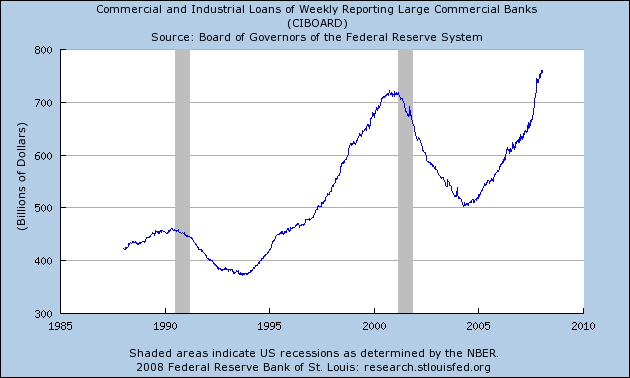
Over at Carpe Diem, however, Mark Perry looks to Federal Reserve data on actual loans and finds that commercial loans from large banks are at an all time high and increasing rapidly.
The credit crunch, if that is what one should call higher standards, appears to be contained to the real estate market.
Posted by Alex Tabarrok on February 5, 2008 at 08:18 AM in Economics | Permalink
Comments
I can see how loan officers would say "oh sure, we're tightening." And at first sight I believed the Fed report. Maybe the Fed's report is a little more forward looking ... future intent.
Is there any way to measure this from the customer side? How would we know what small and medium business feel about their credit lines?
Posted by: odograph at Feb 5, 2008 8:41:55 AM
Alex,
Can we even be sure we're in a credit crunch in the real estate market?
According to Fed data, the value of real estate loans by all commercial banks has continued to increase at relatively the same pace as 2005 and early 2006.
http://research.stlouisfed.org/fred2/series/REALLN?cid=100
But I am puzzled. Why have real estate loans continued to grow while private residential investment has plumeted? Your thoughts would be greatly appreciated.
Posted by: Student at Feb 5, 2008 9:00:38 AM
Alex,
Shouldn't some of that commercial loan growth be involuntary lending by the banks to customers drawing down preexisting lines of credit when the capital markets shut down? Note the huge spike right after the credit crunch began in the summer.
nocountry
Posted by: nocountry at Feb 5, 2008 9:36:26 AM
If businesses that were previously able to issue commercial paper are now having to rely on existing bank lines of credit due to the collapse of the commercial paper market, would this not show up as an increase in bank loans, notwithstanding an overall decrease in available credit?
Posted by: MAS at Feb 5, 2008 9:37:26 AM
Finally a subject on this marvelous site that I know something about; two jobs ago I was the Senior Lending Officer of a community bank in suburban Maryland and completed the Senior Lender’s survey quarterly and in my last job one of my responsibilities was analyzing it to assess market conditions for my non-bank small business real estate lender employer.
Student—loans outstanding continue to grow because banks have commitments outstanding for fundings that they are contractually obligated to fund. The “cycle time” for loan origination is typically months for initial contact, underwriting, approval and closing. Additionally, and especially for real estate construction loans, the funding time can be years for a project. And, if the borrower gets in trouble the bank will continue to fund the loan because a completed empty building/house/condo is easier to sell in liquidation than a half-built building/house/condo. Which is why you still see so much residential construction going on in markets with no demand.
I consider loan funding data to be a lagging indicator because conditions may change but banks are still funding last year’s, or even two or three years ago’s, commitments.
The market for all real estate loans is in the toilet, especially construction, which today is most of the real estate market that banks originate for portfolio. Longer term commercial mortgage loans are quickly securitized and competition from non-bank originator sources is tremendous and cut throat. If a borrower is willing to pay the risk premiums over treasuries demanded today they’ll have no problem finding money from a number of sources if the deal passes underwriting.
While I have no data to back this up I know from discussions with former colleagues that bank money is available almost everywhere for small, medium and large business loans. Pricing and underwriting discipline have returned to the market and the excesses the market saw in 2003-2005 (e.g., no cash flow underwriting “stated income” loans are gone, as are ridiculously high collateral advance rates or high cash flow multiple business valuations) are gone. Business borrowers with reasonably strong balance sheets, positive cash flows, good management and expectations for continuation can find money. But the spreads over Prime, LIBOR, or whatever rate index is being used, are now much higher.
Dr. Krugman is letting his politics, yet again, influence his analysis.
Posted by: Dave Richardson at Feb 5, 2008 9:40:06 AM
Credit is most certainly available to viable businesses. All that is required is salable collateral, or strong financial guaranties by an individual, or extremely favorable returns with strenuous monitoring constraints. If you’ve got one or more of these, you’re in business.
P.S. read Dave Richardson’s post if you want to understand actual commercial lending. Well done Dave.
Posted by: Chicagoan at Feb 5, 2008 10:41:42 AM
Krugman is charting commercial real estate loans, Perry is charting commercial and industrial loans. Papayas to bananas. No country and MAS are on the right track.
Posted by: wendii at Feb 5, 2008 10:56:28 AM
So Paul is taking one type of loans, extrapolating to all loans, and Perry has exposed him. Trying to pretend that papayas are bananas? Paul should be ashamed of himself, but he has been beyond shame for a long time.
Posted by: Rich Berger at Feb 5, 2008 11:25:43 AM
Krugman is not even charting loans. What he is charting is the percentage of loan officers who say standards for real estate loans have "tightened."
Posted by: Alex Tabarrok at Feb 5, 2008 11:30:35 AM
Why the hell does anyone treat guy like a serious economist anymore? Sure, I can understand that the readers of his column are too stupid to understand that he's spewing nonsense, but what about the community of economists? Can someone like Alex answer this? If this dude was a biologist he'd be laughed off the scene for showing such sloppy standards of reasoning.
Posted by: Erik at Feb 5, 2008 11:54:19 AM
Alex,
nocountry and MAS are correct. C&I loans by banks rose because of the liquidity needs that resulted from the collapse in credit markets, in particular asset-backed commercial paper. ABCP and their veihcles, the notorious SIVs, have special provisions to ensure the support of a bank credit line in case market liquidity should dry up, as it was the case in the summer. These arrangements are known as "liquidity back-stops". Here a good primer on the structure of these financial instruments:
http://pages.stern.nyu.edu/~igiddy/ABS/fitchabcp.pdf
The risk is that, as banks face increasing obligations to meet the liquidity needs by SIVs to support ABCP and other asset-backed securities, their balance sheets will come under pressure, and credit to other borrowers will be curtailed.
Adolfo
Posted by: Adolfo at Feb 5, 2008 11:55:56 AM
Krugman is not even charting loans. I stand corrected. But Krugman and Perry are comparing different subsets of total loans and leases at commercial banks.
The asset back commercial paper market (ABCP) froze (no rollovers) in August and commercial banks were forced to lend to its customers based on its contractually obligated back up facilities and guarantees. The ABCP market became unfrozen in January and commercial and industrial loans are relatively flat thus far in 2008. ($756.7 billion on 12/26/07;$757.4 billion on 01/23/08)
Posted by: wendii at Feb 5, 2008 12:04:06 PM
You know, I found the same Federal Reserve Report by a different path, even before the Krugman post. Is that why I see it less "Pauls?"
"Banks are raising their credit standards for mortgages, consumer loans and commercial real estate loans at a pace never seen in the 17-year history of the Fed's quarterly survey of senior bank loan officers, the Fed said."
What the "Fed said" struck me as significant in itself.
(I see that the MarketWatch article is dated 2 hours earlier than the Krugman post. Heck, when I blogged the MarketWatch story maybe I beat Krugman.)
Posted by: odograph at Feb 5, 2008 12:27:59 PM
I should have quoted one more line from MarketWatch:
Plain-vanilla business loans were also much harder to obtain, the Fed said.
Posted by: odograph at Feb 5, 2008 12:31:05 PM
Unless tightened credit in real estate is offset by looser credit elsewhere, then, yes, it is a credit crunch, even if it is only returning to where it should have been all along.
Posted by: Lord at Feb 5, 2008 12:33:27 PM
You should normalize this data by looking at it as a percent of nominal gdp or personal income or something like that.
Loans at roughly the same level as they were 7 years ago is not exactly an expansionary or aggressive norm.
Posted by: spencer at Feb 5, 2008 2:28:20 PM
1) I do not have the data in front of me, but residential refinancings have not gone up dramatically despite the number of applications that have. This means that borrowers are putting in more applications because the probability of getting rejected has gone up.
2) Rates on Jumbo loans have gone up by at least 75 bps and these are for high income earners with good FICO scores. This would be helped by the proposal in Congress to temporarily raise the conforming limit to ~$600K.
3) LIBOR delinked with Fed Funds temporarily and actually increased when the Fed was cutting. It did eventually relink, but has risen 7 bps in the last two days. For those of you who didn't know it, a huge amount of corporate loans are pegged to LIBOR.
Posted by: Patinator at Feb 5, 2008 2:56:52 PM
Real C&I loans are a component of the lagging index and according to that data in December real C&I loans were $777,116 M (2000 $) as compared to a peak of $1,030,615 m (2000 $) in 2000.
This is a level about 25% below the 2000 peak.
Moreover, the growth of real C&I loans peaked in September at 18% and by December it has fallen to 11% -- in Nov & Dec the annualized growth rate was 3.6% and 6.1%, respectively. In each of the six months leading up to Sept. the annual growth rate was in double digits.
You are misreading the C&I data. It really supports Krugmans position.
Posted by: spencer at Feb 5, 2008 2:58:52 PM
The other factor to consider in looking at this data is what is happening in other markets.
The bond market has been closed to many poorer credits. As a consequence these poor credits are drawing on long established bank credit lines that the banks have a legal obligation to fulfill.
That happens to a certain extent every cycle, but it is bigger than normal this cycle. Typically at or around cyclical peaks this type of behavior inflates C&I loans. That is why C&I loans are considered to be a lagging not leading indicator.
Posted by: spencer at Feb 5, 2008 3:22:39 PM
Adolfo's point is valid, and there will be relatively less capital to deploy. However, I think he would agree that banks are likely to allocate capital in "silos" based on each industry and its correlated defaults (at least at the big shops). I maintain that appropriately priced and structured credit is still very available.
Posted by: Chicagoan at Feb 5, 2008 3:50:55 PM
Spencer-
What you said would make sense if Mr. K had been complaining about a credit crunch in 2001-2003. Seems like most of the drop was a consequence of the sluggish economy then, from which we have recovered smartly. Comparing current loan volume to 2000 just before the recession is - dare I say - Krugmanesque.
It is amusing to watch little Paul toss out his poorly thought out posts and leave his admirers to provide justification ex post facto.
Posted by: Rich Berger at Feb 5, 2008 4:30:47 PM
NO RICH -- Comparing credit demands now in real terms shows how the sources of credit in the economy have changed this cycle. In the old days banks loans were the dominant source of business credit. But over the cycles firms have developed methods of directly taping credit markets so bank lending does not play as nearly an important role in providing business credit now as it use to. That is why real C&I loans are now much smaller then they were in 2001.
Your argument sounds like what you would get from someone whose knowledge of credit markets stems from a 20 year old money and banking text book.
Posted by: spencer at Feb 5, 2008 4:52:20 PM
Well Spencer, I don't think I need a 20-year old book to see flaws in your arguments. In one post you claim that C&I loans are 25% below their 2000 peak (in constant dollars), supposedly supporting PK's argument. But then you say:
"NO RICH -- Comparing credit demands now in real terms shows how the sources of credit in the economy have changed this cycle. In the old days banks loans were the dominant source of business credit. But over the cycles firms have developed methods of directly taping credit markets so bank lending does not play as nearly an important role in providing business credit now as it use to. That is why real C&I loans are now much smaller then they were in 2001."
Your second post seems to undercut the earlier one. How do you reconcile the two?
Posted by: Rich Berger at Feb 5, 2008 5:25:30 PM
The current "recession" is more like a correction. It makes for good headlines but there isn't much substance to it, in my opinion. See more on my blog about this at http://moretruth.wordpress.com/2008/02/04/you-are-bankrupting-your-children/ and http://moretruth.wordpress.com/2008/02/05/inconvenient-links-for-february-5-2008/.
Posted by: A More Inconvenient Truth at Feb 5, 2008 6:32:20 PM
the two are perfectly compatible. Overall C&I loans are much less important then they use to be. But in the middle of 2007 when other sources of credit dried up firms returned to the banks and we saw a pop in C&I loans. but towards the end of the year this short run pop also faded.
What was supporting PK's argument was that it was just a minor pop in the middle of the year.
You will have to better then this.
Posted by: spencer at Feb 6, 2008 8:53:12 AM
