« Naughty tourism | Main | Payday loans »
Library of Lost Dreams
Dutch, a kind of archaelogist of recent America, takes us through the abandoned Detroit School Book Depository.
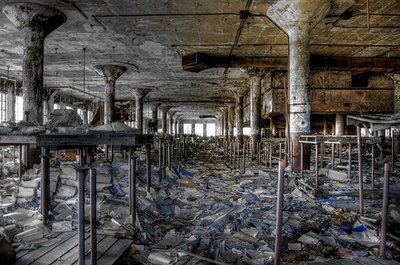
This is a building where our deeply-troubled public school system once stored its supplies, and then one day apparently walked away from it all, allowing everything to go to waste. The interior has been ravaged by fires and the supplies that haven't burned have been subjected to 20 years of Michigan weather. To walk around this building transcends the sort of typical ruin-fetishism and "sadness" some get from a beautiful abandoned building. This city's school district is so impoverished that students are not allowed to take their textbooks home to do homework, and many of its administrators are so corrupt that every few months the newspapers have a field day with their scandals, sweetheart-deals, and expensive trips made at the expense of a population of children who can no longer rely on a public education to help lift them from the cycle of violence and poverty that has made Detroit the most dangerous city in America. To walk through this ruin, more than any other, I think, is to obliquely experience the real tragedy of this city; not some sentimental tragedy of brick and plaster, but one of people.
Pallet after pallet of mid-1980s Houghton-Mifflin textbooks, still unwrapped in their original packaging, seem more telling of our failures than any vacant edifice. The floor is littered with flash cards, workbooks, art paper, pencils, scissors, maps, deflated footballs and frozen tennis balls, reel-to-reel tapes. Almost anything you can think of used in the education of a child during the 1980s is there, much of it charred or rotted beyond recognition. Mushrooms thrive in the damp ashes of workbooks. Ailanthus altissima, the "ghetto palm" grows in a soil made by thousands of books that have burned, and in the pulp of rotted English Textbooks. Everything of any real value has been looted. All that's left is an overwhelming sense of knowledge unlearned and untapped potential.
More pictures here.
Posted by Alex Tabarrok on February 22, 2008 at 07:44 AM in Economics, Education, Film | Permalink
Comments
pretty interesting. too sad. the chi trib ran a front page a year or so ago that talked about how parts of detroit are are being farmed now. urban land returning to ag use.
Posted by: oops at Feb 22, 2008 8:18:59 AM
Better than urban renewal.
Posted by: Ed Lopez at Feb 22, 2008 8:32:03 AM
This city's school district is so impoverished
According to Schoolmatters, the detroit school district spends $13,529 per student in 2005. This is about 30% more than the state average.
Impoverished, perhaps. But not for lack of money.
Posted by: KDeRosa at Feb 22, 2008 8:34:27 AM
KDeRosa: And that's not even considering the fact that the budget has swelled since then while enrollment continues to fall... just to hazard a logical guess, DPS' per student budget is closer to $17,000-$18,000 per pupil now (I've heard numbers like a $1.6 billion budget with 90,000 students).
Talk about a lot of money disappearing into a soul-crushing bureaucracy. The rural Michigan district I went to years back receives about $7,000 per pupil, and the school's rate of Michigan Merit Scholarship recipients exceeds DPS' graduation rate by an amount that borders on the obscene.
Yet they talk about raising DPS' funding while cutting my hometown school's funding level. Tell me how this makes sense.
Posted by: Michael Fisk at Feb 22, 2008 8:39:45 AM
Because throwing money at the problem is the only thing they know how to successfully do. At least until the music finally stops.
Posted by: KDeRosa at Feb 22, 2008 8:48:05 AM
Honest question for those on the right and left, but what is stopping state and local governments from instituting mandates as to how the school's budget is spent? Leaving the spending decisions up to the school boards in many of these cities looks like a recipe for disaster and waste. 13,000 dollars per pupil per year and they dont have the best secondary education in the country? That is disturbing, whether the anti-market folks want to admit it or not the market schools can beat that every day of the week cost and performance wise.
Posted by: john pertz at Feb 22, 2008 9:04:27 AM
Detroit is full of interesting urban ruins. Here are some sites:
http://www.detroitblog.org/
http://www.detroityes.com/toc.htm
http://www.forgottendetroit.com/index.html
Actually, it's hard to imagine a more wretched urban landscape - Berlin in 1945 probably looked better. Detroit has lost about half of its population and a greater percentage of its tax base. The only people left are those who can't escape. Except for a few (heavily subsidized) bright spots like the new stadiums and, of course, the casinos, most of Detroit is a vast urban wasteland. The auto industry is moribund, the government, led by a truly outstanding mayor, totally corrupt, the schools controlled by greedy unions and incompetent bureaucrats. None of this is a surprise to anyone who lives in Michigan.
Posted by: Ned at Feb 22, 2008 9:19:14 AM
hi, author of the original piece here.
I have learned quite a bit about what happened to the book depository since I wrote that personal-essay-style piece.
It is now my understanding that during the 1980s, a fire ravaged the top two floors of the depository. Some supplies were saved, but many more were severely damaged by the fire. I have been informed that under the insurance settlement, the smoke-damaged items inside were not even allowed to be saved for re-use. The school district subsequently sold the building in its entirety to Matty Moroun, who is hardly unique in detroit for his ability to allow personal avarice to get in the way of the preservation of anything with historical or architectural value, but he is really the one responsible for the waste and current dilapidated condition of the building and its contents. Moroun owns the Ambassador Bridge, the only privately-owned US-Canada border crossing. You can read much more about him here:
www.forbes.com/forbes/2004/1115/134_2.html
In addition to the book depository and the bridge, Moroun owns the old beaux-arts train station across the street that is being ripped apart by architectural scavengers and graffiti taggers because of his complete lack of security. Both the train station and book depository have had gaping holes in their fences for months. He doesn't even bother to board up the train station.
Moroun's interest in these buildings is assumed to be the land they sit on: they lie in close proximity to his bridge to canada and there is some speculation that he wants to use the land for some kind of post-crossing trucking facility. their proximity to the train tracks and the train tunnel to canada are also in his interests and he could truly care less if anything happens to these architectural masterpieces or their contents.
Moroun is the one who has allowed these buildings to end up like this, and Moroun is a free-market capitalist if ever there has been one. I would warn you to be careful blaming the public schools or using this building and its contents as some kind of indictment of the schools. Not that there aren't a million other ways to go after the detroit public schools, my sources say that this is not the best one (though, no doubt, it packs a certain visual punch). In other words, the free market capitalist is the bad guy here, not the bloated and disgraced public school system.
Posted by: jdg at Feb 22, 2008 9:27:59 AM
The public education monopoly is one of the last Soviet-style bureacracies in existence in the world. Lenin is smiling.
Posted by: jorod at Feb 22, 2008 9:43:19 AM
Ah, propaganda for the libertarian claque.
Never mind all the capitalist collapse in Detroit: privately owned abandoned buildings, the collapsing auto industry, etc. Never mind that the tax base is collapsing, causing extraordinary budget tightness. There can be no flaw in capitalism: quick, look away, there's a picture of a government problem. Don't ask if there might be a reasonable explanation: that might destroy the illusion that government is always and in all ways wrong.
Don't ask whether the Detroit students are different than those in a rural district and might need more expensive services. Focus only on dollar numbers stripped of context. Don't ask if our tradition of local funding of schools provides enough resources for inner city schools. No private school has ever had to cope with an entire inner city population: they can always pick and choose for better students that are cheaper to educate. But that shouldn't stop libertarians from making invalid comparisons.
The drumbeat of libertarian confirmation bias goes on and on in this blog.
Posted by: Mike Huben at Feb 22, 2008 9:43:30 AM
Ah yes, let's avert our eyes from the school disaster and find some "capitalists" to blame.
Posted by: Rich Berger at Feb 22, 2008 10:00:00 AM
As the original author states. The waste depicted here is of a privately owned building. It was sold to a private party after fire destroyed its top two floors. This is no basis for claiming that the public school system is at fault.
The comments on this blog remind me of the outcry against Arabs and radical muslims after the Oklahoma City bombing--it may be a problem, but it has nothing to do with the problem at hand.
Posted by: MostlyAPragmatist at Feb 22, 2008 10:09:36 AM
And Mr. Huben (who, from his rhetoric, gives the impression of being a public school teacher... not that there's anything wrong with it, it just tends to color the argument a bit) seems to so conveniently ignore about how little "capitalism" was going on in the auto industry, which sold its soul to Satan (er, the UAW) a long time ago. Hard to do business when the workers threaten to walk out every few seconds unless they get higher pay and better benefits. Also conveniently forgetting about the abandoning of private buildings largely due to issues of blight due to the city's infrastructure and safety being so bad. No, wait... "bad" is being way too nice to describe what happened there.
And as to the argument about the Detroit students needing more "special services": Keep in mind the rural districts pay far more in student transportation costs, and have, in many cases, absolutely unheard-of levels of economically disadvantaged students (sometimes as many as two-thirds of the students being enrolled in reduced-price or free school breakfast and lunch programs). Unemployment rates in some of the northern counties in Michigan (in particular Manistee, Benzie, and Lake) make Detroit look like an economic paradise in comparison.
The difference between libertarian theoretical visions and statist theoretical visions are that the latter have been attempted and failed, leaving the libertarians with no real-world success, but, at the same time, no blame for the failures of the past when government is seen as the panacea to society's ills.
Posted by: Michael Fisk at Feb 22, 2008 10:12:21 AM
As the original author points out, the building was sold to a private party after the fire, and its present condition is the result of his not really caring about the structure. Indeed, he almost certainly purchased it solely for the land on which it sits. Even though I have little respect for the management competence of most government agencies, I found it nearly impossible to believe that Detroit still owned this building- government agencies neglect maintenence all the time, but I have never seen an example this bad in the United States.
With that said, I would like to reply to Mike Huben: Detroit's problems are a direct result of governmental incompetence over a period of 50 years. We know this because there are many, many thriving American cities that are better governed by any objective criteria you wish to use. Capitalists do business were they are allowed to do so- if they have abandoned Detroit, it is because they were not allowed to do business there, and once they leave, it is nearly impossible to get them to come back. I think Detroit has probably reached a point of no return.
Posted by: Yancey Ward at Feb 22, 2008 10:37:22 AM
As I was reading this impulsive post, I kept wondering how public outcry never reached a crescendo over this state of the building. When the original author revealed it was actually private property, it all made sense.
Even a poorly informed public wouldn't put up with stuff like that except in the face of serious social collapse. A city, when it is not corrupt, the people are informed (not lied to by politicians and their think tanks) and active in their own affairs, prevents public affairs from deteriorating to that degree. Unfortunately, the shift in economic rhetoric from responsible public affairs to unregulated private affairs has led to our current systemic crisis and economic deterioration.
Posted by: ideogenetic at Feb 22, 2008 10:48:23 AM
Right. Because we know school districts would never engage in this kind of wastefulness.
Here's a charming example of waste from Kansas City:
Warehouses filled up with equipment that schools had ordered but later decided they didn't want. One school ordered light fixtures that cost $700 apiece. Principals of some schools ordered replacements for desks and light fixtures that were in perfectly good condition. ... The district spent $40,000 for a display case for a high school that had no trophies. It bought 286- and 386-model computers and then left them sitting on the shelves so long they became obsolete without ever having been in a classroom. At one point, complained state attorney general Jay Nixon, the district couldn't account for some 23,000 items, including TV sets, CD players, bookcases, office furniture, and (temporarily) a baby grand piano.
Posted by: KDeRosa at Feb 22, 2008 10:51:05 AM
Beautiful. Very nice find. I wish I had the time and motivation to simply explore detroit, but I've lost my interest over the years.
KdeRosa, there's a lot wrong with the article. Unless things have changes recently (with the high unempoloyment in MI, I'd imagine they have), Detroit isn't the most dangerous city.
Not uncommon for detroit to buy things and sell them out the back door for pennies. Amazingly, most of the worst school districts/schools have the most money per student. Highland Park MI has the highest $ per student in the State, but the worst schools.
Posted by: aaron at Feb 22, 2008 11:14:52 AM
Mike, Capitalism may have hurt the big three, and thus Detroit. But, Capitalism brought us better cars. The big three produced crap in teh 70's, and foerign companies filled that void. Detroit got hurt, but we have better cars to drive, and there were more fuel efficient options. Without competition we might still be driving those crappy boats that Detroit continued to make.
Regardless, it is often government's poor ability to adapt to changes in their local economy that compounds problems.
Baltimore is very similar to Detroit, and two things happened, manufacturing left for greener pastures (and not always overseas), the city did not focus on key services that led to the tax base leaving for the burbs (Baltimore let crime run rampant for decades), and the size of government grew despite a declining population. Baltimore's tax base eroded, but rather than make it competitive to attract residents they continue to keep it high. The city has started to do some things right after 30-40 years, they are fighting crime and getting decent reductions. A safer city has attracted residents, but they still need to work on the tax issue. For example, our property tax is twice that of surrounding counties. The city has made one stride by setting up a commission to study the tax issue, though the first report's recommendations were weak. Baltimore owns a lot of abandoned space, and rather then leave it that way, maybe they should consider giving it rent free to startup businesses. Get creative.
This article about Buffalo sums up the dynamics at play that government must be smart to work around.
Posted by: Mcwop at Feb 22, 2008 11:17:08 AM
But.. but... if that building hadn't been part of the public education monopoly, it never would have burned in the first place.
Right?
Posted by: shecky at Feb 22, 2008 11:34:28 AM
The viability of the entire city of Detroit is in question, having lost about 60% of its 1950 population.
The DPS was in state receivership for a number of years, and the state couldn't make a dent in the corruption and incompetence.
DPS closed about 30 schools recently and the plan to properly secure the buildings and move the supplies apparently collapsed, so the book depository is being repeated dozens of time around the city.
Not surprisingly, the newest in a long line of superintendents found the district rife with corruption - still rife with corruption.
Posted by: save_the_rustbelt at Feb 22, 2008 11:41:35 AM
Cross Country: Restarting Michigan's Economy
By David L. Littmann
978 words
04/07/2007
The Wall Street Journal
(Copyright (c) 2007, Dow Jones & Company, Inc.)
Midland, Michigan -- Michigan's state motto makes this confident claim: "If you seek a pleasant peninsula, look about you" (Si Quaeris Peninsulam Amoenam, Circumspice). Indeed, no other state in the union boasts more beachfront property than the Wolverine State.
More important for much of the 20th century, Michigan was a model of prosperity, a magnet for human capital -- attracting and retaining a critical mass of world-renowned engineers and entrepreneurs -- and seemed destined to be an economic engine for the nation. But then came the 1970s and the state has been sputtering ever since. Today, a deep fog has settled over a once bright business climate.
.......Net out-migration from Michigan, according to the nation's largest household moving company, has been occurring for 30 consecutive years. As of early 2007, the net out-migration of firms and population is so profound that some rental car companies in the state no longer allow one-way rentals. Their fear is they won't find anyone to return the vehicles.
Another myth: that Michigan's business climate ranks in the middle of the pack among the 50 states. This ignores the fact that Michigan's private sector is contracting compared to the expanding tax bases of every other state.
..........The economic fog will lift when policies are enacted that make Michigan a good place to do business for newcomers as well as for existing firms. This won't happen if the legislators in Lansing, the state capital -- who advocate heavier tax burdens on the remaining taxpayers to subsidize or attract firms handpicked by government officials -- get their way. These targeted subsidies simply redistribute scarce income. Nor is the governor, Jennifer Granholm, moving in the right direction. Her recent call to impose a 2% tax on most services is a nonstarter. But she's also calling for a new tax on the estates of wealthy residents, giving those with the means an even more urgent reason to leave. Michigan's slide will continue.
Two fundamental reforms are essential if the state is to make a comeback. Michigan was a formidable competitor prior to 1967, when the state had no personal income tax. Why not return to these days by abolishing the state's 3.9% personal income tax and replace it with nothing? Even a slow phase-out of the tax will allow the state to vie for business, new jobs and private-sector investment with fast-growing Florida, Texas and the nearly half-dozen other states that do not levy an income tax. If Florida and Texas -- two of the fastest growing states in the union -- can survive without income taxes, Michigan can too.
Second, it's time for Lansing to pass right-to-work legislation, which would allow workers to take a job without also being forced to join a union. If citizens can once again embrace the truth about competitive markets and adopt a welcoming attitude toward profit, the fog may yet break up, brightening our "pleasant peninsula."
Mr. Littmann is an economist formerly with Comerica Bank and now with Mackinac Center in Midland, Mich
Posted by: jorod at Feb 22, 2008 11:49:32 AM
I used to occasionally visit the Inner Harbor in Baltimore and catch an Orioles game. I remember telling a friend of mine, who has family in Baltimore, how much I liked Baltimore. He thought I was insane, of course, since his family had to actually live in that crime-infested place.
And he was right. I remember one visit deciding to walk with my girlfriend from Fell's Point back to the Inner Harbor rather than take the water taxi ... we got a block away from the tourist zone before getting seriously threatened by all the bums, junkies, and criminals. No fun being outnumbered by the dregs with no sign of police around to keep order.
I still like the Inner Harbor area. And Camden Yards is a fantastic baseball stadium.
Posted by: jim at Feb 22, 2008 11:56:19 AM
At least the Detroit School Book Depository has a less tragic history than its Texas counterpart.
When I was attending elementary school in Connecticut, in a building then probably 65 to 75 years old, a work crew found a long-forgotten storeroom with its door covered behind wall paneling. The room was filled with hundreds of textbooks ordered decades earlier and never used. As best could be determined - a difficult process as all the people originally involved likely were dead - the boxes containing the books had been put in the storeroom with the intention of using them in the next school year; due most likely to miscommunications and personnnel transfers, the room was thought to be unused and was boarded up.
Posted by: Peter at Feb 22, 2008 1:07:29 PM
My parents and my extended family are all from Michigan, specifically from the suburbs of Detroit. The many amazing family experiences I have enjoyed give the city a nostalgic place in my heart. However, as I age (I am 25 now), I notice the decrepit nature of the area more and more. Despite the abundance of natural beauty north of Detroit, this applies to the entire state of Michigan. My grandmother owns a cottatge on one of the many gorgeous lakes in the Lower Peninsula, and everytime my family visits her another of the business we patronize fails and nothing replaces it. This is truly one of my favorite places in the world and I hate to see it disintegrate before my eyes.
Posted by: Andrew at Feb 22, 2008 1:34:19 PM
Matty Moroun should be thanked for purchasing a completely and totally useless building in order to turn it towards productive uses. While I won't deny the value some get in from viewing architectural ruins like this, I believe jobs and productivity are much more valuable in Detroit.
Posted by: Grant at Feb 22, 2008 4:13:21 PM
It doesn't take 13 grand to learn how to read and do math. It takes about 10...dollars, not 10 thousand.
Most textbooks are complete crap anyway. Get a public library card and read some real books. Or get a decent internet connection. You can get a fine education with those two sources.
Posted by: elbita at Feb 22, 2008 5:59:06 PM
"turn it towards productive uses" = turning a blind eye to vandalism and performing zero maintenance so he can eventually demolish it with the excuse "it's too far gone to save."
in fact, moroun has had a permit to demolish the albert kahn-designed book depository since 2001, he's just too cheap to do it.
grant, you obviously know nothing about moroun or the current state of detroit/windsor politics. because of moroun's obstructionism, the detroit metro area and the industries it supports are losing incredible amounts of money. no one will see a dime from any industry on those sites. my guess as to why he's sitting on those properties is their proximity to the mouth of a train tunnel to Canada that has been proposed as an alternative truck border crossing to Moroun's bridge monopoly. if Moroun can buy up enough land around the mouth of that tunnel, he can block any efforts by the groups who are trying to create another route to Canada that will allow more traffic, goods, and money into the region from Canada.
Also, Moroun was a huge supporter of Kwame Kilpatrick's reelection campaign, and along with several other large corporate donors looking for quid pro quos, he can be blamed for the fact that the city of Detroit is stuck with that fat philandering idiot.
Posted by: jdg at Feb 22, 2008 6:09:57 PM
Since when does "failure" *automatically* equal "bad"? I'm pretty sure that a system of profit and loss needs the loss to tell us what *not* to do as much as the profit to tell us what *to* do. In this case, it says that the Detroit public schools don't really need this building, land, or these books for their former use. In the case of the rest of Detroit, it says that those aren't needed for their former uses, either. It doesn't make any sense to blame someone for buying abandoned property for the fact of abandonment; in fact, shouldn't they be viewed as something between a sucker and an altruist?
BTW, I doubt that the owner is both "free market" and a capitalist. Capitalist, maybe.
The auto industry in Detroit may be collapsing (that's at least debatable), but I don't think any free marketeers are going to defend any particular industry, much less a particular business. If Toyota is now the dominant auto builder, I'm okay with that, especially given the wawy in which they have achieved it (which, by the way, includes building 2/3 of the cars sold here in North America). Claiming that the status quo must exist in perpetuity is a premise of the conservative and the conservationist.
And it's great to hear that they are farming abandoned properties in Chicago. I wish for their success.
Posted by: Eric H at Feb 22, 2008 6:52:03 PM
jdg,
You're right, I know nothing about Detroit. I thought you'd meant Moroun purchased the land to use it to sell services to trucking companies. Capitalists tend to buy resources in order to use them in more productive ways than they were in the past (at least insofar as markets are allowed to operate; though by your description of the collusion of business and government there may not be much of a market in this area). That if they don't, they fail at capitalism.
If Moroun has purchased the land just to preserve his monopoly, then he is likely making a poor business decision. It is usually more profitable to rent the land to the would-be competitor than it is to block its use altogether. Although it sounds like the competitor would by the governments of the two cities, who could likely just use eminent domain.
At any rate, I don't think its likely that the average citizen of Detroit cares very much about preserving abandoned buildings if they could be used for productive purposes. However, I suppose its always possible to raise the money to preserve and restore the building if there is demand for it.
Whatever the case, I don't think anyone here knows what the hell is really going on with that property.
I agree with Eric, capitalists are rarely pro-market.
Posted by: Grant at Feb 22, 2008 7:24:06 PM
Oh, the photos (and write-up) are very well done. I'm not sure if you're a writer or professional photographer, but that sort of thing would make a great coffee-table book or (at the least) magazine article.
Posted by: Grant at Feb 22, 2008 7:33:24 PM
thanks for being so civil, grant. truth be told I'm out of my league here---I normally just write a dull personal blog for a very different audience. I'm afraid I'm far from some wonkish economist type and I was bluffing my way through some of that "free market capitalist" talk.
Moroun has a sweet deal with the bridge and he wants to preserve his monopoly and actually build a new bridge alongside it. the train station actually changed hands for $80,000 at some point---this for a 16-story office tower and a waiting room to rival grand central station's in grandiosity. buffalo has a similar train station that was in a similar state, but its ownership passed to a preservationist non-profit, and now its future looks much brighter. I'm sure Moroun could hand the station itself over to a similar group and still keep whatever interest he has in the property to protect his monopoly.
one thing Moroun does do is rent the train station out to Michael Bay every few years to film big action movies. Both The Island and Transformers feature the building prominently, in the latter it was used in the scene where the protagonist runs with that orb thing up the stairs and fights the bad guy on the top.
Posted by: jdg at Feb 22, 2008 7:46:30 PM
I don't think you can really make the argument that the fall of Michigan is entirely due to poor policies from Lansing.
Take Michigan cities like Grand Rapids and Midland. Both are thriving.
And they are thriving because they are not connected to the auto industry.
Michigan's fall occurred at the same time of the fall of such heavy industry regions of the world as Manchester england, Turin Italy, Essen Germany....
Posted by: thehova at Feb 22, 2008 9:04:42 PM
jdg,
Given the political connections one likely needs to build a private bridge connecting two nations, I wouldn't be at all surprised if his monopoly is due to political collusion and corruption. But those are some impressive buildings. At least they are being put to good use to some degree in Hollywood.
thehova, why all those buildings and things were not put to better use? The auto industry declined in America, but that sort of thing happens even without market and/or government failure. Generally other industries take the place of failing ones. Why do you think other businesses were not able to grow in Detroit while the auto industry declined?
Posted by: Grant at Feb 22, 2008 9:45:29 PM
Grant, I consider myself a libertarian in government policy. I concede that state and local government policies have hurt Michigan. But only to a very limited degree.
Take the south side of Chicago. This area of Chicago is just as impoverished as Detroit. Is Springfield to blame for this?
I think it's really tough to convert industrial zones into growth machines. And to be honest, besides pro-growth tax policies, I don't think any governmental effort would help.
There is one good side to this: housing is very cheap in Detroit.
Posted by: thehova at Feb 22, 2008 10:01:57 PM
thehova, I wasn't trying to take a side on any 'government vs. market' battle in why Detroit has gone to hell. I'm just curious as to why it would. Generally you'd think businessmen would take advantage of cheap real estate price and the existing infrastructure. Of course, crime is a big issue; perhaps crime deters more development? Or perhaps the poverty came before the crime?
Posted by: Grant at Feb 22, 2008 10:36:41 PM
Yeah, I don't really understand it either Grant.
I would love to read a book on why Detroit fell (hopefully there is one out there).
For some reason, business developers seem to stay out of industrial zones, even though real estate prices decline.
yeah, crime might have something to do with it. My grandparents live in the suburbs of Detroit. They avoid entering Detroit like the plague.
Posted by: thehova at Feb 22, 2008 11:02:23 PM
thehova, funny you should ask. In fact I initially planned this post in the context of a discussion of the chapter in Tim Harford's book The Logic of Life that discusses the decline of cities like Detroit. Harford builds on Ed Glaeser's paper on urban decline and housing initially called something like why does anyone still live in Detroit?
See here
http://www.economics.harvard.edu/pub/hier/2001/HIER1931.pdf
and here for more relevant Glaeser papers
http://www.economics.harvard.edu/faculty/glaeser/papers_glaeser
Alex
Posted by: Alex Tabarrok at Feb 22, 2008 11:28:17 PM
Thanks Alex for the links. I can't wait to read up on this.
Posted by: thehova at Feb 23, 2008 12:04:25 AM
To make good new jobs in today's world, you seem to need good universities. There are plenty of good jobs around Lansing and Ann Arbor.
To renew Detroit, I'd guess its leaders have to make some kind of deals to get better higher ed. I've lived in Baltimore, which has done much better in terms of the renewal game via great biotech and medical research jobs.
Posted by: Jon Kay at Feb 24, 2008 1:42:20 AM
Another thing that I think people are missing about Detroit is CLIMATE.
People don't want to create startups in a region that is cold, is a relative transportation backwater, has little to offer its denizens during the wintry months (not even skiing!) and that, coupled with all of the socioeconomic problems above, makes a killer case for not-Detroit. the Twin Cities make up for this with massive expenditures on anti-winter infrastructure, including but not limited to, heated bus stations, skywalk street networks, passive solar heating everything and so, as a result, those areas are not as unappealing even when major industries go under.
Posted by: Neal at Feb 25, 2008 10:31:11 AM


