« Who Killed Davey Moore? | Main | Buy self-constraint at StickK.com »
The Rich Pay for the Federal Government
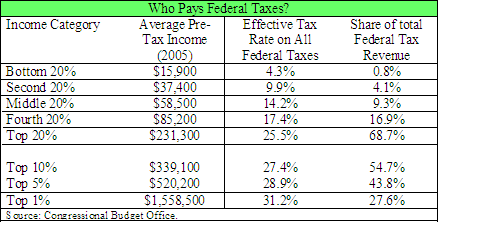
Despite all the deductions, loopholes and clever accountants the federal income tax is strongly progressive. Moreover the federal tax system remains progressive even if you include the payroll tax, corporate taxes and excise taxes. The chart below with data from the Congressional Budget Office, shows the effective tax rate by income class from all federal taxes. Effective tax rates are considerably higher on the rich than the poor.
The effective tax rate is higher on the rich and the rich have more money – put these two things together and we can calculate who pays for the federal government. The final column in the table shows the share of the 2.4 trillion in federal tax revenues that is paid for by each income category. The remarkable finding is that the rich and especially the very rich bear by far the largest share of the federal tax liability. The top 10% of households by income, for example, pay more than half of all federal taxes and the top 1% alone pay over a quarter of all federal taxes.
(Click the table if it is not clear.)
Posted by Alex Tabarrok on December 18, 2007 at 08:34 AM in Economics | Permalink
Comments
Can you explain to me how the top 10% can pay a higher percentage of the total than the top 20% do?
There must be a screwed up formula in there somewhere.
Posted by: Bill at Dec 18, 2007 8:42:37 AM
Thanks Bill. I transcribed a few numbers from the wrong column. I have fixed.
Posted by: Alex Tabarrok at Dec 18, 2007 8:50:04 AM
I'd be curious to see the same chart, but covering ALL government taxes & fees, federal, state, and local, such as sales taxes, property tax, social security, etc. I'm not sure if this would make the situation look more "progressive" or not, but I think it would be a much more interesting number. For me as a taxpayer, the distinction between "federal income tax" and all the other taxes and fees is pretty close to meaningless - because over time I've seen that when one set of taxes goes down another set seems to go up about an equivalent amount. Thanks.
Posted by: Steve R at Dec 18, 2007 9:01:57 AM
How does net worth by each income category compare to share of tax revenue? Is that data available as well?
Posted by: Bob at Dec 18, 2007 9:13:49 AM
The "left" likes to criticize the progressivity of the tax system by pointing out how much income the rich keep. The "right" instead tries to focus on how much the rich pay into the tax system. It is this conflating of metrics that politicians will continue exploit in their arguments.
Posted by: Riemannian at Dec 18, 2007 9:14:33 AM
I should have mentioned the word "percentage" in there somewhere.
Posted by: Riemannian at Dec 18, 2007 9:20:33 AM
I feel like there is a deeper meaning. Like, maybe politicians do what the rich tell them to because they pay the government more than anyone else?
Posted by: brainwarped at Dec 18, 2007 9:24:06 AM
Excellent. We can see that at given point in the recent past (at least between 2004 and 2005), the “rich” paid higher tax rates than everyone else. My only question is why is this interesting? Who actually questioned whether this was the case?
Not even Paul Krugman has claimed that the US doesn’t have a progressive tax system. At most, he has claimed that the tax code has grown less progressive in recent years (particularly since the 2001), a claim that cannot be tested fairly with only two years of data.
Posted by: Student at Dec 18, 2007 9:26:58 AM
So the bottom 40% pay about 5% of all federal taxes paid. Of course this is in large part due to the fact that so many people have no tax liability at all. No wonder there isn't an outcry for tax relief in this country.
"From those according to their ability to those according to their need."
Posted by: Colin at Dec 18, 2007 9:42:29 AM
A better twist on this table is not average income for each bracket (which is a mathematically sloppy term anyway -- I presume they mean mean and not median?) would be the minimum cut-off (e.g., if you make more than $X, then you are in the top 5%, etc.)
Posted by: KipEsquire at Dec 18, 2007 9:45:14 AM
I find this assumption rather troubling:
Far less consensus exists about how to attribute corporate income taxes (and taxes on capital income generally). In this analysis, CBO assumes that corporate income taxes are borne by owners of capital in proportion to their income from interest, dividends, capital gains, and rents. (The shares of various tax liabilities borne by different income groups in 2004 and 2005 are shown in Summary Table 2.) Over the long term, however, some models suggest that at least part of the burden falls on labor income.
What is the net effect on the table of the imputation of corporate income tax to individual owners? To not attribute at least a portion of this to labor income strikes me as wildly unrealistic, frankly.
Posted by: Stephen at Dec 18, 2007 9:49:41 AM
Student - lots of people question whether the rich pay more. Try five seconds on Google, e.g.
http://www.sptimes.com/2007/08/05/Opinion/America_is_taxing_for.shtml
Posted by: Alex Tabarrok at Dec 18, 2007 9:50:17 AM
Student -- As a taxpayer, I find the data *very* interesting. ;-) More importantly, one argument that politicians seem to trot out regularly is that taxes on the rich should not be cut because the middle class is being "squeezed." But the data suggest that the middle class is, if anything, getting a good deal in terms of what they pay in relative to their share of total income.
Posted by: jp at Dec 18, 2007 9:50:55 AM
Who gets the greatest financial benefit from government? How much wealth would each person have, and keep, if there were no government?
The top 1% are getting a very, very good deal by that metric.
And yet some of them complain that the system is unfair to them.
What chutzpah!
Posted by: A student of economics at Dec 18, 2007 9:52:47 AM
The commie, egalitarian lefties hope nobody realizes this. Just a modicum of rational thought reveals that even a flat tax results in the rich filling a grossly unfair percentage of the government trough. If the so-called "fair-minded", "egalitarians" really gave a "damn" about "equality". They'd propose a tax system where the bottom quintile has an effective tax rate of 35% and the top quintile has an effective tax rate of 2.5%. That way they'd both be paying for equal shares of the government.
Of course, the lefties get apoplectic when this is pointed out, because total spending would decrease and the handouts to the lazy, unproductive "unfortunates" would have to disappear.
;-)
--MostlyASatirist
Extrapolating to ridiculous conclusions so that you don't have to!
Posted by: MostlyAPragmatist at Dec 18, 2007 10:04:33 AM
Here's some context for Alex's table. According to the CBO report (see page 6, table 2),
http://www.cbo.gov/ftpdocs/88xx/doc8885/12-11-HistoricalTaxRates.pdf
The top 1%, 5% and 10% received: 18.1%, 31.1% and 40.9% respectively of income.
The top 1%, 5% and 10% paid: 27.6%, 43.8% and 54.7% respectively of all Federal taxes.
Their share of state and local taxes, which tend to be less progressive or even regressive, is likely to be lower.
All in all, it appears we have a mildly progressive federal tax system. Alex may find the shares of total taxes paid by high income groups "remarkable", but a few minutes of googling reveals this to be mainly a reflection of an increasingly unequal distribution of income. In 2005, the top 10 percent and top 1 percent and received the greatest share of income since 1929.
Posted by: A student of economics at Dec 18, 2007 10:11:43 AM
About these numbers--so what?
Posted by: Person at Dec 18, 2007 10:15:33 AM
The FICA tax rate alone is 15.3% (employer and worker combined) for those under $102,000. This table claims to "include the payroll tax, corporate taxes and excise taxes. The chart below ... shows the effective tax rate by income class from all federal taxes." Seems pretty dubious. Without the math it is hard to believe such a counter-intuitive result.
If there was a real point being made here it might be interesting to understand how the numbers were put together. For example, where is my college student son? (Income $4,000, FICA tax rate 15.3%, income tax rate 0.0%, federal alcohol taxes not non-zero.) Or my 90 year old father? (Income $120,000, FICA tax rate 0.0%, income tax rate roughly 10.0%.) Without some context, it is hard to know what to make of this especially when most wage earners in the bottom 80% pay 15.3% off the top.
However, at the end of the day, it is not clear what the point is.
Posted by: Ernest at Dec 18, 2007 10:17:50 AM
“The remarkable finding is that the rich and especially the very rich bear by far the largest share of the federal tax liability.”
Why is this remarkable? With gross income inequalities, it of course has to be the rich who pay for the bulk of govt spending. You cannot take much off those who have little in the first place. A table over at Mankiw’s shows that the share of taxes paid by the rich has been increasing over time – but so has their share of income…
http://gregmankiw.blogspot.com/2007/12/progressivity-of-income-tax.html
The pattern of tax revenues reflects income inequality rather than somehow correcting for it.
Posted by: Mark at Dec 18, 2007 10:19:28 AM
There is no semantic difference between Student's "mildly progressive" and "remarkably" progressive. The line separating regressive from progressive is fairly clear, but who can tell me what the distribution is which demarcates "mild" and "remarkable" progressiveness? In matters like this there are always going to be some people saying "that's too much" and others saying "that's just right" and there's no way for them to convince each other because these are completely subjective views.
That said, if we wanted to measure relative progressiveness of two tax systems, I'd say we should take the difference of the area under the Gini curves of income and tax burden. Does that seem reasonable to any one else? And does anyone know where I might find some well-formatted historical data for this?
Posted by: Jared at Dec 18, 2007 10:37:53 AM
To those who wonder what Alex's point is: stop being so nice. Alex's point is that his table refutes the claim that the tax rate isn't progressive with respect to hedge-fund managers. I understand it's hard to believe such a hare-brained thesis would appear on a blog that is frequently as insightful as this, but that's what he's saying.
Posted by: MostlyAPragmatist at Dec 18, 2007 10:39:01 AM
If you take away 31.2% everything someone makes, you're not "correcting" for his high income by some mysterious somehow-- you're "correcting" for it by taking away 31.2% of everything he makes. (Scare quotes around "correcting" are for the purpose of highlighting the tendentiousness of that word.)
The only people who are entitled to regard payroll taxes as taxes are those who do not regard them as insurance premiums. How many lefties does that leave us?
Posted by: Paul Zrimsek at Dec 18, 2007 10:42:59 AM
It is barely progressive. It used to be MUCH more progressive. Every time a Republican gets elected, the tax burden is shifted down towards the middle class. This has been happening since the New Deal. With each tax cut, the rich are paying less and less and guess who's paying more? You and me. Read Paul Krugman.
The tax rate IS NOT progressive with respect to hedge fund managers! The table shows averages. Hedge fund managers probably pay a smaller fraction of their income in taxes than you do.
Why is WORK taxed higher than INVESTMENTS? The rich simply collect their dividends without working and pay less in taxes than folks working 50 hours per week.
Posted by: Eric S. at Dec 18, 2007 10:53:43 AM
Where do corporations fit in to this?
Didn't the founding fathers intend for corporations to pay for the federal government?
Posted by: Jeremy at Dec 18, 2007 11:01:54 AM
Jared writes: "I'd say we should take the difference of the area under the Gini curves of income and tax burden."
An easy way to provide a general sense of this would be for Alex to include a column in his table labeled "share of income" adjacent to the column labeled "share of total Federal tax revenue". Such a column is in original CBO report, but Alex omitted it. See my post above.
Alex: it's still not too late for you to update the table so we can have the relevant facts as we discuss this issue.
Posted by: A student of economics at Dec 18, 2007 11:03:02 AM
It is clear we need to raise taxes. We are well to the left side of the Laffer curve, meaning that raising taxes will raise overall revenues. Everyone knows that the Laffer curve peaks when the effective tax rate is 24.649382% of gross income.
In any case, I find the numbers hard to believe. I would not think that the top 20% of households made $231,000 in 2005 dollars. But, then, I guess I am not wrong. Mark Twain was. Statistics don't lie.
Posted by: Allan at Dec 18, 2007 11:12:19 AM
Eric, how does the table Mankiw posted (http://gregmankiw.blogspot.com/2007/12/progressivity-of-income-tax.html) jive with the idea that every Republican president shifts tax burden off of the upper income groups? It appears their burden grew in the first five years of the Bush administration. Now I know this is only income taxes, but that's the data I've got to work with right now, and since income taxes are a dominant share of tax revenue, it's going to have to do.
Furthermore, the tax system isn't as progressive with respect to retirees either, since they're living only off investments. It isn't as progressive with respect to people who commute long distances in cars, since their gas-tax liability is increased. Effects like this are why it's futile to discuss progressiveness with respect to a narrow subset of people. The system has to be considered as a whole.
And absent any data at all on the top .001% of income earners (a ballpark figure of how many hedge fund managers there are, and assuming they're all at the very top of the pack), I'm going to disregard your bilious conjectures about fictitious rich people who sit around waiting for dividend checks.
Posted by: Knox H. at Dec 18, 2007 11:27:18 AM
The CBO figures comes largely from the IRS SOI (statistics of income). Assuming high net worth individuals are not stupider than the average Joe, if the IRS's SOI accurately did not seriously understate the income of high net worth individuals, either PricewaterhouseCoopers and the like would not offer extremely pricey services to high net worth individuals because there wouldn't be high net worth individuals willing to pay for those pricey services.
On the other hand, the SOI are probably pretty accurate at counting income off some working stiff's W-2.
Posted by: cactus at Dec 18, 2007 11:32:50 AM
I disagree. There's no question that the rich turn in bigger checks to the government, but that in no way means they are actually paying the taxes. The person who actually pays a tax is the person who's standard of living is diminished by the tax. Thus there is no such thing as a progressive tax. There is only the propaganda of a progressive tax. And the purpose of the propaganda is to get the people who actually pay taxes to agree to pay more taxes than they otherwise would.
Posted by: Randy at Dec 18, 2007 11:38:47 AM
I'm just amazed at how rich the US is. As the CEO of a silicon valley company (admittedly a startup) I'd have guessed that I'm in the top 10% of earners but that is just not the case. I just scrape into the top 20%. It takes $340K to make it to the top 10%. I find that amazing. One in ten in the country is making over $340K. If "middle class" is going to mean anything it tops out at an very high ceiling by any reasonable standard.
Posted by: Paul at Dec 18, 2007 11:45:28 AM
Student, yes that what I'm looking for, and actually thought it was there. I guess I was flipping back and forth between here and Mankiw too quickly and thought that column was on both tables. But what I'd really like to see is that same data for every five years going back to, let's say, WWI?
Eric writes: "Why is WORK taxed higher than INVESTMENTS? The rich simply collect their dividends without working and pay less in taxes than folks working 50 hours per week."
I could just as easily ask, and with no less pique, why investments are being taxed in the first place. Here I am, havig earned some money, and having had a nice chunk taken out by the taxman. And I save a little money, allowing others to use it in the meantime to better their lives, or improve productivity, or grow a business, and generally make lending possible, and as a consequence allow our economy as we know it to prosper, and furthermore to grow. And what do I get for my efforts? Another slice gets taken away. Now if I threw in some words in ALL CAPITALS I could seem as outraged as YOU.
I'm not advocating ending capital gains taxes. I'm just trying to make a point that a tax rate on investments that is lower than that on income is not ipso facto immoral, nor would it be immoral to have a capital gains rate higher than that on income. All you've got is a subjective, personal opinion that the tax code ought to look different in a way that would make you happier. The fact that it would also give Krugman the warm and fuzzies is not an argument in any sense.
Posted by: Jared at Dec 18, 2007 11:47:00 AM
The FICA tax rate alone is 15.3% (employer and worker combined) for those under $102,000. This table claims to "include the payroll tax, corporate taxes and excise taxes. The chart below ... shows the effective tax rate by income class from all federal taxes." Seems pretty dubious. Without the math it is hard to believe such a counter-intuitive result.
Perhaps, but it is accurate. There are more detailed charts in the same report, freely available, that explain more of it. Among other things, note that the lower 20% have a large negative income tax, net. Also, the income includes a few things that are ineligible for taxation. It also includes the employers' portion of FICA taxes as income-- which makes the combined FICA tax rate 14.2% of the nominal wage income + employers' portion, and other benefits are excluded as well. Retirement benefits, food stamps, school lunches, support from parents or children, etc. make up substantial portions of income for the lower 20%.
Where do corporations fit in to this?
Good question, Jeremy. That's one of the biggest potential problems in the report, as they note. They claim in this report that corporate income taxes are paid by the owners of capital, and include it in that way in that report. In reality, labor pays a substantial amount of corporate taxes in lower wages (as above, it's easier for capital to move than for labor to move), and that a great degree of incidence of corporate income taxes falls on labor. So this probably does overstate the proportion of taxes paid for by the rich (although it also assumes that Social Security tax incidence falls entirely on the worker). Corporate taxes are not a great way to raise taxes on the rich.
Posted by: John Thacker at Dec 18, 2007 11:49:47 AM
The tax rate IS NOT progressive with respect to hedge fund managers!...The rich simply collect their dividends without working and pay less in taxes than folks working 50 hours per week.
Interestingly, the entire argument on why hedge fund managers should be taxed more is predicated on the idea that they're being paid for work, not investments. They do work extremely long hours.
Capital is taxed less because capital responds so much more quickly and to a greater degree to taxes and incentives. It is much easier for someone to go invest his money somewhere else; the effect of someone moving to work somewhere else is smaller and slower. The Laffer curve actually becomes significant on taxes on capital at a rate much lower than taxes on labor. Taxes on capital have greater deadweight loss as well, by discouraging the movement of capital from one area to another, they reduce efficiency in the economy.
In any case, one of the trends to go along with rising inequality is that being rich is associated with working much more than it used to be. For most of human history, the rich have indeed worked less than the poor, and hours worked have declined up the income scale. This is much less true than it used to be; the inequality increase has been associated with a growth in industries such as finance and consulting where the well-compensated also work incredibly long hours.
Posted by: John Thacker at Dec 18, 2007 11:53:19 AM
I'm just amazed at how rich the US is. As the CEO of a silicon valley company (admittedly a startup) I'd have guessed that I'm in the top 10% of earners but that is just not the case. I just scrape into the top 20%. It takes $340K to make it to the top 10%.
For a household, which includes two earners for a greater and greater percentage of the top households. Also take note of what is included in income. Not only are investments and such included, but things that you might not expect. Up to around $7000 of employer-paid Social Security and Medicare payments are included as income, even though it's not on paystubs.
Posted by: John Thacker at Dec 18, 2007 11:56:32 AM
Every time a Republican gets elected, the tax burden is shifted down towards the middle class. This has been happening since the New Deal. With each tax cut, the rich are paying less and less and guess who's paying more? You and me.
The people who really paid more are those in the "top 20% but not top 5% of households" category, since a great portion of those household face the AMT, which was not cut. The vast majority of the top 5% pays enough in regular income taxes that the AMT wouldn't make them pay any more. It's the group right below whom the deductions brings their tax burden down to a small enough percentage of income that the AMT kicks in. The mortgage deduction is capped, rich people don't have a proportionately larger number of children, etc.
The "tax burden" has not shifted down towards the middle class; that's separate from inequality. Inequality can growth without the marginal rates shifting, and the result is that the rich pay a greater percentage of taxes, as one would expect. (And one can still be annoyed at the inequality growth, certainly.)
Posted by: John Thacker at Dec 18, 2007 11:58:08 AM
What's the point?
Well, the figures raise a couple of obvious questions:
(1). Some like to complain that "the rich" manipulate the government to favor their interests. But why shouldn't they, given that they mostly pay for it?
(2). Contrariwise, why should the bottom 20% (or even 40%) expect to exercise much influence over government policy, given that they contribute so little to its support?
Posted by: Steve Burton at Dec 18, 2007 12:03:34 PM
MostlyAPragmatist: Alex's point is that his table refutes the claim that the tax rate isn't progressive with respect to hedge-fund managers.
It doesn't quite. Remember that the top 1% is more than a million households -- there's a lot of variation hidden in that number.
Paul: It takes $340K to make it to the top 10%.
No -- the $340K figure is an average for the top 10%. If you back out the top 1%, 5% and 10% you get these averages:
Top 11%-20%: $123,500
Top 6%-10%: $158,000
Top 2%-5%: $260,625
Posted by: alkali at Dec 18, 2007 12:13:04 PM
I still think that the progessiveness of our federal tax rates could be more progressive. I don't see why we couldn't add another level in which income greater than $1mn is taxed at 50%. I believe polls have shown that most people in the upper 20% believe that income taxes are too low for us, myself included.
Realistically, as someone who has benefited from the growing wealth gap, I can attest that it hasn't really improved my lifestyle. I as well as most people I know in the same income category (definitely in the 20% group or maybe slightly in the 10%) have spent their increased wealth on moving to neighborhoods with better schools rather than a bigger house. So at least in my experience the growing wealth gap has worked something like this:
My income goes up as well as others. We use our higher income to bid against each other for a limited number homes in the few neighborhoods that actually don't have bad schools. Those people already living there get to cash out at much higher prices. The end result? A value transfer from young, newly formed families living in major metro areas to retirees who use the money to move to Florida, Arizona, Nevada and California. Hence the a much larger boom in property prices in those locations. Declining interest rates and looser credit standards certainly helped this trend along as well.
Posted by: asiequana at Dec 18, 2007 12:13:56 PM
I believe polls have shown that most people in the upper 20% believe that income taxes are too low for us, myself included.
I'm pretty shocked at that considering how big of an issue the AMT is, but perhaps this is true.
I as well as most people I know in the same income category (definitely in the 20% group or maybe slightly in the 10%) have spent their increased wealth on moving to neighborhoods with better schools rather than a bigger house.
Yes, this certainly happens. The linkage of the quality of "public" schools to being able to afford an extremely expensive house really makes a mockery of the idea that they're public.
Posted by: John Thacker at Dec 18, 2007 12:17:00 PM
Incidentally, this paper(*) presents some effective tax rate computations for segments of the top 1%. The paper concludes:
"[T]he most dramatic changes in federal tax system progressivity almost always take place within the top 1 percent of income earners, with relatively small changes occurring below the top percentile. For example, many of the recent tax provisions that are currently hotly debated in Congress, such as whether there should be a permanent reduction in tax rates for capital gains and dividends, or whether the estate tax should be repealed, affect primarily the top percentile of the distribution—or even just an upper slice of the top percentile. This pattern strongly suggests that, in contrast to the standard political economy model, the progressivity of the current tax system is not being shaped by the self-interest of the median voter."
(* Thomas Piketty & Emmanuel Saez, "How Progressive is the U.S. Federal tax system? A Historical and International Perspective," Journal of Economic Perspectives, 21(1), 3-24, Winter 2007.)
Posted by: alkali at Dec 18, 2007 12:26:50 PM
It's interesting to note from the original CBO report that the bottom three quintiles together account for a whopping 0.6% of '05 personal income tax liability. In part, this is because the bottom two quintiles have a negative liability. Never having paid attention to those numbers before, I found this pretty startling. The same 60% of households account for 25.8% of income.
Posted by: j-l at Dec 18, 2007 12:26:56 PM
Mr. Studio and Mr. Suite both live in a boarding house. Each month, in addition to their rent, Mr. Studio and Mr. Suite each pay Miss Landlady an amount for the two daily meals that Miss Landlady provides. On December 1, Miss Landlady stops Mr. Studio in the hall and tells him that, given the rise in food prices, she will have to increase the monthly amount the tenants have to pay for their meals, and that Mr. Studio's payment will go up from $20 to $25. Mr. Studio starts complaining: "Why do you have to raise my payment so much? I rent only one room. Mr. Suite on the other hand rents three rooms and has his own bath! Why not make him bear more of the costs and give me a break for a change?"
Miss Landlady says, "Please come with me. I want to show you something."
She leads Mr. Studio to her office and pulls out her account books. She shows him her food budget for the year and how much she anticipates in payments from her tenants for their meals. Mr. Studio sees that the budgeted food costs for the coming year total $3,000, and that of the four tenants (who all eat the same amount), Mr. Suite will pay $1,600 for meals, Mr. Tworoom will pay $700, and Miss Attic will pay $400. Mr. Studio will continue to pay the least, at $300.
Upon taking this all in, Mr. Studio splutters, "Why are you showing me this? How is this relevant to anything?!"
Posted by: jp at Dec 18, 2007 12:36:42 PM
The largest tax at the state and local levels is the sales
tax, which is regressive, although state income taxes tend to
be modestly progressive. The net effect of state and local taxes
is likely to be pretty close to neutral.
Progressivity of the federal income tax system has been mostly
declining since 1964, with a blip upwards under Clinton. The top
marginal income tax rate between 1940 and 1960 in the US was well
over 90%, a fact rarely mentioned by those who trumpet the importance
of low marginal income tax rates for high income earners as a factor
in economic growth, given the embarrassing fact that the US economy
grew more rapidly during that period than it has since 1982, when the
top marginal rate was lowered to 50%, and which it has not exceeded
since.
Posted by: Barkley Rosser at Dec 18, 2007 12:44:38 PM
Alkali, I presume that this because politicians' rhetoric is in hock to the mythos of the "squeezed" middle class while utilizing the language of rich-poor class warfare.
Posted by: Riemannian at Dec 18, 2007 12:53:17 PM
Several have asked to compare share of tax with share of income. Here are the ratios of tax share to income share by income quintile:
lowest 0.20
second 0.48
middle 0.70
fourth 0.85
highest 1.25
This means that the only quintile that pays more than the average tax rate for all income is the top quintile, and those people pay 125% of the average tax rate. The middle quintile pays only 70% of the average tax rate. (I'm defining the average tax rate as the ratio of total tax revenue to total pre-tax income.)
Some questions:
1. If you think the tax code favors the rich, then what numbers would you prefer to see in this table?
2. When the top 40% of the income earners pay roughly 85% of the taxes, should we be surprised that this is the group that benefits from tax cuts? Isn't it hard to benefit from a tax cut when you don't pay taxes?
The people who benefit from tax cuts are the people who pay taxes. Shocking!
Posted by: Fly Fisher at Dec 18, 2007 1:00:06 PM
As a mild libertarian I have to ask what is the point of taxing the poor and middle class. Why not just start taxing income over 80 K at a flat 15 percent rate and leave it be. Why do we need to tax people making below 80 K when obviously their tax contributions are meaningless to the federal government?
Posted by: John Pertz at Dec 18, 2007 1:06:18 PM
"I believe polls have shown that most people in the upper 20% believe that income taxes are too low for us, myself included."
Feel free to write a larger check to the government.
Posted by: rluser at Dec 18, 2007 1:08:44 PM
Jp. Nice story. But I am unsure how it means anything. When you are receiving bundled services, the prices for each individual service can be jerry-rigged pretty easily. For instance, assume a hotel would normally charge $10 for a breakfast and $80 for a room. If a competing hotel charges $90 for a room and throws in breakfast, are you getting a deal because you get breakfast for free? Money in this case is fungible. Mr. Studio was right to wonder what, indeed, this had to do with him.
One would wonder what would happen if Mr. Suite figured out the fungible thing. If he refused to pay for food, the others would be forced to pay higher fees. On the other hand, the landlady might just raise Mr. Suite's rent, so that it reflected the true cost of the room. As it is, it looks like Mr. Suite is underpaying for his room to the tune of $850 and overpaying for his meals for the same amount. It's a wash for him (assuming he believes that the room and board are fairly priced).
Further, it does not relate to this story because we do not know the incomes of Mr. Studio and Mr. Suite.
In the US, we too receive bundled services from the government. I would submit that the wealthiest of us receive the greatest number of services. Therefore, the wealthiest of us should pay the highest taxes.
Posted by: Allan at Dec 18, 2007 1:14:59 PM
Because this mistake has been made a few times:
The table shows AVERAGE income by quintile. Therefore, it does not mean that you need an income of 340k to make it into the top 10%. 340k is the AVERAGE income of the top 10%. Presumably with the top 1% pulling the average up, the required income to be in the top 10% would be significantly less. How much less, I'm not sure. Anyone have the data?
Posted by: 99paa at Dec 18, 2007 1:45:24 PM
I am amazed that all the ecomists here missed this. The figure given is for all taxes including corporate taxes and excise. It is obvious that all corporations are included in this. The top 1% would actually consist of all the biggest corporations GE, IBM, Walmart etc, and every million company out there.
Once that is taken into account, this does not look so lopsided.
Posted by: rishi at Dec 18, 2007 1:48:21 PM
"given the embarrassing fact that the US economy
grew more rapidly during that period(1940-1960) than it has since 1982"
Not very fair comparison, Barkley. Do you advocate bombing 80% of manufacturing capacity outside of the US, as happened in WWII? I'm sure we could replicate that type of growth again. Oh, but first we'd have to have a hell of a depression to make those after numbers look good, too.
Most economists try to figure out what 1982- present would look like under different scenarios. Its harder, but a lot more honest.
Posted by: Tom at Dec 18, 2007 2:02:41 PM
According to the NTU, $364K in 2005 puts you in the top 1%. $103,912 puts you in the top 10%. $62K puts you in the top quarter. Are these numbers adjusted for capital gains and the associated taxes? I would expect those in the top 1% to pay lower taxes as a percent of income than those in the top 5%, since they are both at the highest marginal rate and those in the top 1% have a higher proportion of their earnings in capital gains.
http://www.ntu.org/main/page.php?PageID=6
Posted by: Mo at Dec 18, 2007 2:09:14 PM
Tom:
The real relevant year is 1973, when the Bretton-Woods system was abandoned. Growth was cut in half at that point, never to recover since. There's a better explanation than solely post-war factors. Then again, if you want to make the argument then you should.
Posted by: polarized at Dec 18, 2007 2:24:01 PM
Tom,
I am neither advocating returning to such ridiculous tax rates,
nor am I claiming that such tax rates were responsible for the
growth rates, quite the contrary. If anything, I am pointing out
that way too much of the discussion of tax rates way overstates how
important they are for growth performance. It is more the point that
we managed to grow pretty well during those earlier years despite
having such wildly high marginal tax rates, so high that when I tell
students about them now, most do not believe that such could have
been the case.
Oh, and the Great Depression was pretty much over by 1940, and
it was only 1941-45 that we were bombing factories in other countries.
There is another 20 years after that to this period, with some of the
highest growth coming at the end of it in the early 1960s.
Posted by: Barkley Rosser at Dec 18, 2007 2:26:32 PM
"In the US, we too receive bundled services from the government. I would submit that the wealthiest of us receive the greatest number of services. Therefore, the wealthiest of us should pay the highest taxes."
Allan - I completely disagree, but would appreciate citation of specific examples where the highest income brackets received more and/or different government services than the lower.
Thanks.
Posted by: AlanM at Dec 18, 2007 2:33:03 PM
Mo -- Thanks for the link. Am I reading the table right in concluding that half of all taxpayers have less than $30,881 in AGI? That's quite surprising. (Or maybe it just seems surprising because I'm used to thinking in terms of households rather than individuals?)
Posted by: jp at Dec 18, 2007 2:41:32 PM
"I completely disagree, but would appreciate citation of specific examples where the highest income brackets received more and/or different government services than the lower."
I'm not Allan, but I'll answer. When I was in college, I was in the bottom 20%, and almost everything I owned fit inside my 20 year old Buick Skylark. I also had a few hundred bucks in a bank account. The money in my bank account belonged to me because the government guaranteed it. It is not fear of being fired that keeps a clerk at B of A from fraudulently moving people's money out of their accounts, it is far of spending time in jail.
Now, I make a bit more money, and I have more money in the bank. I own a bit of stock, etc. Again, the stuff I own, I own because the government guarantees my ownership.
Get rid of government, and the guy at the bottom doesn't lose very much. The guy at the top loses everything. Preventing that from happening is worth a lot more to those that have than to those who don't have... but could have if the system broke down.
Posted by: cactus at Dec 18, 2007 2:44:36 PM
In the payroll taxes, are "employer shares" accounted for, or is it just the "employee's share"? More than half the taxes paid as part of an employee's compensation package are typically not included in the employee's "visible" pay...
Posted by: Foobarista at Dec 18, 2007 2:46:13 PM
It is argued that sales taxes are not regressive here.
Robert Higgs claims the Great Depression continued into the 40s and throughout WW2 here.
Posted by: TGGP at Dec 18, 2007 2:47:10 PM
AlanM,
The vast majority of people who drive are wealthy enough to own a car. Thus, the state highway system benefits them.
Most of the poor do not have the wherewithal to travel outside the country. Therefore, custom services do not benefit them as much.
Wealthy people consume more, so they need to get the stuff to them. Thus, they benefit more from all government activities involved in trade.
Home mortgage deductions benefit the wealthy.
The poor would probably not be much worse off if we were invaded and occupied, say by Canada. The rich would be. Thus, the rich benefit more from national defense.
The entire capitalist system benefits the capitalists, who, generally, are the ones with money. Take away the laws that allow for corporations and for land ownership and the poor would be in the same position (or slightly worse), but the rich would really be bad off.
Certainly, there are some social services that benefit the poor. But I would say that the amount spent on these is dwarfed by the amount garnered by the wealthy.
Generally speaking, our government benefits those with money. Both in tangible ways (think farm subsidies and military spending) and intangible ways (by allowing them to accumulate and keep their wealth).
Posted by: Allan at Dec 18, 2007 2:47:42 PM
I question assumptions people have made about what would happen when the government disappears. The only example we have to us is Somalia, which is discussed in Better Off Stateless.
Posted by: TGGP at Dec 18, 2007 2:50:05 PM
"Now, I make a bit more money, and I have more money in the bank. I own a bit of stock, etc. Again, the stuff I own, I own because the government guarantees my ownership."
So, based upon that argument - and since we're discussing the derivation and allocation of annual taxes, then there must be quite a large annual expenditure for the Federal government to provide that service within the context of Allan's original assertion. So, what is it? I would venture to say close to nothing, because it's not an actual tangible service provided - nor does it's provision differ between what anyone at any income level receives from it.
I'm not sure my original question was veiled under a condition of complete anarchy either. To say that higher income levels receive more services is, in my humble opinion, categorically untrue. Public education, social welfare, paying-better-than-market government jobs, etc. are all benefits solely for lower classes funded by the upper. My ability to travel on paved highways or enjoy the alleged regulation of industry is no greater than anyone else.
And if I interpreted this correctly, to say that the existence of jails are a benefit for the upper classes is startling. While I may not want to be robbed at gunpoint, I wouldn't consider the incarceration of societal offenders to be any more advantageous to me than someone in the ghetto. I consider a benefit to be something of value - that is merely a zero-sum situation of crime and punishment.
Posted by: AlanM at Dec 18, 2007 3:04:26 PM
In the spirit of rluser's response and the repeated musings of Warren Buffett and Ben Stein about how the rich should be paying more in taxes, I would like to propose a more innovative experiment.
Our politicos could introduce legislation creating a series of projects devoted to various "worthy" causes. Each could be called "Fund for the elimination of progressive guilt #1" etc. The fund would receive from under taxed citizens commitments to sponsor the funding of each mission statement defined project. Each dollar of funds committed would also receive one vote toward the election of a board of directors to manage the project. When the project is fully funded it would be activated and would commence the pursuit of its mission statement.
So how does this differ from "The Bill and Melinda Gates Foundation"? It doesn't, but it would give people a first hand experience with how government manages their "tax dollars hard at work" in comparison to private sector counterparts. Why doesn't Buffett donate his fortune to government to fix societal problems rather than going to private sector solutions? Might it be that he doesn't believe government would do as good a job?
If such a venture were created it would create converts to the conservative cause after the project fails due to the inefficiencies of government. Sweet revenge!!
Posted by: Mike at Dec 18, 2007 3:19:56 PM
"The vast majority of people who drive are wealthy enough to own a car. Thus, the state highway system benefits them."
I would easily argue that unless these people walk everywhere, that the buses they use travel on the same roads and highways as my car. If those were unavailable, we would be equally inconvenienced. Not to mention that it is absurd to say that the majority of the population does not own a car themselves.
"Most of the poor do not have the wherewithal to travel outside the country. Therefore, custom services do not benefit them as much."
Straight from the US Customs purpose statement: "Missions include detecting and preventing the illegal entry of persons and goods into the country." I can't imagine how you believe that Customs benefits those that travel more than those that don't, especially based upon their own mission statement. I receive the same service from customs as everyone else as the foreign-produced goods that I purchase here at home are inspected, as are people entering. Look at Walmart, the largest company in the world (last time I checked) - the majority of their goods are foreign produced. What does their customer base look like? Enough said.
"Home mortgage deductions benefit the wealthy."
I've heard this before and it's comical. Anything related to tax reductions for those that pay the most is ridiculous to argue as a benefit. The obvious answer is that if each person paid their equitable (by equitable, I mean same amount as the term intends) taxes, I guarantee I would be more than happy to give up my mortgage deduction. Trying to make the tax structure more fair is not a "benefit." Sorry.
"The poor would probably not be much worse off if we were invaded and occupied, say by Canada. The rich would be. Thus, the rich benefit more from national defense."
You have got to be kidding. So, now preserving America and all it has ever stood for is solely a benefit for the upper classes. I don't have the patience to respond to any more of this.
Posted by: AlanM at Dec 18, 2007 3:24:38 PM
Alan M,
I did not argue that the poor get nothing from the federal government. My argument is that the rich benefit much more than the poor do.
Yes, the poor use the roads. But the rich benefit more from the roads.
Yes, the poor benefit from customs. But the rich benefit more from the wervices.
The poor do not benefit from the home deduction. Arguably, the rich do not either.
The rich benefit more from our system of government than the poor do.
We could go on and on. The rich benefit more from the existence of the Federal Reserve. The rich benefit more from the SEC. The rich benefit more from the judicial system. The rich benefit more from government spending (non-entitlement programs).
The poor probably benefit more from other agencies, like OSHA and the NRLB.
Heck, the rich benefit by having the poor around. Capitalism cannot work without the ability to exploit labor (tongue firmly planted in cheek).
Our system benefits most, if not 100%, of the people who live in this country. However, it unarguably benefits the wealthy more than the poor. Consequently, the wealthy should pay, and be willing to pay, more for the government to run effectively. The only question is how much more.
Posted by: Allan at Dec 18, 2007 3:37:05 PM
"Get rid of government, and the guy at the bottom doesn't lose very much. The guy at the top loses everything. Preventing that from happening is worth a lot more to those that have than to those who don't have... but could have if the system broke down."
Cactus,
Respectfuly, this argument sounds sillier each time I hear it. As you see it, government is nothing more than a rich person's insurance policy against the mob. Or, the variant most often heard from those left of center, is that if we "get rid of government" it's the guy at the top who will take everything from the guy at the bottom. Note to politicians: when pandering, use the latter argument, even though in your heart you believe the former.
And one technical question: if we "get rid of government", and the guy and the bottom as well as the guy at the top "loses everything", where did everything go?
Posted by: Jeff S. at Dec 18, 2007 3:37:52 PM
John Pertz,
"...what is the point of taxing the poor and middle class."
To maintain their belief that there really is such a thing as a progressive tax. They end up paying it all, of course - the rich don't pay taxes, they collect taxes. But as long as the poor and middle classes believe that the rich are paying for a free lunch they will continue to support (and pay) higher taxes.
Posted by: Randy at Dec 18, 2007 3:46:26 PM
TGGP,
Your sources base their arguments on redefining terms, such as
"regressive" and "depression." So, your source on sales taxes
fully admits that in general sales taxes are regressive with
respect to income, which is how everybody but this source defines
the term, but then claims they are not with respect to consumption.
Excuse me, but duuuuh. The source then notes that it is possible
to alleviate the actual regressivity of sales taxes by modifying
them, such as making people below certain income levels not have to
pay them, although that is not practical. What is practical, and is
done in certain states, is to exempt certain necessity items from
them, most frequently either food or medical items, or both.
Regarding the WW II argument by Higgs, again we are dealing with
a redefinition. Everybody but him agrees that a depression involves
declining real GDP. This did not occur during WW II. Now, he argues
that civilian consumption was down and that therefore living standards
were not high (plus getting all bent out about how the US economy was
a command economy then, as if that has anything to do with whether or
not a depression was going on). Of course civilian living standards
were held down due to rationing and the like as production shifted to
military uses. However, they were up for some people who had formerly
been unemployed. In any case, this is again an argument based on
redefining a term to make it mean what the author wants it to for a
blatantly ideological rant.
Posted by: Barkley Rosser at Dec 18, 2007 3:48:08 PM
It's hard to believe that there are still economists naive enough to assume "taxation" means "just money". Particularly when those same economists rail on such a fallacy in every other context.
I've been on both sides of the wealthy/poverty fence. When you're on the poverty side, you spend countless hours filling out forms, worrying about a speeding ticket because you don't know the lawyer who can fix it, paying more for the same car insurance, wasting time on the phone with government agencies -- and to begin with you waste your time in government schools. THAT'S taxation.
Becoming wealthy has been my greatest form of self-defense against the federal government. Just judging by my hourly rate and my personal guess as to how much less of my time is robbed by endless government programs, I am certainly paying a smaller percent in taxation than ever before.
And I'm getting more for my money -- the police actually show up when I call them!
Posted by: infopractical at Dec 18, 2007 4:10:53 PM
Here's one of my favorite paragraphs on the incidence of tax cuts; disregard the stolen wallet sentiment:
Sometimes, though, justice is about returning a stolen wallet to the person from whom it was stolen. Why return the wallet to that person? Not to restore a previously fair arrangement but to restore the wallet to the person from whom it was stolen. Sometimes, justice is about returning the wallet, not distributing it. The wallet’s history trumps any thoughts about how it might best be distributed.
David Schmidtz
March 6th, 2006
Posted by: almrr at Dec 18, 2007 4:22:16 PM
Jeff S.
Come to think of it, part of what our government is "is a rich person's insurance policy against the mob."
Indeed, all governments work to protect the system. Sort of the reason for being. If the government does not provide protection for the masses, there is generally a revolution, e.g., France in the 1790s and Russia in the 1910s. Everything is class warfare, at its base. The governments that survive over time are the ones that provide for the masses (e.g. modern Europe and, yes, the US) or the ones that can effectively cower the masses (e.g., apartheid South Africa). Even communism is a protection system for the wealthy (although the communist leaders who were wealthy would not call themselves such).
Generally wealth leads to power and power leads to wealth in this country. And government is there to protect the powerful. I would conclude that the government is the way to protect the wealthy from the mob. Our government does this by ceding some of the power to the mob. The less power it cedes, the more susceptible it is to a revolution.
Posted by: Allan at Dec 18, 2007 4:22:43 PM
...part of what our government is "is a rich person's insurance policy against the mob."
Where do you think the police spend more time, in poor neighborhoods or rich?
Who is more likely to be murdered, someone who can afford to be accompanied at all times by bodyguards, or a single teen male living in an inner city?
Posted by: Patrick R. Sullivan at Dec 18, 2007 5:08:52 PM
Every time I hear the rich complain about how much paying for govrnment costs them, I always want to remind them that it is only the instruments of government - laws, military, police - that allow them to keep their wealth.
And when they complain about the high cost of taxes, I am always happy to suggest that they move to a land without taxes: Somalia.
Posted by: Stephen Downes at Dec 18, 2007 5:41:48 PM
Thanks for the reminder, Stephen Downes, and for identifying yourself and your inclinations, so that when the brink of governmental collapse arrives my rich friends and I can get together and open a preemptive can of whup-ass on you and yours.
Posted by: Jeff S. at Dec 18, 2007 5:51:02 PM
"allow them to keep their wealth"
So far, at least two people have used that turn of phrase in this thread. Is the underlying thought that we own things on sufferance?
Posted by: jp at Dec 18, 2007 6:16:02 PM
Couldn't this be used to demonstrate that income is inelastic with respect to income tax and that all the talk about taxes being dis-incentivizing is, at least in this case, ridiculous?
Posted by: Ben at Dec 18, 2007 6:30:47 PM
Corporations paying for the government. Interesting idea. But make it even more fair and say business pays for the government. The money comming out of the profits instead of the paychecks. And while we're at it, how about if the only taxes paid are for defense. Everything else is taxed locally.
Posted by: But who am I to have an idea at Dec 18, 2007 6:36:09 PM
Progressivity of the federal income tax system has been mostly
declining since 1964, with a blip upwards under Clinton. The top
marginal income tax rate between 1940 and 1960 in the US was well
over 90%, a fact rarely mentioned by those who trumpet the importance
of low marginal income tax rates for high income earners as a factor
in economic growth, given the embarrassing fact that the US economy
grew more rapidly during that period than it has since 1982, when the
top marginal rate was lowered to 50%, and which it has not exceeded
since.
Posted by: Barkley Rosser at Dec 18
Who actually paid an effective rate of 90%? No one, I would venture. (Can you disprove this?)
The economy did not grow faster during WW II than during the 1980s. The post-WW II period was starting at a much lower base, so we might expect a faster growth rate than during the 1980s.
The Reagan regime lowered marginal tax rates, but don't forget that it closed lots of so-called loopholes too.
Posted by: Bill Stepp at Dec 18, 2007 7:05:50 PM
"Corporations paying for the government. Interesting idea. But make it even more fair and say business pays for the government. The money comming out of the profits instead of the paychecks."
And while we're at it, let's make every day a holiday!
Posted by: jp at Dec 18, 2007 7:07:11 PM
Stephen Downes: "Every time I hear the rich complain about how much paying for govrnment costs them, I always want to remind them that it is only the instruments of government - laws, military, police - that allow them to keep their wealth."
Stephen,
How does the overseas spending of the U.S. military allow me to keep my wealth?
How do agriculture subsidies allow me to keep my wealth?
How does the billions spent on various transfers allow me to keep my wealth?
All that is necessary for me to keep my wealth is a strong system of law enforcement and a true defense system. I'll gladly pay for that if I can get rid of the rest of the government. I suspect most of the "wealthy" would take that deal in a heartbeat.
The problem is that I'm paying for a government that not only allows me to keep some of my hard-earned wealth but also a government that takes another part of my wealth and gives it to those who elect not to work very hard at all. And, yeah, I do think most of the recipients of non-retirement transfers - some of whom are my relatives - are lazy and unmotivated. I have walked a mile - many miles, in fact - in their shoes.
Posted by: John Dewey at Dec 18, 2007 7:48:55 PM
Bill Stepp,
Well, actually the Reagan tax law changes of 1981 increased the number of loopholes.
It was the tax simplification of 1986 that closed loopholes, and thus was able to
bring about a much more dramatic lowering of marginal rates while remaining revenue
neutral.
Well, I don't the numbers, and lots of people did use loopholes of one sort or another
to avoid taxes back in the days of those very high marginal rates, but some people did
pay them. One who did by his own account was Ronald Reagan. It was the experience of
facing those rates when he was a Hollywood star that convinced him of the labor supply
part of the supply side economics story. He used to recount how he did not make extra
movies because the government would take over 90% of the pay, so he was convinced that
cutting rates would increase revenues and effort, which probably holds for cutting such
rates.
Posted by: Barkley Rosser at Dec 18, 2007 7:51:19 PM
Jeff S,
"As you see it, government is nothing more than a rich person's insurance policy against the mob."
Government is nothing more than a social construct. And governments have been constructed in many ways in history - sometimes government favors the physically strong, or those who are best able to speak to the gods, or those best able to speak whatever slogans are preferred by those in power. Variations of each of these exist today.
In our society, government favors those who have the most intangible assets, preferably through inheritance. Regardless of who government favors, the trick is getting those who aren't favored to go along. Because regardless of who is benefited by the system, every so often, the mob does rise up.
Posted by: cactus at Dec 18, 2007 7:54:20 PM
These arguments that the rich benefit more from security than the poor are ridiculous. In the worst places, the rich trample everything to poor own, steal their labor, their daughters, their food and leave them diseased, malnourished, fearing for their life, and without hope in the betterment of their children.
You honestly think that the poor here, with their subsidized education, health care, TVs, shelter and security are the same as Somalia or Medieval France? The rich have everything in those places without any obligations, but here they pay for most of the benefits afforded the poor and aren't allowed to kill, maim, jail or rape them for the kind of whingeing going on here. Bummer.
Posted by: guy in the veal calf office at Dec 18, 2007 8:29:57 PM
There doesn't seem to be much consideration of the consent of the governed in many of the comments above, particularly comments along the lines of "why should the poor expect anything from the government since they don't pay for it?"
Heck, why don't we just sell tickets to the voting booths in that case?
They expect something from government because they're part of the governed.
Posted by: Shane Milburn at Dec 18, 2007 9:38:53 PM
Most of the income of a 'rich person' (in the millions of $) is channeled back into the economy. The typical rich guy spends a small sum relative to his total income. The rest goes invested back to the market. This is the part that gets taxed. The tax does not affect his lifestyle, but subtracts precious dollars from the market where they would provide the most efficient benefit. It leads to a tax on the market economy, which leads to everything costing more since it raises the cost of money. This is what it means 'taxing the rich'.
Posted by: joe blower at Dec 19, 2007 2:13:38 AM
I think the real lesson in this table is that the top 1% have so much money that they can pay for over a quarter of the U.S. federal government—the most expensive entity in the world—and pay only a 31.2% average tax rate. Why isn't their tax rate higher? At that point money is a purely positional good, so it can't have an incentive effect of any significance.
Posted by: Elliot Reed at Dec 19, 2007 3:16:48 AM
Elliot Reed: "they can pay for over a quarter of the U.S. federal government—the most expensive entity in the world—and pay only a 31.2% average tax rate. Why isn't their tax rate higher?"
What arrogance! Is that your only justification for taking from the most productive? That you have decided they do not need it?
FYI, money is not a purely positional good for most in the top 1%. It is a means by which they provide life to our economy through their wise investments. Our nation is far stronger when the Fred Smith's and Steven Job's decide how to invest their earnings than when the Tom Delay's and Nancy Pelosi's and Trent Lott's and Harry Reid's waste it on inefficient government programs.
Posted by: John Dewey at Dec 19, 2007 4:37:31 AM
I guess guy-in-the-veal-calf-office and John Dewey together have pretty much nailed why the rich pay a lot of tax.
"You honestly think that the poor here, with their subsidized education, health care, TVs, shelter and security are the same as Somalia or Medieval France? The rich have everything in those places without any obligations,(...)"
"It is a means by which they provide life to our economy through their wise investments. "
Our 5% or 10% richest people, especially the many hard working, smart and wise people among them, would not have been the rich in medieval times or Somalia. Steve Jobs and Warren Buffet would have made very lousy dukes or warlords, and your doctor would most likely have been a sustenance farmer. It's people who hope to become well to do, or even truly rich, on their own efforts that have most to gain from a stable and relatively fair government. When they succeed, they pay for that. Doesn't seem to bad to me.
Posted by: GreatZamfir at Dec 19, 2007 7:36:18 AM
"If anything, I am pointing out that way too much of the discussion of tax rates way overstates how important they are for growth performance."
Point taken, Barkely.
The point of the depression and the war is that it did fuel the 1940-1960 growth directly. Pent up demand from consumer from 1929 to the end of wwII, along with that we were the only major manufacturer in the world caused this growth. We were coming from a very low number (depression) to a very high number (huge consumer & exporter). By 1960 the rest of the world was able to manufacure most of their own goods.
This unusual situation masked the bad effects of high tax rates, and is not an effective way to point out that "tax rates way overstates how important they are for growth performance."
I know that none of this is new to you as you have made this argument in the past and have been called on it (better than anything I have written). Yet you make the same arguement.
Posted by: Tom at Dec 19, 2007 8:11:44 AM
Many of the commenters who insist that even higher tax rates should be imposed on the "wealthy" commit the post hoc, ergo propter hoc fallacy. In other words, because we have a particular type of government, the income and wealth of the better off is due to that government. Since most of the federal budget (and large portions of the state budgets) consist of transfer payments, which shift money to the lower paid, it is hard to argue that the better off benefit. A minimal state that guaranteed contracts and property rights, provided for courts and law enforcement, roads and national defense would be a much smaller and less costly state. I do not think most of the higher earners would be affected (except for those on "corporate welfare" - eliminate it).
Posted by: Rich Berger at Dec 19, 2007 9:26:45 AM
Rich berger: you are basically saying, if we keep all parts of the state that benefit the rich, and abolish all other parts, then the rich would be better off than they are now. Sure.
But why would the rest of the people support a state that only serves the richest few percent? Besides, this is not a thought experiment. Nightwatch states were pretty common before the 20th century, and they weren't pretty for the most of the people.
Posted by: GreatZamfir at Dec 19, 2007 9:46:47 AM
An earlier comment asked: "As a mild libertarian I have to ask what is the point of taxing the poor and middle class. Why not just start taxing income over 80 K at a flat 15 percent rate and leave it be. Why do we need to tax people making below 80 K when obviously their tax contributions are meaningless to the federal government?"
well if you only made people over $80K pay income tax, you would also lose all the tax you collect from the first $80 k of these people, so tax revenues would fall quite a lot.
Posted by: disinterestedobserver at Dec 19, 2007 10:04:38 AM
Well GZ, I suppose if you believe that the state is the source of all our blessings there is no reason to support one that benefits the rich. I believe that the source of our blessings is largely the private activity of free individuals, with the state living off the fat of the land and actually impeding productivity.
The real trickle down effect is the vast array of good and services that are available to us for the rather small price of profits.
Posted by: Rich Berger at Dec 19, 2007 10:19:22 AM
For those are commenting on the influence that the rich can/should have upon government remember that regardless of their tax payments every person who chooses to vote has an equal say. Now, I am not so naive to suggest that money does not provide influence but there is a limit to what money can buy.
Re: the taxation on capital and the comments relative to "double-dipping" a distinguishing point between the layperson be being taxed on capital gains and a hedger-fund manager keeping a portion of the capital gains as income is that the manager was provided the money for investment where as the layperson had to invest that money. I am not totally familiar with the laws in this area but it would seem a distinction in the investment markets to make any income trapped by the manager taxable at income levels but any pass-through to the investor be taxed at capital-gain levels (or in accounting ALL gains get passed through but a separate transaction for fees is generated that is taxed as normally).
Posted by: David Johnston at Dec 19, 2007 10:28:16 AM
Mr. Milburn:
Why is being "part of the governed" a good reason to "expect something from government?"
Posted by: Steve Burton at Dec 19, 2007 11:26:29 AM
Mr. Zamfir:
Well, the bottom 40% of people *don't* support the state to any significant degree. So why should they expect it to serve their interests?
Posted by: Steve Burton at Dec 19, 2007 11:34:01 AM
I think the rich could argue that they have insufficient representation for their taxation.
Posted by: Jarick at Dec 19, 2007 11:43:46 AM
Steve,
Re; "Why is being "part of the governed" a good reason to "expect something from government?"
Thank you. Best to just think of it as a rent payment and then get back to business.
Posted by: Randy at Dec 19, 2007 12:34:10 PM
Tom,
That I have been "called on this before" does not
mean that I think it was a very successful calling.
I would say the "pent-up" demand argument pretty much
was burned out by 1950. Then you get other boosters
like the Korean War and the super growth of the recovering
and unifying economies in Europe. And, growth was actually
higher after 1960 than in the 1950s, a point I made to which
you did not respond, with those tax cuts not snapping in
until mid-decade (and the top marginal rate was still a
whopping 70% or so after them).
Posted by: Barkley Rosser at Dec 19, 2007 1:01:29 PM
"Nightwatch states were pretty common before the 20th century, and they weren't pretty for the most of the people."
To the extent that life was not pretty for most people before the 20th century and has since become prettier, there is growing support for the (IMO persuasive) argument that we *grew* our way out of any such ugliness, and that increased government regulation of business was much more coincidental than causative.
Posted by: jp at Dec 19, 2007 1:17:55 PM
I'm quite late to the party, but I discuss this topic on the About site.
The short version: The data doesn't show what you think it shows, because of the difference between 'legal incidence' and 'economic incidence' of taxation. In particular, corporate income taxes are not wholly paid for by shareholders. You remove that assumption, recognize that these taxes are borne somewhat by labor, and the system turns out to be a lot less 'progressive' than it appears at first glance.
Posted by: Mike Moffatt at Dec 19, 2007 2:03:01 PM
Allan and Cactus, that position (that without government, the rich lose more than the poor) is demonstrably incorrect. There are numerous countries in the world without the rule of law, and in almost every case the very wealthy can figure out a way to protect themselves, even if that means moving abroad or hiring their own armies. Admittedly inefficient, but the people who have the most to fear from mob rule or expropriation are almost always the poor.
Posted by: M.D. Fatwa at Dec 19, 2007 2:36:32 PM
"What arrogance! Is that your only justification for taking from the most productive? That you have decided they do not need it?
FYI, money is not a purely positional good for most in the top 1%. It is a means by which they provide life to our economy through their wise investments. Our nation is far stronger when the Fred Smith's and Steven Job's decide how to invest their earnings than when the Tom Delay's and Nancy Pelosi's and Trent Lott's and Harry Reid's waste it on inefficient government programs.
Posted by: John Dewey
one of the best examples of lickspittle i've ever seen.
Posted by: yoyo at Dec 19, 2007 3:18:31 PM
Mike Moffat,
Excellent! Legal incidence vs Economic incidence. That's exactly what I've been trying to say, but you say it much better. It seems to me that what the government actually taxes are transactions, and in any given transaction, who actually pays the tax is a function of relative power. It seems so freakin' obvious to me, but it always just goes over with a big thud when I try to explain it. Thanks very much for a more professional interpretation.
Posted by: Randy at Dec 19, 2007 3:19:13 PM
M D Fatwa,
"There are numerous countries in the world without the rule of law, and in almost every case the very wealthy can figure out a way to protect themselves, even if that means moving abroad or hiring their own armies. Admittedly inefficient, but the people who have the most to fear from mob rule or expropriation are almost always the poor."
Of course you always end up with haves and have nots. But when a country degenerates into an Afghanistan in 2000 or does what the old USSR did, many (not all) of those who were at the top of the old food chain fall quite a few rungs, and many of those who didn't have a seat at the table originally get one.
If the US went the way of Somalia, hedge fund managers and trust fund kids would, at best, hold their position, but I wouldn't bet on it. On the other hand, a Crip from Inglewood with a Tec-9 has a good chance of improving his lot in life. The only thing that keeps that Crip in Inglewood and out of Bel Air right now are the taxes paid by the folks who live in Bel Air. They may not want to pay taxes, and they may not want the Crip showing up at their doorstep, but the two desires are mutually exclusive.
Posted by: cactus at Dec 19, 2007 3:44:33 PM
Mike, obviously the CBO understands economic incidence and you do a disservice to them and to your readers by pretending that they do not. The CBO made reasonable choices about how to correct for incidence, choice which are arguable but consistent with that of other economists. See Peter Orszag's discussion of the CBO's methodology here:
http://cboblog.cbo.gov/?p=40
More importantly look at the numbers, the corporate income tax is puny it accounts for only about 10% of federal tax revenues so you can make any assumptions that you want about the incidence of the corporate tax and it will still be the case that what I said is correct, the federal government is paid for by the rich.
Posted by: Alex Tabarrok at Dec 19, 2007 3:54:52 PM
"one of the best examples of lickspittle i've ever seen"
I think it couldn't be lickspittle if John Dewey has a very high income. There's no way to know whether he does or not from what is posted here.
Posted by: jp at Dec 19, 2007 3:55:35 PM
According to Samuelson ,commenting a similar report on the Reagan era tax cuts , the politicians pander to the middle class because they are more.The rich can pay a lot still they are only 5 % of the population.They need the middle class to keep their jobs.So the taxes will be lower for middle and low income people.
During the Reagan government the taxes were up for the rich since many loopholes were closed
Posted by: Juan at Dec 19, 2007 3:58:01 PM
Cactus
Resorting to the Somalia scenario in trying to prove your case for the U.S. just makes your argument look all the more pathetic. On the upside, you reveal your true opinion of "the poor". Also, the next time you're tempted to dribble something as meaningless as "Government is nothing more than a social construct", as a test speak the sentence to yourself first, unless you're really an eighth-grader trying to impress his mother after the first day of civics class.
Posted by: Jeff S. at Dec 19, 2007 4:04:29 PM
The CBO made adjustments for economic incidence, Alex? Forgive me for saying, but I don't think that's possible, because I happen to think the economic incidence is total. I don't think its even possible to tax the powerful.
Posted by: Randy at Dec 19, 2007 4:06:10 PM
Juan,
Good lord, what nonsense. Reagan had two rounds of tax cuts.
The first, in 1981, cut the top marginal rate from 70 to 50%,
while increasing the number of loopholes. The second, in 1986,
cut the top rate from 50 to 28%, while eliminating a lot of loopholes.
Now, there were some high income folks who lost out in 1986 who had
made excessive use of such loopholes, especially some involving
commercial real estate. But the overall effect of both rounds of
tax cuts was to massively tilt the system in favor of higher income
earners, especially when combined with the massive FICA tax increase
he also oversaw, which is very regressive, in the name of making the
social security system solvent for the baby boomers.
Posted by: Barkley Rosser at Dec 19, 2007 4:52:39 PM
yoyo,
If "lickspittle" means that I have great admiration for entrepreneurs such as Fred Smith, Steven Jobs, Herb Kelleher, and Sam Walton, then I'm guilty as charged. I'll even tell you why I admire them: I know what its like to take risks and work my tail off building a business from the ground up. My risks and my vision were puny compared to theirs, but I can still appreciate what they've done.
So, tell me, yoyo, who do you admire? Do you have a reason for admiring anyone at all?
Posted by: John Dewey at Dec 19, 2007 5:12:10 PM
YoYo,
The hundreds of FedEx employees I know also admire Fred Smith the way I do. Everyone at Southwest Airlines loves Herb Kelleher. I hope you are someday fortunate enough to work for an industry legend, as I have done three times in my long career. You may then understand that these guys have earned the respect they enjoy.
Posted by: John Dewey at Dec 19, 2007 5:29:10 PM
So, why are we letting in all these unskilled illegal immigrants who are never going to make it out of the bottom one or two quintiles? And whose children and grandchildren almost never make it into the top decile?
Posted by: Steve Sailer at Dec 19, 2007 6:50:47 PM
Jeff S,
"Resorting to the Somalia scenario in trying to prove your case for the U.S. just makes your argument look all the more pathetic. On the upside, you reveal your true opinion of "the poor". Also, the next time you're tempted to dribble something as meaningless as "Government is nothing more than a social construct", as a test speak the sentence to yourself first, unless you're really an eighth-grader trying to impress his mother after the first day of civics class."
Well, that's pretty cogent. I'm convinced.
Posted by: cactus at Dec 19, 2007 7:12:52 PM
Well, the federal government is mostly paid for by the rich, but those of us at the lower income levels have provided the rich with their incomes.
For example, we did not pay any income taxes last year because we had about $19,000 of college tuition to pay for out of an income of $40,000. The tuition probably went mostly to people in the upper 20%. I don't feel bad that they have to pay it. On the whole, their tax burden percentage is not that much more than what the middle class has to pay, and they still have much more disposable income than they did under higher tax rates of the past.
Posted by: wood turtle at Dec 19, 2007 9:36:43 PM
What I find interesting is that when you mention the top rate after WW II, how many actually would have been subject to that top rate as opposed to the number who would be subject to the top rate today. Also as has been mentioned before, the Marshall Plan and the redevelopment of all the manufacturing industries would force the economy to blossom since most of the world no longer had the manufacturing facilities they did before. Those who are trying to make a big deal out of the growth then seem to ignore those factors.
Posted by: dick at Dec 19, 2007 10:33:40 PM
wood turtle: "we had about $19,000 of college tuition to pay for out of an income of $40,000. The tuition probably went mostly to people in the upper 20%."
Did the tuition pay for only the salaries of professors and upper level administrators? Or was some of it used for wages of the janitorial staff? for the salaries of graduate assistants and department secretaries? What about the computer operators at the campus data center? Do you think the fees for pest control might have been paid out of that tuition? How about utilities expenses? Bsed on budget data I've seen for a couple universities, I think it unlikely that more than 30% of tuition finds its way to high income individuals, either directly or indirectly.
Posted by: John Dewey at Dec 20, 2007 10:55:31 AM
This is an interesting point of comparison:
http://www.faculty.fairfield.edu/faculty/hodgson/Courses/so11/stratification/income&wealth.htm
As noted above, the top 1% of income earners pay 27.6% of taxes. But the top 1% based on net worth had 34.3% of the nation's wealth.
Yes, income and net worth are different measures, but looking at just income may be a bit simplistic.
Posted by: Jim at Dec 20, 2007 11:01:56 AM
Any calculation of the tax burden should also include basic health insurance costs. The insuarnce industry is effectively a private arm of our government system. We need insurance, and most people have little choice over which insurance company their employer uses. Lower income people usually pay more in insurance cost than taxes (if you include the employer paid portion of their premium - which comes out of the money avaiable for their wage).
Posted by: steve at Dec 21, 2007 2:07:43 PM
This is only the partial truth. Income taxes make up a small part of what a rich person "earns" in a year. A major part comes from capital gains and THOSE are taxed at a very much lower rates (check it out: longterm capital gains rates are in the 10's and 20's) than income from wages. So the working stiff really gets screwed here. Of course you could say that investment income has already been taxed once, when it was "earned". But we are in a situation of such great disparities and there are rich heirs of no known earnings of their own work, that one might wonder if a rethinking isn't in order.
Posted by: at Dec 21, 2007 5:00:19 PM
This is only the partial truth. Income taxes make up a small part of what a rich person "earns" in a year. A major part comes from capital gains and THOSE are taxed at a very much lower rates (check it out: longterm capital gains rates are in the 10's and 20's) than income from wages. So the working stiff really gets screwed here. Of course you could say that investment income has already been taxed once, when it was "earned". But we are in a situation of such great disparities and there are rich heirs of no known earnings of their own work, that one might wonder if a rethinking isn't in order.
Posted by: at Dec 21, 2007 5:01:53 PM
Mr. Burton,
Let's reverse the question: Why should a government exist at all if we don't have expectations from it?
Posted by: Shane Milburn at Dec 22, 2007 4:41:03 PM
Mr. Burton,
Let's reverse the question: Why should a government exist at all if we don't have expectations from it?
Posted by: Shane Milburn at Dec 22, 2007 4:43:24 PM
The average pre-tax income column may be heavily skewed by a few rich outliers. According to the US Census Bureau, only 4% of American households earn above $200k per year (http://pubdb3.census.gov/macro/032007/hhinc/new06_000.htm).
Posted by: david at Dec 23, 2007 8:24:23 PM
Mr. Milburn:
Why, indeed?
Posted by: Steve Burton at Dec 24, 2007 12:48:37 AM
Mr. Milburn:
Why, indeed?

