« Vox | Main | Six-word stories »
Rent Seeking Kills
It's illegal to offer compensation for a transplantable human organ. As a result of the price control there is a shortage of organs and thousands of unnecessary deaths. None of this is news to readers of this blog. The price control on organs, however, kills in another less well recognized manner. The reduced supply of organs raises their value. Organ donors can't capture that value so who does? Transplant centers.
Transplant centers are artificially high profit centers because they capture some of the rents generated by the shortage of organs. As a result, there are too many transplant centers in the United States and each center performs too few transplants. Practice makes perfect so when a transplant center performs only a few operations a year lives are lost.
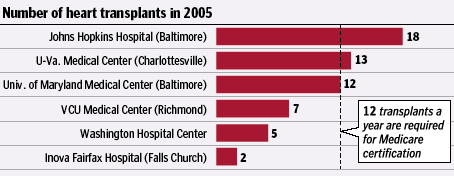
Medicare requires that transplant centers perform 12 transplants a year to be certified but many programs are in violation of that standard with little consequence. Medicare is even thinking of reducing the standard from 12 per year to 9 in 30 months. As one specialist says "I wouldn't take my car to be serviced by someone who repaired nine cars over the past three years. Would anyone do that?"
This Washington Post article has more on the excess number of centers although it doesn't draw the connection between the organ shortage and the incentive to build a center. Here's some data, from the article, on centers local to Washington.
Posted by Alex Tabarrok on October 10, 2006 at 07:21 AM in Economics, Medicine | Permalink
Comments
Alex,
Why don't you expand this a bit and write it up as an op-ed for the WSJ or
perhaps even better the New York Times? This is an important issue
and should be read by more people.
Posted by: Bill Stepp at Oct 10, 2006 9:23:21 AM
Terrific post, Alex. I'm not convinced that we should allow organ sales, but I you've helped me appreciate the cost of this scruple.
Posted by: Bill Gardner at Oct 10, 2006 10:56:52 AM
Imagine finding that your heart transplant team hasn't done this in 6 months! At what point would this fact be disclosed to the patient and would the disclosure detail the added risks?
As transplants of more everyday parts like tendons, ligaments, and corneas become commonplace, won't the discussion become easier to separate from the charged "morality" that the medical bureaucrats now use to dominate policy? Cornea transplants are often done on an outpatient basis and sometime restore good vision to the previously blind.
How soon might we expect a significant percentage of Americans to go abroad for some types of transplant? Will there be laws restricting insurance reimbursements for such surgeries?
Posted by: Dave Meleney at Oct 10, 2006 11:02:11 AM
Wonderful analysis!
Posted by: Chris Meisenzahl at Oct 10, 2006 12:05:21 PM
Some time ago I looked up the transplant centers in Texas, and found that they were neatly divided by geography. Perhaps this arrangement is there to administer the federal policies on geographic allocation of organ supply. An alternative hypothesis--one based in rent seeking theory--is that transplant centers are arranged to avoid competition with each other. Alex, I don't know the institutional detail on this, but it would be an interesting complement to the story. Cheers,
Ed
Posted by: Ed at Oct 10, 2006 12:14:52 PM
I agree with the other comments: Great post Alex. It is irresponsible for this kind of surgery to be performed by a rusty or inexperienced medical team.
Posted by: Matthew Cromer at Oct 10, 2006 12:31:41 PM
http://en.wikiquote.org/wiki/Monty_Python's_the_Meaning_of_Life#Part_V:_Live_Organ_Transplants
But of course, we now know that you really CANNOT mock life...
http://www.hrw.org/reports/1994/china1/china_948.htm
...even in the "free" world...
http://www.internationaltaskforce.org/holland.htm
I can support a free market for body parts when I can guarantee that my role as a provider is freely chosen.
And not before.
Posted by: Nathan Zook at Oct 10, 2006 1:09:24 PM
If only we had a free market in organ sales like china
Posted by: Rob at Oct 10, 2006 3:06:36 PM
This situation is nothing short of an outrage, and it should be brought to the attention of the American public. This may very well be a perfect example of rent-seeking behavior. However, I am also curious as to how much of this problem is caused by a lack of organ donors. What percentage of the American public is an organ donor? How many people who die each year wish to or are able to donate their organs? How does this number compare to the number of people who need organ transplants?
On another note, it seems that a free market for human organs can be easily defended if based on economic rationality. However, one can only imagine the horrible slayings that would occur in order to harvest human organs. Therefore, the principle cannot be defended using common sense or the mainstream definition of rationality.
Posted by: Kristin Russell at Oct 10, 2006 3:41:45 PM
The people who are worried about slayings committed to involuntariyly harvest human organs are jumping at shadows. It might happen once in a great while under a regime of legalized organ sales, but far less than under a black-market regime. If anything, the option to pay for an organ from a voluntary donor is a substitute for knocking someone on the head and stealing it. And what reputable hospital would ever accept an organ for transplant whose provenance it couldn't validate? And for living donors, how practical is coercion and how much would a functioning market contribute to it?
The objectors need to look into the history of life insurance. At its inception, many people were very sure that it was a terrible idea because people would be murdered for the insurance money. Well, it does happen sometimes, but the gains vastly swamp the costs.
Please stop scare-mongering on an issue where economic rationality would save thausands of lives.
Posted by: srp at Oct 10, 2006 4:13:01 PM
Kristin:
1) Wouldn't knowing that your family would receive a payment for any organs used after you die increase the rate of organ donation?
2) Isn't the incentive to kill the highest when profit margins are the greatest? And aren't profit margins the highest in a black market?
Posted by: Jody at Oct 10, 2006 4:17:31 PM
If people are truly driven to murder others for their organs, wouldn't the system we have now, with terrible shortages of organs and people dying on waiting lists, encourage such murders to take place all the time? How come they only happen in totalitarian regines like China, where the government can kill people with impunity?
Posted by: LisaMarie at Oct 10, 2006 4:19:21 PM
Why does US News not rank hospitals based on transplants?
http://www.usnews.com/usnews/health/best-hospitals/tophosp.htm
If a hospital is non-profit, would the added profit from the high cost of transplants be spread administratively? …..would it go toward research?
What incentive do people have not to donate organs when it is as simple as checking a box on a DMV form? We don’t want to see illegal transplantation (kidnapping, prison deaths etc…) so for the acceptable instances of sudden death, why would money be a factor? If people have religious concerns, I doubt that a reasonable sum would suffice to convince them to donate.
Do you support Medicare/Gov’t regulation or standards for transplant programs? It seems that the market is determining which programs fail and which succeed. If Baltimore and Charlottesville are feasible alternatives, then why should we be concerned that INOVA is failing?
If we focus on reducing rejection rates with better drugs, would more people be willing to donate (as confidence in the program rises)?
Posted by: Chairman Mao at Oct 10, 2006 4:23:39 PM
NewYork-Presbyterian/Columbia has the largest heart transplant program in the country, having performed more than 1,700 transplants since the inception of its heart transplant program in 1977.
NewYork-Presbyterian Hospital/Columbia University Medical Center performed 118 heart transplants in 2005, a one-year record for any U.S. medical center in the history of heart transplantation.
The survival rate for these 118 NewYork-Presbyterian/Columbia heart transplant recipients in 2005 is 95 percent, 10 percent higher than the national average — despite the fact that many patients are more severely ill.
The previous one-year record of 113 heart transplants, set in 1998, was held by The Cleveland Clinic.
The size of the metropolitan area can’t be a factor if NY is competing with Cleveland for the highest rates. Why are these areas/hospitals more successful?
Posted by: Chairman Mao at Oct 10, 2006 4:25:08 PM
Comparative Costs
One of the driving forces for illegal organ trafficking and “transplantation tourism” is the price differences for organs and transplant surgeries in different areas of the world. According the New England Journal of Medicine, a human kidney can be purchased in Manila for $1000- $2000, but in urban Latin America a kidney may cost more than $10,000. Kidneys in South Africa have sold for as high as $20,000. Price disparities based on donor race are a driving force of attractive organ sales in South Africa, as well as in other parts of the world. The Voluntary Health Association of India reports the prospect of such a small fortune has enticed about 2,000 impoverished Indians to sell a kidney every year. In China, a kidney transplant operation runs for around $70,000, liver for $160,000, and heart for $120,000. Although these prices are still unattainable to the poorer citizens of the world, especially those whose governments offer little or no financial health care support, compared to the fees of the United States, where a kidney transplant may demand $100,000, a liver $250,000, and a heart $860,000, Chinese prices have made China a major provider of organs and transplantation surgeries to other countries.
Posted by: Chairman Mao at Oct 10, 2006 4:26:28 PM
My wife has worked with hundreds of surgeons over her 30 year career. They don't always stay with the same hospital. And they occasionally do surgeries at more than one hospital. Surgeons doing high-risk surgeries have their own teams, employed by them and not by the hospital. It's possible that key players in a transplant surgery may be very experienced even if some support members are not.
The article confirms that the surgical temas may be more experienced than the hospital:
"surgeons perform more transplants than statistics from the medical center alone indicate, because they also do transplants at the local veterans hospital -- a point that VCU leaders have made to Medicare officials."
Posted by: JohnDewey at Oct 11, 2006 11:08:19 AM
Alex's comment is another example of mindless libertarianism run-amok. The costs of involuntary organ-harvesting are not considered; including the costs of those who avoid medical care because they rationally fear being harvested.
One thing that libertarians don't get is that utility is measured in much more than money. We should not compromise ethics to crass monetary calculation. Alex thinks markets in organ transplants and harvesting are free; but only because he fails (willfully or blindly?) to see the costs. What ever happened to the idea that "there is no such thing as a free lunch." I thought economists knew that all actions have trade-offs.
The following would be a much better post, if Alex wanted to actually be persuasive to those of us who have chosen to abstain from libertarian koolaid. (I am sympathetic, being an ex-libertarian.) Tell me about the COSTS as well as the BENEFITS of switching from the present system to your market in transplants. And when I am talking about COSTS and BENEFITS, I mean ALL costs and benefits, not just those that can be monetized. Thats right. Not just money. Poor people matter, and I would argue matter equally, even if their lack of money means their utility gets little weight in some attempts at "cost benefit analysis" where money is used instead of utility.
If you say its "free" to switch then you have lost all credibility. You can make an argument, but for it to have any persuasive value, you have to include the COSTS as well. Only after you acknowledge the costs and make an argument that acknowledges rather than ignoring them will you have any chance at persuasion. Your post has failed to do that. And thats kind of bothersome coming from an economists. I thought economists were all about tradeoffs and rational informed decision-making? Not when it conflicts with libertarianism??? [Note: I recognize that Tyler is not a libertarian. I am not sure about Alex, but I think he leans heavily that way.]
In my view, we should weigh the scales (how much?? I am not sure) of uncertainty against those who need a transplant. Especially when those who need such a transplant have gotten there due to their decision to not take care of themselves physically. Hey, guess what, all decisions have consequences (or tradeoffs in economist-speak). Too many hours in the office making money (or writing scholarly papers for academic status) and not enough in the gym could be deadly.
Money: the ultimate end for many in our status-obsessed society -- I want more and more and more "things" culture -- economists should be proud:-- man exactly as predicted, with an insatiable appetite for more "things" to bring him yet more and more utility in orgies of self-aggrandizing utility maximizing hedonism -- And of course, any taxes that seek to curtail this hedonism to provide the basics, say healthcare, for others in the community, why, that would just result in dreaded "deadweight" loss. Well maybe. If you measure everything in money, like those who spend too much time at the office and not enough in the gym tend to do. (Or force employees under them to do -- oh wait, that goes against libertarian ideology -- employees are never forced or coerced, only the government, not private sector employers, exercises power over individuals -- thats why we should worry exclusively about government and leave the private sector alone -- because coercion doesn't exist in the private sector -- yum, libertarian koolaid is fabulous). What could be better. Enjoy your work and ever more money as your health deteriorates all so you can own more "things." Hey, what could be more rational?? Do economists ever wonder if the humans that lie behind this utility-maximizing assumption should be condemned rather than celebrated?? Do they ever question whether unsatiable desire for more and more money is really rational??
Sadly, all too often, no transplant is going to change reality. You have ONE body. You had better take care of it. If you sacrifice it for filthy lucre or academic status, you are not rational. You are insane. (I would make an exception for those who make such sacrifices not for more "things" or status, but to provide basics for their family. They are not insane, but perhaps unwise. Or alternatively, coerced.)
Of course, transplants occur for all sorts of reasons, not all of them involving a failure to take care of owns own body. And I fully sympathize with those who need a transplant, even if the reason is because they failed to take care of themselves. But some transplants CAN be linked to failure to take care of oneself. And I think that should be part of the calculus when we consider proposals to create a market in organs and thus perhaps expose the rest of society to risks of organ harvesting or economic or other coercion or deception concerning the use of their organs. Keeping in mind that medicine is not fully a science, but rather a field where doctors and health professionals are making informed guesses when it comes to both diagnosis and prognosis. It is not unheard of for someone to survive despite a negative prognosis or die despite a positive prognosis.
Some might think that with the person who has the organs ought to have the best shot they can rather than transferring it to someone else. Should someone who has a 1% chance of survival with their organ and a 0% chance without it transfer it to someone with a 99% chance of survival with the organ, but a 0% chance without it? Only if the person with the high percentage chance of survival can pay tons of money to the person with the 1% chance? Does Bill Gates deserve a life-saving transplant, because he can bribe someone to donate to him, while someone else doesn't, because they can't afford it?? Whatever your answer to the question of who should get the organ, the person who was born with it, or someone else, I don't think that "let the markets decide" satisfactorily answers the question.
One last response to SRP: "The objectors need to look into the history of life insurance. At its inception, many people were very sure that it was a terrible idea because people would be murdered for the insurance money. Well, it does happen sometimes, but the gains vastly swamp the costs."
I take it you were not the person who was murdered. Maybe your assessment of the costs and benefits might just be different if you were. Anyway, I am waiting for your best argument that "gains vastly swamp the costs" addressed to the hypothetical person who knows they are going to be murdered in the future for the proceeds of their non-cancellable life insurance policy. Explain to that person why the value of their life is so easily "vastly swamped" by the gains coming from said policy (and policies that don't involve murder).
Ragerz - The ex-libertarian
Posted by: Ragerz at Oct 11, 2006 6:23:20 PM
Ragerz,
People sometimes get killed by other people who wish to take their cars. I propose to ban vehicle ownership.
Posted by: LisaMarie at Oct 11, 2006 7:39:31 PM
A friend of mine was talking to me just the other day about how in Moldova, many people becoming willing organ donors for as little as $10,000 USD. That's equivalent to as much as half a decade of income for those people. While this seems like a very good deal to them (you won't die if you're short one kidney, in most cases), almost universally these people had atrocious quality of life after only a few years had passed.
I suppose what I'm saying is, it may seem like a good idea for organs to come from willing donors, but in reality you'd just be preying on the poor and ignorant, who probably wouldn't even see most of the money that recipients would be paying in the first place. After all, in my example where the donor receives $10,000USD for his kidney, the company that arranged the surgery would get $90,000. That hardly seems just to me.
Posted by: MattM at Oct 11, 2006 7:55:45 PM
Alex brought up some alarming points in his blog, but should the behavior of the transplant centers be classified as rent-seeking? Rent seeking is defined as the process by which an individual, organization, or firm seeks to gain through manipulation of the economic environment. I would argue that the transplant centers are taking advantage of a pre-existing economic condition. The centers didn't have to push for the laws preventing compensation for organs, the government would have likely passed the law whether the medical community supported it or not.
Posted by: Lance F at Oct 11, 2006 9:21:22 PM
LisaMarie,
Your comment, which I am assuming (probabilistically) is an attempt at sarcasm, is too obscure to understand.
With respect to whether we should ban car ownership, the economic view would be that we should do that only if the costs outweigh the benefits. In the case of car ownership, I think the benefits outweigh the costs. If everyone, regardless of wealth, is considered equal, then I would say an hour of one person's time is as valuable as another person's time. (I am not talking about money or what people should be paid. I am saying that if there was a way that a rich person could add one year to their life at the expense of a poor person losing 5 years of their life, this would be unjust and immoral. There time has equal value, even if the rich person could make 100 times more an hour.) Since one's life can be conceptualized as a period of time, things that save time, like cars, are extremely valuable. Furthermore, adequate transportation saves lives. With adequate transportation it is more possible to get healthy food and other goods that are necessary for a healthy life. Further, it is possible to transport people in emergencies, whether it is an injured person to the hospital or emergency personell to the scene of an accident.
Overall, the benefits of transportation are so high, that I would say that car ownership is worth the 40,000 people who are killed each year in car accidents. (Of course, reducing these fatalities might be a good argument for increasing the liability of bars who irresponsibly allow drunks to get on the road after serving them as well as increasing DUI penalties and perhaps penalizing friends who allow their drunk friends to drive.) Surely, more lives are saved each year by having an adequate transportation infrastructure than that, given a population of more than 300,000,000, most of whom greatly benefit from our excellent transportation infrastructure.
I know of NO lives saved via the existence of life insurance. All it results in is a redistribution of wealth from A to B. I don't think that the benefits of such redistributions are equivalent to the lives lost due to insurance-motivated murder. Thus, I think life insurance should be outlawed. While the benefits exceed the costs with respect to car ownership, it seems to me that the costs exceed the benefits with respect to life insurance. At least if one puts an appropriate value on human life (which every reasonable person agrees cannot be measured in monetary terms).
Of course, given the brief nature of your comment, I am not sure if I am addressing the issue you meant to bring up. Of course, not being understood is one potential downside of using obscure sarcasm.
Ragerz - The ex libertarian
Posted by: Ragerz at Oct 12, 2006 12:01:34 AM
The worry that people will be murdered for their organs is utterly unfounded, and based on ignorance of the economic and medical realities of organ transplantation. If a market were legalised then it is likely that insurance companies and government agencies would be the primary buyers of organs. As such, people who have access to insurance and government coverage would not be motivated to buy "stolen" organs, as it is likely that they would receive transplant organs that would be legally acquired. So, the only persons who would be in the market for such organs would be people not covered by private or government insurance. These persons would be likely to be the very poor. As such, they would not be able to pay for the expense of a black market transplant operation. Realistically, then, in a legal market for kidneys there would be NO market for stolen organs.
Furthermore, people should also realise that there have been precisely NO documented cases of organ thefts at all. That people are murdered for their organs, or have their kidneys stolen, is simply a myth.
Posted by: JSTaylor at Oct 14, 2006 1:24:39 PM
Uw online verzekeringsmakelaar Eerst Europa Doelstellingen: De Ci2i Verzekering (Ci2i) zal het nummer een gebrandmerkte pan Europese commoditized online verzekeringsmakelaar door 2010 zijn.
Posted by: First Europa NL at Nov 2, 2006 4:21:38 AM
liqingchao 07年8月17日
google排名
google排名
wow gold
wow gold
powerleveling
powerleveling
wow gold
wow gold
powerleveling
powerleveling
wow powerleveling
wow powerleveling
wow power leveling
wow power leveling
wow power level
wow power level
world of warcraft powerleveling
world of warcraft power leveling
china tour
china tour
hongkong hotel
hongkong hotel
beijing tour
beijing tour
翻译公司
翻译公司
上海翻译公司
上海翻译公司
北京翻译公司
北京翻译公司
北京搬家公司
北京搬家公司
鼓风机
风机
风机
货架
光盘刻录
光盘刻录
光盘制作
光盘制作
光盘印刷
光盘印刷
红外测温仪
红外测温仪
超声波测厚仪
超声波测厚仪
超声波探伤仪
超声波探伤仪
频闪仪
频闪仪
涂层测厚仪
涂层测厚仪
电火花检测仪
电火花检测仪
google排名
仓库
仓库
仓库出租
仓库出租
物流园区
物流园区
集团电话
集团电话
四环素牙
口腔常识
口腔常识
口腔医生
口腔医生
网站设计
网站设计
多媒体
监控
监控
监控系统
监控系统
门禁
门禁
门禁系统
门禁系统
搬家公司
搬家公司
条码打印机
条码打印机
牙周炎
牙周炎
Posted by: wslmwps at Aug 17, 2007 1:26:12 AM
吴尊
阿穆隆
林志玲
尚雯婕
大人物
王睿
Mac DVD Ripper
火狐浏览器
Firefox浏览器
吴尊
阿穆隆
林志玲
尚雯婕
大人物
王睿
Mac DVD Ripper
火狐浏览器
Firefox浏览器
吴尊
阿穆隆
林志玲
尚雯婕
大人物
王睿
Mac DVD Ripper
火狐浏览器
Firefox浏览器
吴尊
阿穆隆
林志玲
尚雯婕
大人物
王睿
Mac DVD Ripper
火狐浏览器
Firefox浏览器
吴尊
阿穆隆
林志玲
尚雯婕
大人物
王睿
Mac DVD Ripper
火狐浏览器
Firefox浏览器
吴尊
阿穆隆
林志玲
尚雯婕
大人物
王睿
Mac DVD Ripper
火狐浏览器
Firefox浏览器
吴尊
阿穆隆
林志玲
尚雯婕
大人物
王睿
Mac DVD Ripper
火狐浏览器
Firefox浏览器
吴尊
阿穆隆
林志玲
尚雯婕
大人物
王睿
Mac DVD Ripper
火狐浏览器
Firefox浏览器
吴尊
阿穆隆
林志玲
尚雯婕
大人物
王睿
Mac DVD Ripper
火狐浏览器
Firefox浏览器
吴尊
阿穆隆
林志玲
尚雯婕
大人物
王睿
Mac DVD Ripper
火狐浏览器
Firefox浏览器
吴尊
阿穆隆
林志玲
尚雯婕
大人物
王睿
Mac DVD Ripper
火狐浏览器
Firefox浏览器
吴尊
阿穆隆
林志玲
尚雯婕
大人物
王睿
Mac DVD Ripper
火狐浏览器
Firefox浏览器
吴尊
阿穆隆
林志玲
尚雯婕
大人物
王睿
Mac DVD Ripper
火狐浏览器
Firefox浏览器
吴尊
阿穆隆
林志玲
尚雯婕
大人物
王睿
Mac DVD Ripper
火狐浏览器
Firefox浏览器
吴尊
阿穆隆
林志玲
尚雯婕
大人物
王睿
Mac DVD Ripper
火狐浏览器
Firefox浏览器
吴尊
阿穆隆
林志玲
尚雯婕
大人物
王睿
Mac DVD Ripper
火狐浏览器
Firefox浏览器
吴尊
阿穆隆
林志玲
尚雯婕
大人物
王睿
Mac DVD Ripper
火狐浏览器
Firefox浏览器
吴尊
阿穆隆
林志玲
尚雯婕
大人物
王睿
Mac DVD Ripper
火狐浏览器
Firefox浏览器
吴尊
阿穆隆
林志玲
尚雯婕
大人物
王睿
Mac DVD Ripper
火狐浏览器
Firefox浏览器
吴尊
阿穆隆
林志玲
尚雯婕
大人物
王睿
Mac DVD Ripper
火狐浏览器
Firefox浏览器
吴尊
阿穆隆
林志玲
尚雯婕
大人物
王睿
Mac DVD Ripper
火狐浏览器
Firefox浏览器
吴尊
阿穆隆
林志玲
尚雯婕
大人物
王睿
Mac DVD Ripper
火狐浏览器
Firefox浏览器
吴尊
阿穆隆
林志玲
尚雯婕
大人物
王睿
Mac DVD Ripper
火狐浏览器
Firefox浏览器
吴尊
阿穆隆
林志玲
尚雯婕
大人物
王睿
Mac DVD Ripper
火狐浏览器
Firefox浏览器
吴尊
阿穆隆
林志玲
尚雯婕
大人物
王睿
Mac DVD Ripper
火狐浏览器
Firefox浏览器
吴尊
阿穆隆
林志玲
尚雯婕
大人物
王睿
Mac DVD Ripper
火狐浏览器
Firefox浏览器
Posted by: hoojk at Dec 2, 2007 9:11:42 PM