« Education makes you healthier | Main | Battlestar Galactica Season Three Preview »

A Premium Puzzle

Dave Undis writes to me:

For as long as I can remember, the cost difference between different grades of gasoline has been 10 cents a gallon.  For example, when Regular was selling for $2.39, Plus was selling for $2.49 and Premium was selling for $2.59.

Earlier this year when gas prices rose significantly, I noticed this pattern changed.  The cost differences were often 8 cents or 9 cents a gallon.

...Can you explain this?

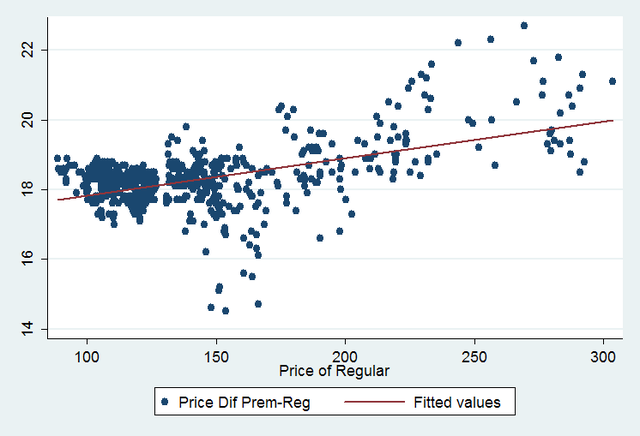
I quickly came up with several explanations for why we might expect an increase in the price differences with a increase in the price of regular but a decrease?  That was more puzzling.  Being an economist, I question the facts before I question the theory, however, so I graphed the difference in price between premium and regular gasoline against the price of regular gasoline using weekly data from the Energy Information Administration (Nov 28, 1994-July 17, 2006).   Click to enlarge.

Dave appears to be incorrect there is a slight tendency for the difference to increase with the price of regular, although the date is noisy.  Theory ahead of evidence once again.Gaspremreg
Ok, so what's my explanation?

    When the demand for oil rises refineries are pushed to  operate at full capacity.  Producing premium requires greater effort than regular and this has a higher opportunity cost when refineries are operating at full capacity.  (In other words, it's cheaper to produce premium when you have spare capacity on your hands.)  The increase in costs is reflected in the price increase. 

There is a countervailing factor, the demand for premium declines (i.e. the relative demand for regular increases) as the price of gas rises.  Effects like this can be neat as, for example, when a tax on cigarettes increases the demand for "discount" cigarettes thereby appearing to violate the law of demand.  It's conceivable that the decline in demand (a shift along the supply curve) could counteract the increase in the cost of supply enough to lower the differential but in practice this appears not to occur on average.

Comments are open.

Posted by Alex Tabarrok on July 19, 2006 at 07:05 AM in Economics | Permalink

Comments

If you define different grades of gas as substitute products you certainly could get a higher elasticity of demand for the premium as prices rose significantly (assuming a linear demand curve for simplicity) shifting demand across to regular. That would put a bit of downward pressure on the price of premium and a bit of upward pressure on the price of regular, though how much is an empirical question. It would be a matter of the cross elasticities of demand for different grades.

Posted by: Brian Ferguson at Jul 19, 2006 7:35:48 AM

I believe you have it backwards. An across-the-board increase in gas prices would cause the relative price
of premium gas to fall compared to regular, not rise. Likewise, a per unit tax on cigarettes causes the
relative price of 'premium brands' to fall compared to 'discount brands,' not rise as you suggest. This
means that the quantity of premium gas demanded would rise relative to regular gas, not fall.

Posted by: Apples at Jul 19, 2006 7:54:36 AM

Apples seems to have it right - I recall it being called the third law of demand in some places. A classic example in micro courses is one where you would expect the average quality of oranges consumed in NYC to be better than the average quality of oranges consumed in Florida.

Posted by: Mike at Jul 19, 2006 8:04:15 AM

I was afraid someone might mention that since Tyler and I actually have a paper on the Alchian-Allen theorem! The theorem, as is suggested above, points out that a fixed cost added to the price of a low and high quality good shifts relative prices in favor of the high quality good. e.g. the high quality good is $10 the low quality good $5 for a 2:1 ratio, add a fixed cost of $5 and the prices go to $15 and $10 for a relative ratio of 1.5. Thus "the good apples are shipped out," - it doesn't pay to ship the bad apples out so the proportion of good to bad apples is higher for exported apples than for apples in Oregon. Alternatively, you can find lots of cheap wine in France but only the good stuff is shipped out.

Does this apply here? For the reasons stated in the text the cost shift is not necessarily fixed but more importantly the brute fact is that the proportion of premium consumed falls the higher the price of regular - this is well known. The income effect, in other words, exceeds the substitution effect.

Alex

Posted by: Alex Tabarrok at Jul 19, 2006 8:22:38 AM

I think there might be a bit of a techincal reason as well, modern engines (in many cases) that advice premium will operate on regular gasoline. The difference is that premium gasoline burns more slowly and is less reactive (which allows an engine to operate at higher compression. Which is why if you have an engine that calls for premium you were supposed to put the good stuff in it, regular will explode too early and either retard your perfomance or damage your pistons/connecting rods if it happens too often. However, automakers developed sensors that detected "knock"and adjust the timing (causing a controlled burn earlier in the compression cycle) when lower quality gasoline is put in the car.
This results in most cars operating with all grades of fuel, although they give up some performance and potentially some efficiency. Most drivers do not understand this but realize that premium is somehow better for their car (even if not necessary) so it makes sense that the income effect would be high on an unneeded extra.
Basically, don't downgrade, if you hear a pinging, notice a drop in efficiency, or have an older (non-electronic ignition) high compression (typically Japanese or German engine).

Posted by: bluto at Jul 19, 2006 8:43:51 AM

Isn't that an example of a Giffen good, then?

Posted by: Ben Hoffman at Jul 19, 2006 9:31:07 AM

I'm not a petroleum engineer, but isn't it likely that premium and regular are jointly-produced goods? In other words, refining regular from crude automatically gets you some (adjustable, but non-zero) amount of premium as well?

Posted by: floyd at Jul 19, 2006 9:49:52 AM

I agree with Brian and Apples (who seem to be saying exactly the same thing, despite Apples' insistence that they are disagreeing...has some post editing been going on?). I would guess that it's just a substitution effect, but I suppose the only way to know for sure would be to ask someone in the refining industry.

Posted by: Chris Ball at Jul 19, 2006 9:54:46 AM

The reason all this is complicated is that
there are both demand-side issues and supply-
side issues. It seems to me that Tyler
addresses mostly the supply-sdie issues,
focusing on cost differences in production
when (presumably) the price of cruce rises.
The problem for producers is to price
correctly a set of substitutes, all of
which they produce. In short, there is
no easy answer.

Also, there may well be differences in the
aggregate price data used by Tyler and
prices in local markets--aggregates might not
reflect changes in all markets. (Note that
the problem raised in the initial question
remains a valid one even if the absolute
price differential between grades remains
fixed in nominal terms--as prices rsie, the
price of premium relative to the price of
regular falls.)

Posted by: Donald A. Coffin at Jul 19, 2006 9:56:25 AM

Oops. Should have said "the problem that
Alex addresses." Should read more
carefully.

Posted by: Donald A. Coffin at Jul 19, 2006 9:57:56 AM

The singular of data is anecdote. I'm one economist who has switched from regular to intermediate grade of gas. And I'd seriously consider premium if I thought my car would run better on it.

Posted by: Jonathan at Jul 19, 2006 10:15:19 AM

MTBE has been banned as an additive, driving up the cost of other additives, like ethanol, driving up the cost of premium gas in general.

Posted by: bjk at Jul 19, 2006 10:15:57 AM

Hm. I've noticed the reduced differential at gas pumps in Mississippi.

Not being an economist, I just thought the stations figured that people were even less likely to buy premium now, so they were knocking a couple of cents off its price to encourage its purchase.

But obviously that is too simple.

Posted by: Anderson at Jul 19, 2006 10:33:09 AM

Here in Canada, premium is 10 cents PER LITRE (not per gallon) higher than regular. That's about, what, 37 cents per gallon?

For instance, if, in the USA, regular is $2.50 and premium $2.60, that's a 4% difference. In Canada, if regular is $1.00, and premium is $1.10, that's a 10% difference.

This anomaly has always confused me. Why should the premium premium be two-and-a-half times as high in Canada?

Posted by: Phil at Jul 19, 2006 10:39:54 AM

In Oregon the difference has remained relatively constant at around $.10 per gallon. This represents a roughly 50% decrease in the relative, er, premium for premium gas.

So I've been taking the opportunity to experiment with premium to see if my car runs better and/or gets better mileage. So far the answer to both of those questions is no.

Posted by: samerwriter at Jul 19, 2006 11:41:57 AM

In WA (Seattle area) I've seen the price difference increase to > 10 cents.

Posted by: bob montgomery at Jul 19, 2006 12:13:45 PM

I've only recently seen the price difference on premium go up to eleven cents.

In my experience, my car gets 10-15% better gas mileage on premium than on regular. So when the difference in price is 3-5%, it's just obviously a lot smarter to buy premium.

And I see that this is yet ANOTHER blog incapable of verifying an SSL link, and thus insisting that my URL is "invalid".

Posted by: Caliban Darklock at Jul 19, 2006 1:04:34 PM

Phil, aren't all Canadian prices subject to more distortive forces than your unwashed neighbors?

Posted by: caveatBettor at Jul 19, 2006 1:54:37 PM

caveatBettor: Perhaps you're right. But what are the distortive forces and how do they work?

Posted by: Phil at Jul 19, 2006 2:21:45 PM

I think the use of linear regression is obscuring what is going on. At lower prices the difference is relatively stable at $.10 per gallon, but as the price rises further a slightly greater difference is introduced. By personal observation of prices at local stations suggests this is true as well. The price difference was about $.10 up to $2.50 per gallon and then increased slightly as prices rose to $3.00 per gallon.

Posted by: am at Jul 19, 2006 2:31:20 PM

I think I'll just add that a lot of this
discussion involves the absolute difference
in prices, when we ought to be thinking
about the changes in relative prices.

As one person noted, if the difference
between premium and regular is $0.10
at a price of $2.50 for regular, that's
a 4% differential. So when regular rises
to $3.20 (as it is here), a 4% differential
would imply a $0.13 absolute differential.

The relative price of premium has fallen,
as the chart in Alex's post actually makes
clear.

Posted by: Donald A. Coffin at Jul 19, 2006 3:03:49 PM

To give the scientific perspective...

Octane rating is essentially a measure of how resistant gasoline is to combustion, which itself is essentially a question of the relative amounts of single-chain and branched molecules there are in the gas. The octane rating system is based on heptane, which is a single-chain and very volatile molecule with an octane rating of zero, and iso-octane, which is a highly branched molecule with an octane rating of 100. Note that you can achieve stabler molecules than iso-octane, thus getting a higher octane fuel (i.e., racing car fuel).

In the refineries, the heavy hydrocarbons of crude oil are broken into shorter chains. The result then goes through isomerization and further cracking processes (which also involves some isomerization). Thus, premium gas costs more because it takes more work to produce.

In the old days, the fuel-air mix going into auto engines was regulated by carbeutors, which are not exactly high-precision devices. Thus, when carbon deposits build up and reduce the volume in the cylinders (as well as heating up), higher grades of gas would be needed to prevent knocking. Today's cars, with electronically controlled fuel-air mixes, do not need premium fuel for the most part. There are high-performance cars that do need premium fuel since they are designed to operate at higher compression ratios. Thus, using lower grade fuels would result in loss of performance and/or mileage (though the difference is not necessarily significant if one isn't pushing the car to the higher performance range).

I suspect that there may be a lagging effect in prices in adjusting to the supply/demand curve-- as gas prices go up, people who don't need to use higher grade fuel (and even some who probably should) but have bought into the myth that higher grades treat their cars better, drop down to lower grades to save some money. I don't know if this effect is very large, though. More significant, perhaps, may be the fact that if gas prices start spiking, then there does seem to be a common mob mentality in the American population to rush to their local gas station and fill up whatever space is left in their tank as soon as possible, before the price goes even higher. Since much more people use the regular grades than higher-octane grades, the supply of regular grades dries up faster. This is only a temporary effect, and eventually the prices stabilize relative to each other, but with a higher price differential due to the opportunity cost (as Tyler mentioned).

As a side note, I looked at the national gas gauge on the front page of US Today this morning, and it seems that the mid-grade average is about 15 cents higher than regular, and the differential between the mid-grade average and the premium average was not as large, perhaps 12-13 cents.

Posted by: Scott at Jul 19, 2006 3:17:07 PM

More significant, perhaps, may be the fact that if gas prices start spiking, then there does seem to be a common mob mentality in the American population to rush to their local gas station and fill up whatever space is left in their tank as soon as possible, before the price goes even higher.

That's a fact? It seems somewhat plausible, but I've never witnessed it nor read any accounts of that happening.

Posted by: bob montgomery at Jul 19, 2006 3:44:31 PM

To make premium gasoline, a refiner has to suffer higher yield losses. Most (probably all) premium gasoline has a portion of product from catalytic reforming mixed in to increase octane. Regular gasoline too will usually have catalytic reforming product mixed in, just not as much as premium. The volume out of a catalytic reformer is smaller than the volume in. One barrel of crude oil would result in a greater volume of regular gasoline than it would if used to make premium. Octane costs money in terms of yield loss and extra productions costs.

The cost of yield loss would be proportional to the price of crude, processing costs would not be, and taxes would not be. Of course, pricing in the market would depend on demand and the tradeoff consumers make between the two, but in terms of input costs, the cost of premium would rise with the price of crude.

I'm not sure I agree with Alex's comment that producing premium has a higher opportunity cost when refineries are operating at full capacity. I don't think it's cheaper to produce premium when there is spare capacity at a refinery. Regular and premium are the same except that premium has higher octane. Octane is generally created by running side streams through special units, e.g. catalytic reforming, which exists solely to increase octane. Processing upstream of the catalytic reformer in a refinery is unaffected by a refinery's choice on how much premium relative to regular to produce. Thus, the premium/regular split probably won't affect the amount of crude oil a refinery can put into the first processing unit

Posted by: JV at Jul 19, 2006 3:47:59 PM

JV, your explanation sounds pretty plausible to me.

bob, I can't really point at any solid documentation myself, but I have experienced such effects where I am... when gas prices spike at a high enough level, it is not unexpected to go to a gas station and see that they have no regular gas available, but I saunter over to the premium gas nozzle and fuel up (I have one of these "high-performance, high-compression engines that are designed to operate on premium fuel and thus would not perform as well on regular fuel)...

Posted by: Scott at Jul 19, 2006 4:21:36 PM

Post a comment